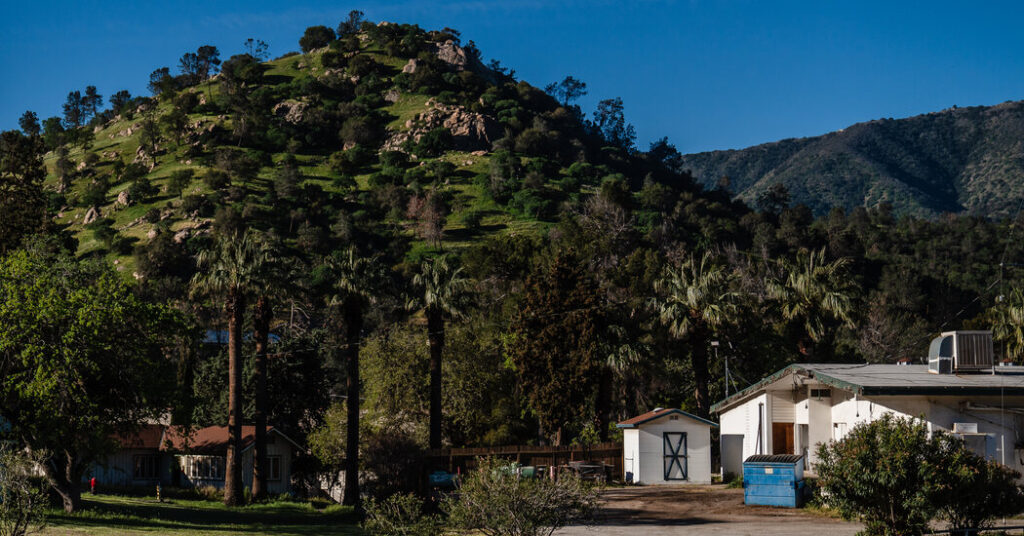
It was 1979, and Cesar Chavez, then the head of the United Farm Workers, called a staff meeting at the union’s remote headquarters in the Tehachapi Mountains, 125 miles north of Los Angeles. As the proceedings came to an end, Mr. Chavez abruptly switched topics and instructed someone to turn the lights off.
“Who can see my aura?” he asked the room.
Larry Tramutola and his wife, an organizer and bookkeeper who had worked with the union for years, exchanged an uncomfortable glance in the dimness. They revered the charismatic U.F.W. leader. His movement had turned one of the nation’s most exploited and downtrodden populations of farmworkers and their supporters into an army to be reckoned with.
When Mr. Chavez had ordered the couple and their children to come live on the union’s nearly 200-acre compound to help him organize, they did it. When he directed that everyone critique each other in encounter groups that often became vicious, they joined in. When Mr. Tramutola’s wife fell ill, they assumed that Mr. Chavez had only the best of intentions when he once offered to heal her by laying his hands on her body.
Still, “it was bizarre,” Mr. Tramutola, now 78, recalled of that 1979 meeting. “His aura! Swear to God. Some people even said they saw it. We looked at each other and were like, yeah, time for us to get out of here.”
In the days since The New York Times revealed evidence of sexual abuse and assault by Mr. Chavez, memories like the one shared by Mr. Tramutola have ricocheted through California’s powerful organized labor circles. Revelations about Mr. Chavez, a towering figure of the civil rights movement, have shocked longtime activists who thought they knew him.
In particular, their thoughts have turned to the compound near Bakersfield that was known as La Paz, where as many as 200 followers at a time lived with Mr. Chavez and his family from 1970 until his death nearly a quarter-century later. Looking back, they said, it was there that Mr. Chavez, who seemed to have willed the farm workers into a force through sheer drive and charisma, seemed to lose his way.
Biographers have documented Mr. Chavez’s years at La Paz as a chaotic mix of celebrity, pop psychology and paranoia. But in dozens of new interviews, former U.F.W. members cast light on what many said were abuses of his moral authority and power. Men and women who used to live and work at the mountain compound told The Times that the leader who had galvanized workers in the fields turned controlling and cultish after his organization moved to the mountains.
Mr. Chavez became infatuated with so-called Silva Mind Control meditation and what he believed was its power to influence events and people. Challenges to his authority, real or imagined, would prompt purges or mandates that one potential rival or another relocate. He taped meetings and dispatched union officials to root out what he called “spies” and “infiltrators.” He began managing according to the principles of Synanon, a drug-treatment program centered on verbal abuse, attack therapy and public humiliation.
Insisting that “sacrifice” was central to the movement, he fasted and marched to the point of internal injury and back pain, and demanded that residents perform extra half-days of manual labor on the compound on weekends. He claimed that his touch had the power to heal.
Clara Solis, an 18-year-old volunteer in 1978, said she would hyperventilate as union members hurled insults at one another during Synanon sessions, “trying to prove that they were the most loyal.” At one point when she fell ill, she said, Mr. Chavez came to her room at La Paz and hovered his hands over her abdomen.
“I closed my eyes because I was embarrassed,” recalled Ms. Solis, 66, adding, “I felt warm where his hands were. It was just kind of strange.”
By the end of 1979, most of the union’s lawyers were gone, forced out by Mr. Chavez, and top leaders and advisers had left or begun to question his judgment. La Paz felt “like a cult,” Ms. Solis said.
Mr. Tramutola and several others who used to live there agreed. The place wasn’t an issue, but its leader had become one. “It was the cult of Cesar,” he said.
La Paz, once the site of a hospital for tuberculosis patients, was ringed by fences and patrolled by guard dogs. Union members shared meals, celebrated together and organized campaigns while living on meager stipends that mirrored the poverty of the workers they represented.
At first, for the families living there in weathered dormitories and repurposed hospital wings, the isolation felt necessary. It protected them from the death threats and harassment Mr. Chavez faced as a result of his challenge to powerful agricultural interests and the political establishment. There was a deep sense of community, of a shared purpose that they called, simply, La Causa — Spanish for The Cause. Idealistic young volunteers came and went, forging bonds that would shape their careers for a lifetime. There was hardscrabble joy, and birthday parties and weddings. In the spring, the hills would come alive with wildflowers and birdsong.
And yet, the remoteness of La Paz, along with his celebrity and his position as the head of the union, gave Mr. Chavez a level of authority there, far from public view, that was almost unquestioned. He was at once the de facto mayor, police chief and pastor of this mini-city and the many men, women and children who lived and worked there. Many were related to him, or had known him for decades.
Even with his wife and children living there, the setting allowed him, the Times investigation found, to manipulate and groom. In interviews, two women, both daughters of union organizers, told The Times that they were molested and sexually assaulted by Mr. Chavez as adolescents during the 1970s. They said his sexual contact with them began at La Paz when they were 12 and 13, and he was in his mid-40s.
A third woman — the U.F.W.’s co-founder, Dolores Huerta — said he sexually pressured and later raped her in the 1960s, encounters that produced two children that she gave to others to raise and kept secret for years.
By the 1980s, Mr. Chavez struggled to adjust to a changing landscape. Legislative victories he had reaped for workers had also imposed new rules for organizers and threatened to weaken his personal control over the union. The spectacle of marches and boycotts that had put farm workers on the map was less effective under the new order. Membership, which stood at about 60,000 during the union’s peak years, dropped to about 22,000 by the 1990s. It has stood at around 5,500 in recent years.
“You can draw a straight line from La Paz,” said Miriam Pawel, a California historian and author who has written about Mr. Chavez’s leadership of the union. “It was this little world in and of itself that was created to be more separate, that became more and more of a problem as the union became a real union. There’s this dissonance that builds and builds.”
In more recent years, La Paz was transformed into a memorial of Mr. Chavez’s life and work. As president in 2012, Barack Obama turned La Paz, where Mr. Chavez is buried alongside his wife, Helen, into a federal monument that has become a tourist attraction.
In the wake of the Times investigation, members of Congress have introduced a bill to abolish and defund the Cesar E. Chavez National Monument. “Not one dime of taxpayer money should be spent on a monument that glorifies a monster like Cesar Chavez,” Senator John Cornyn, Republican of Texas, an author of the bill, said in a statement. “Especially when that monument stands quite literally at the scene of some of his alleged crimes.”
Most of those who worked with Mr. Chavez said they were stunned by the sexual-abuse accusations, and viewed the decision to move to La Paz as reasonable for a famous civil rights leader following the assassinations of Senator Robert F. Kennedy and the Rev. Dr. Martin Luther King Jr. Consumed with the movement, union supporters worked punishing hours. Most of those interviewed said they thought little of the teenage girls Mr. Chavez summoned to his office and often kept close by his side during public events.
“You have to understand the ’70s to know the context,” said Sandy Nathan, 81, a former U.F.W. lawyer. “It was the civil rights movement. The antiwar movement. The environmental movement. The women’s liberation movement. The mentality then was so different. There was the sense that we were in a war in those days. And in a way, we were.”
La Paz arose from a conversation Mr. Chavez had in 1968 with a Hollywood producer who had come to see him: Ed Lewis, whose films had included “Spartacus” and “Seven Days in May,” had helped end the Hollywood blacklist. By then, Mr. Chavez was a celebrity, his embrace of nonviolent protest inviting comparisons with Dr. King and Gandhi. Mr. Chavez was conducting a hunger strike when he and Mr. Lewis met.
Mr. Chavez told the wealthy producer that he had big ideas about social justice and hoped someday to create an education center. Mr. Lewis replied that if Mr. Chavez found an appropriate site, he would help finance it.
When the grounds came up for auction, Mr. Lewis purchased the land from Kern County for the farm workers union. Mr. Chavez named the retreat Nuestra Señora Reina de la Paz — Our Lady, Queen of Peace. Everyone called it La Paz for short.
Mr. Chavez by then had achieved national status with a history-making grape boycott. Growers who for generations had exploited cheap migrant workers, most of them from Mexico, were forced to sign their first significant union contracts; now the union was beset with administrative responsibilities to enforce them. Pulled in every direction, Mr. Chavez told one of his top aides to pack up his wife and children and get the compound ready to become a retreat for the union staff and leadership.
The aide, Lupe Murguia, and his wife worked to renovate the old hospital, learn to operate the heating, sewage and irrigation systems, and make repairs. In the nearby community of Keene, some residents bristled at the newcomers. At one point, according to essays later written by the Murguias, La Paz residents were warned that ranchers had gathered at a nearby store to run them off the property with shotguns. The sheriff’s department responded and explained that the property had been transferred to an arm of the union, and the union added security, according to accounts by the Murguias in union archives.
Mr. Chavez proposed making La Paz the union’s headquarters. His associates balked. La Paz, they said, was too remote from farmworkers and the cities where the union conducted its business. But Mr. Chavez framed it as a neutral hub to serve many far-flung workplaces, and a retreat where farmworkers could receive short courses in union philosophy and practical skills such as contract negotiation. Also, it was easier to secure from threats. The union’s executive board, stacked with Mr. Chavez’s allies and relatives, voted yes.
By 1972, Mr. Chavez and his family had moved to the compound. Anxious to maintain momentum, he sent troops to organize farmworkers outside of California. Stretched thin, the union was charging seasonal workers year-round dues and assessing extra fees to underwrite a strike fund, and workers were questioning their membership as the union’s first contracts neared expiration. Growers and competing unions were on the attack, and Mr. Chavez fought back with more strikes, boycotts and fasts.
He worked almost around the clock, former residents said, surrounded by acolytes, volunteers, college students, relatives — and bodyguards. It was around this time, in 1972, according to Mr. Chavez’s accusers and others, that he began to molest two girls in his office. One was Ana Murguia, the daughter of Mr. Murguia, who was the first to move his family to La Paz, and the other was Debra Rojas, the daughter of two early and prominent organizers, Al and Elena Rojas.
Each new contract and labor action ratcheted up the growing political pressure outside. In 1973 during a strike, violence claimed the lives of two union members. By 1974, rival unions were elbowing in, the U.F.W. was in financial trouble, and the press was speculating that Mr. Chavez had been defeated.
At a union convention, Mr. Chavez told journalists that those he had mentored would oust him if he did not vanquish them first, and he maneuvered new power for himself in the union constitution. By now, his vegetarianism was so strict that his bodyguards brought blenders to make vegetable smoothies for him when he traveled. He became fixated on the Silva Mind Control method, a fad at the time based on purported manipulation of brain waves.
The appeal of mind control, recalled Marshall Ganz, a union organizer and one of his top lieutenants, was that it gave Mr. Chavez “the feeling of domination.”
“I’ve come to think of Cesar as tragic — not pathetic but tragic,” Mr. Ganz said. “His strengths were incredible, but then it all went into the dark side.”
As the union’s needs shifted, Mr. Chavez would not delegate, despite advice from a parade of consultants. In 1977, he summoned the union’s executive board to a training at Synanon, the drug rehab program. Its leader was renowned for his hold over Synanon’s members, who at his behest were swapping wives, getting vasectomies and shaving their heads.
Synanon’s hallmark was called “The Game,” sessions when a group of people ganged up on one person at a time, hurling profanity and accusations, until the person experienced a supposed emotional breakthrough. Mr. Chavez made it a requirement. A community gathering became a platform for public purging of critics, according to archived tapes and former members. During one Game session, Mr. Chavez’s board castigated him for letting the union decline while he played guru.
Nell Campbell, who served as a photographer for the union in 1976 and 1977, said she had seen Mr. Chavez insult union members he perceived as disloyal and was herself accused by him of bringing an uninvited guest to a party celebrating his 50th birthday.
Days after the party, Ms. Campbell said, after watching Mr. Chavez and other union leaders mount verbal attacks on people and have one of them physically removed from the room, she reached her breaking point. She said she told them she quit, “and walked out.”
She retreated to the darkroom, and a guard was sent to monitor her while she packed up her equipment.
In hindsight, she said, Mr. Chavez may have had the power to inspire millions, but he wasn’t prepared to lead a bureaucracy.
“He wanted to make a movement,” she said, “and he lost interest in making a union.”
Nicholas Bogel-Burroughs, Jesus Jiménez and Jill Cowan contributed reporting.
Shawn Hubler is The Times’s Los Angeles bureau chief, reporting on the news, trends and personalities of Southern California.
The post ‘The Cult of Cesar’: Inside the Mountain Compound Led by Cesar Chavez appeared first on New York Times.