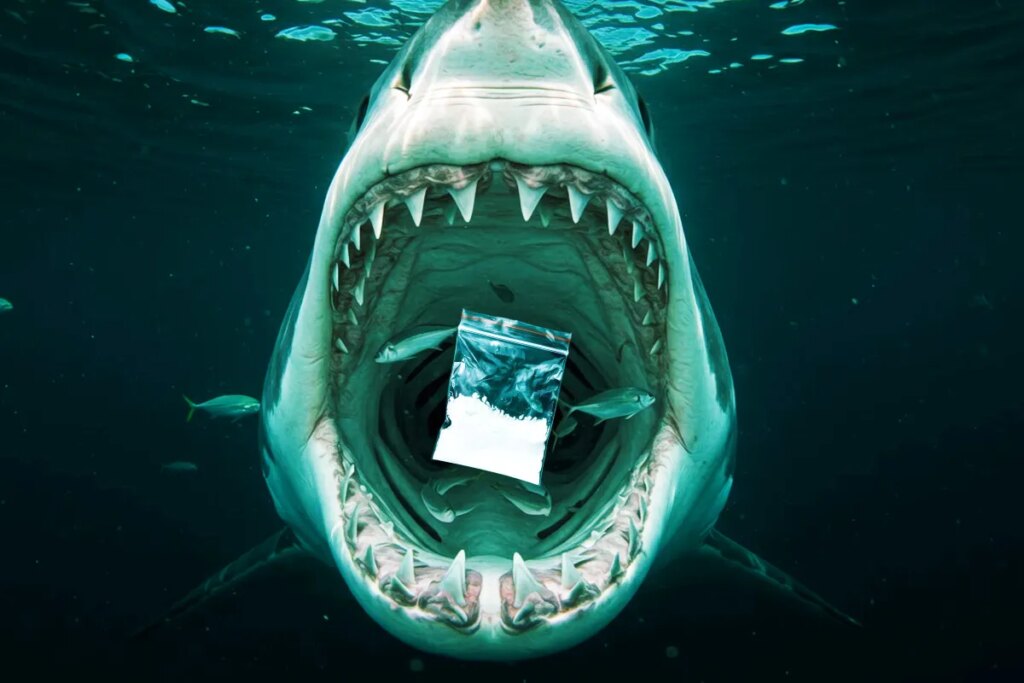
The expression “coked to the gills” has never been more apt.
Scientists from Brazil have discovered that sharks swimming in the Bahamas are testing positive for a potpourri of substances, ranging from caffeine to cocaine and painkillers — as if they, too, are ready for a party in an island paradise.
The implications of the findings, detailed in a study in the journal Environmental Pollution, make for quite the comedown. That the substances are turning up in detectable quantities in sharks points to an “urgent need to address marine pollution in ecosystems often perceived as pristine,” the authors warned in the study, with divers in the area being the most likely culprit.
“It’s mostly because people are going there, peeing in the water and dumping their sewage in the water,” study lead author Natascha Wosnick, a biologist with the Federal University of Paraná in Brazil, told Science News.
Wosnick’s team conducted a previous study that found cocaine in sharks off the coast of Rio de Janeiro. In their latest work, the team collected blood samples from 85 sharks that were rounded up near Eleuthera Island, one of the more remote islands in the Bahamas. In theory, its environment should be pristine.
Not so. Twenty eight of the sampled sharks contained substances including caffeine, as well as non-steroidal anti-inflammatory painkillers like diclofenac and acetaminophen, the active ingredient in Tylenol. The species that tested positive included Caribbean reef sharks, Atlantic nurse sharks, and lemon sharks. (No great whites were represented here, representing a failure in nominative determinism.)
Some of the sharks, including a baby lemon shark, also turned up cocaine. Wosnick speculates that the shark ingested a packet containing cocaine residue.
“They bite things to investigate and end up exposed,” she told Science News.
Cocaine is undeniably the most the head-turning find here, but Wosnick says we shouldn’t snort at the implications of the other substances either.
“While the detection of cocaine — an illicit substance — tends to draw immediate attention, the widespread presence of caffeine and pharmaceuticals in the blood of many analyzed sharks is equally alarming,” Wosnick told CBS News. “These are legal substances, routinely consumed and often overlooked, yet their environmental footprint is clearly detectable.”
More on shark science: It Turns Out Sharks Make Noises, and Here’s What They Sound Like
The post Sharks Showing Unusually High Levels of Cocaine appeared first on Futurism.