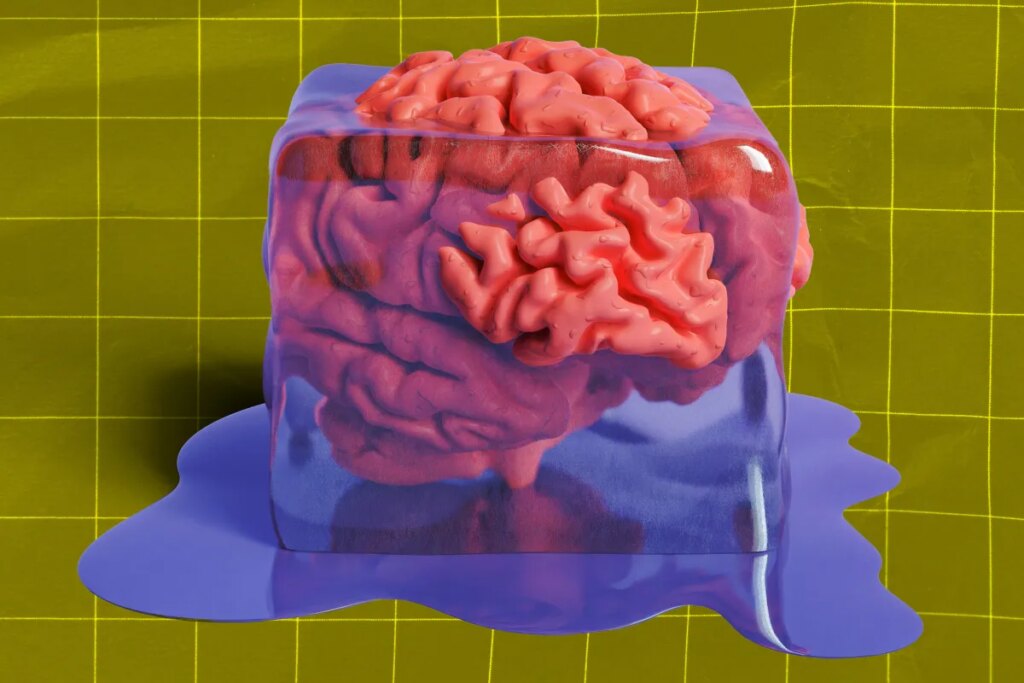
Shortly after the influential biogerontologist L. Stephen Coles was declared legally dead in 2014, his brain was put on ice, sealed in a vat in Arizona. For over 10 years it sat there, held at -146 degrees Celsius, or nearly -295 degrees Fahrenheit.
The brain — or chunks of it, to be exact — finally saw the light of day when Greg Fahy, acryobiologist and friend of Coles’, began a biopsy over a decade after the man’s death. Despite having been frozen at such extreme temperatures, Fahy told MIT Technology Review that his friend’s brain is “astonishing well preserved.”
When he died, Coles requested his brain be preserved and studied at a later date. According to Popular Mechanics, he was one of the first patients in the world to opt for brain-only cryopreservation, sometimes categorized as “neuropreservation” — a grisly procedure that involves decapitating the subject after death and freezing their disembodied head.
Typically, people who get themselves frozen after death are hoping that advanced medical science in the future will be able to bring them back to life. But Coles’ goal was more scientific in nature.
“He thought that if he had himself cryopreserved, we could learn from his brain whether cracking was going to happen or not,” Fahy told Tech Review, referring to the kind of damage that happens to human organs when they’re subjected to such extreme temperatures.
Having been stored at a lower temperature, and preserved with a slurry of “cryoprotective” chemicals, Coles’ brain chunks fared pretty well. Where one would usually expect the chemical brew to wreak havoc on the brain cells, Fahy found the structure of the tissue to have survived relative vigor — giving him hope that the organ might one day be reanimated.
Following the cryogenic playbook, Fahy told Tech Review, “it seems that you can preserve everything.”
Still, there are some caveats. The tissue chunks aren’t entirely unscathed, as Fahy himself was forced to admit in a yet-to-be peer reviewed research paper. There are also plenty of skeptics who doubt Coles’ grey matter could ever be restored to its former glory. As John Bischof, a cryopreservationist at the University of Minnesota told Tech Review, “this brain is not alive.”
More on brains: Researchers Get Human Brain Cells Running Doom
The post Scientist Thawing Out Fragments of His Friend’s Cryogenically Preserved Brain appeared first on Futurism.