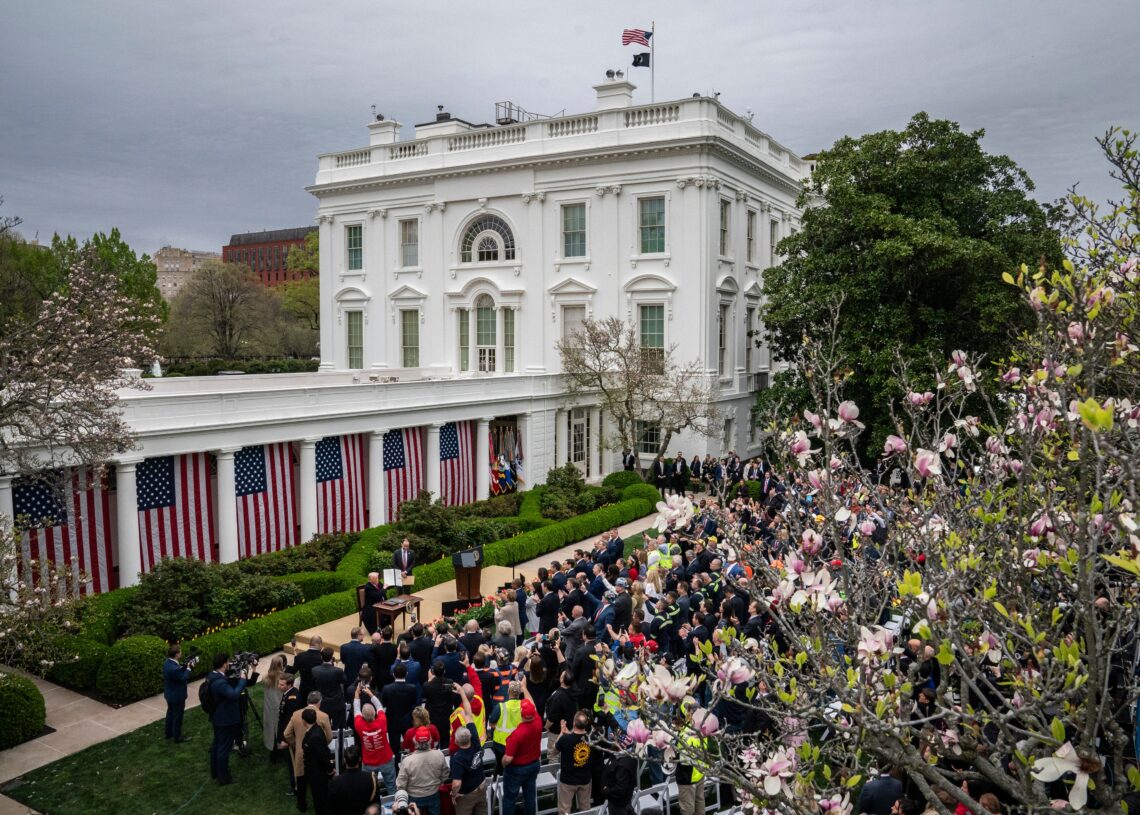
One year after President Donald Trump stood in the White House Rose Garden and announced the highest U.S. tariffs in nearly a century, the number of factory jobs is down and inflation is up.
But the chronic trade deficit, which the president that April afternoon declared a job-killing national emergency, has declined for 10 consecutive months. More than 20 trading partners yielded to the president’s tariff threats — in some cases after resisting for years — and agreed to open their markets to U.S. products. Some foreign leaders also promised generous investments in new factories that one day might employ the president’s blue-collar supporters.
This mixed picture emerged following an uneven year of policymaking. Trump’s habit of threatening tariffs over matters large and small and his tendency to water down or forget his most bellicose threats earned the dismissive shorthand “TACO,” for “Trump Always Chickens Out.” In February, the Supreme Court ruled most of his emergency tariffs unconstitutional, forcing him to start over and refund more than $150 billion.
Whatever the flaws in Trump’s improvisational approach to governance, however, U.S. engagement with the global economy has been profoundly reshaped. China no longer ships nearly as many goods to the United States as it did during globalization’s heyday, and the U.S. government is mobilizing to secure domestic supplies of the minerals required for a 21st-century economy rather than rely on foreigners. Most notably, higher tariffs appear set to endure beyond the end of Trump’s presidency.
“What has changed is the idea of free trade is pretty much gone,” said Wilbur Ross, who served as Trump’s first-term commerce secretary. “He’s changed global perceptions.”
That may be true. But while some elements of Trump’s trade critique have become conventional wisdom, the shape of a new international system remains unclear, according to trade specialists.
Changes are likely in the 2020 U.S.-Mexico-Canada Agreement, which is up for review this year and may not obtain needed congressional approval until 2027. Likewise, the U.S. commercial relationship with China remains fluid, with Trump and Chinese President Xi Jinping scheduled to meet in Beijing in May.
As the U.S. abandons its traditional support for multilateral trade arrangements, other nations are making their own plans. On May 1, a new trade deal between the European Union and Latin America’s Mercosur bloc will take effect provisionally. The E.U. also has concluded negotiations with India on a trade pact that could take effect next year. Sixteen small and midsize countries, including Singapore, Norway, Chile and New Zealand, in the fall launched investment and trade talks aimed at buttressing the rules-based system that the U.S. now rejects.
Businesses remain cautious about the revolution in U.S. trade policy.
Last year’s tariffs cut into profit margins for many companies, including automakers General Motors and Ford, industrial giants Caterpillar and Raytheon, and retailers such as Macy’s and Williams Sonoma.
“The tariff landscape was uncertain and unpredictable in 2025, and we expect it will remain that way in 2026,” Laura Alber, chief executive of Williams Sonoma, told investors this month. “We will stay flexible and continue to adjust quickly as the tariff environment evolves.”
Trump has abandoned the gospel of trade liberalization that governed U.S. policy for decades following the Second World War and peaked on the eve of the 2008 financial crisis. Throughout that era, the U.S. kept its overall tariffs low and pursued global trade deals that would eliminate such barriers in other nations.
Trump began his second term with a tariff blitz that crescendoed on April 2, which he billed as “Liberation Day,” when Americans would be freed from an unfair trading system. New barriers to foreign products — a 10 percent tax on all imports coupled with higher “reciprocal” tariffs on individual nations — would protect U.S. companies from foreign competitors, the president said.
The administration at first said that new tariffs would be imposed after an exhaustive review of nations’ specific trade practices. But critics swiftly discovered that the new levies, as high as 50 percent, actually had resulted from a simplistic formula: dividing a nation’s trade deficit with the United States by its exports to the U.S. and then cutting that number in half.
The president targeted dozens of countries, making little effort to distinguish between major and insignificant trading partners, and also employed tariffs out of personal irritation with foreign governments in Brazil, Canada and Switzerland rather than to secure national interests.
“Trump undermined his own ostensible goals and promises of more manufacturing. … It’s kind of hard to imagine how one could more mess up the use of tariffs,” said Lori Wallach, the director of the Rethink Trade initiative at the American Economic Liberties Project, who supports the president’s goal of boosting domestic manufacturing.
Trump’s questionable tariff debut was a harbinger of what was to come.
The president gambled on using an untested 1977 economic emergency law to impose his tariff plan, a strategy that the Supreme Court ultimately rejected. As a first step toward reestablishing his tariff wall, the president imposed a universal 10 percent tariff using Section 122 of a 1974 trade law.
Those levies will expire in mid-July. Trump’s aides are performing studies needed to erect a more permanent tariff regime at that time using other well-established legal authorities.
The president mainly used tariffs for two purposes: to raise government revenue and as a negotiating cudgel.
In the current fiscal year, American importers have paid more than $144 billion in tariffs, putting the government on track to raise more than $300 billion on an annual basis. That windfall alone is reason to expect future presidents to preserve most of Trump’s tariffs.
Tariff threats also helped persuade other governments to reach trade agreements with the United States. But in subsequent months, the administration was repeatedly forced to clarify its tariff plans after leaders in Japan and Vietnam disputed White House accounts about what had been agreed. In August, trading in gold bullion was disrupted by an erroneous U.S. Customs and Border Protection ruling — later reversed — that unexpectedly applied new higher tariffs to gold bars.
If implementation was sometimes sloppy, the hurried trade deals also produced genuine achievements.
Japan agreed to accept U.S. auto safety standards for imported American vehicles. The United Kingdom increased the amount of U.S. beef that could be sold each year. And Malaysia said it would mirror U.S. economic security provisions, including export controls and sanctions, a move that analysts said was aimed at China.
“When I look at April 2 last year, a year later, my assessment is — at least in round one — the administration seems to have won. But I say ‘round one’ because successfully negotiating a deal is just the first step,” said Wendy Cutler, a former U.S. trade negotiator and now a senior vice president at the Asia Society Policy Institute in Washington.
Indeed, Malaysia this month declared its trade deal “null and void,” following the Supreme Court’s invalidation of Trump’s emergency tariffs, which had persuaded Kuala Lumpur to make concessions. Agreements negotiated with two other major U.S. trading partners, India and Vietnam, also remain unfinished.
But most other deals appear unaffected by the legal wrangling. The European Parliament last week approved major provisions of the agreement that the bloc reached with the U.S. last year.
“I’m increasingly convinced that these alternative agreements on reciprocal trade and the framework agreements between countries are going to be more durable, and potentially even survive well beyond this administration,” said Everett Eissenstat, a trade attorney with Squire Patton Boggs who served in the first Trump administration.
Unveiling the emergency tariffs one year ago, Trump promised that “jobs and factories will come roaring back into our country.” That has not yet happened, though administration officials insist it is just a matter of time.
Factories employ 12.6 million workers, 93,000 fewer than they did on “Liberation Day.” Manufacturing output is up about 1 percent over that period, though it remains below levels reached under President Joe Biden, according to Federal Reserve data.
Inflation also has ticked higher, though not nearly as much as some economists expected. Prices rose over the past year by 3.1 percent, according to the Fed’s preferred inflation gauge, up from 2.5 percent in April 2025.
“These things take time,” said Nick Iacovella, spokesman for the Coalition for a Prosperous America, which supports tariffs. “It’s unfair for people to say, ‘Oh, we haven’t had a huge increase in manufacturing since Trump’s been in office.’”
Manufacturing activity rose in February for the second straight month, according to the Institute of Supply Management purchasing manager index, a standard measure. But new orders and production metrics were down slightly from the previous month, according to Susan Spence, head of the ISM survey panel.
Makers of industrial machinery have been a consistent bright spot in the manufacturing sector, reporting strong orders for a fifth straight month, according to Fed data that some tariff supporters cite as evidence of a nascent rebound.
But most mainstream economists remain skeptical of the administration’s game plan, noting ISM respondents’ uniformly negative comments about the impact of tariffs on raw material costs. The recent improvement in manufacturing sentiment is tied to the boom in artificial intelligence and appears to be “in spite, rather than because, of tariffs,” Neil Shearing, chief economist with Capital Economics in London, said via email.
The past two months of good news from U.S. factories follows more than two years of contraction and will be challenged by rising energy costs if the war with Iran continues, said Greg Daco, chief economist with the consultancy EY-Parthenon.
Prospects for achieving the manufacturing boom that the president promises are hampered by the outlook for continued policy volatility, leaving businesses unsettled.
“They don’t trust tariffs in the same way, partially because of the way Trump’s executed this: They’re there one day, they’re not the next,” said Andrew Gier, managing director at Capstone, a policy analysis firm. “The investments in the U.S.? It’s hard to say the tariffs alone are enough to move that in a big way.”
The post One year later, Trump has remade global trade — with mixed results appeared first on Washington Post.