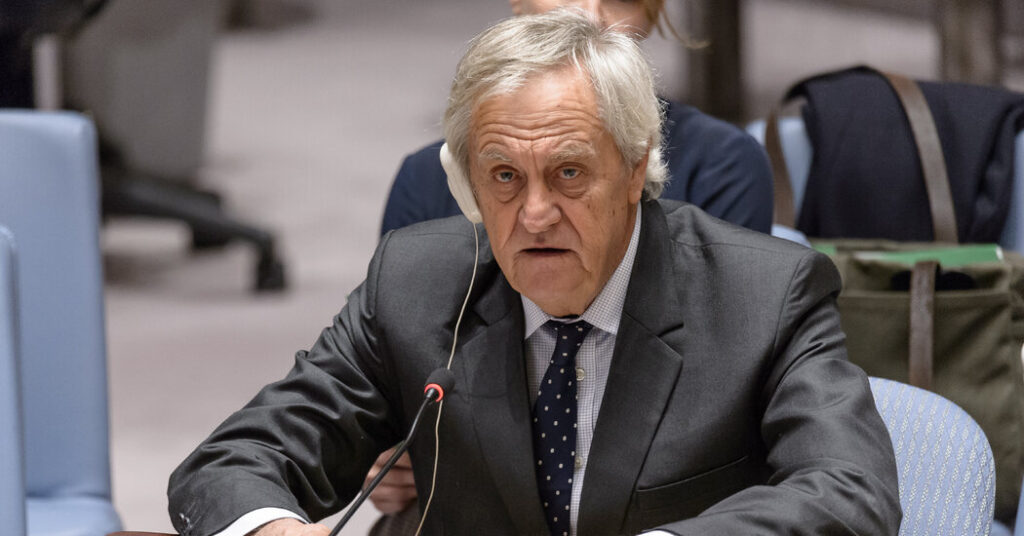
Nicholas Haysom, a South African lawyer who fought apartheid, became a close legal adviser to Nelson Mandela and went on to represent the United Nations in global hot spots, died on March 17 in Manhattan. He was 73.
His death, in a hospital, was confirmed by his daughter Simone Haysom, who said her father had been suffering from heart and lung problems.
Secretary General António Guterres of the United Nations said in a statement that Mr. Haysom had “devoted his life to justice, dialogue and reconciliation” in “some of the world’s most complex and fragile settings.”
Mr. Haysom was the secretary general’s special representative for South Sudan at the time of his death.
His career was forged confronting apartheid in its vicious final years in the 1980s, and he was imprisoned for his efforts. He drew on that experience and his subsequent role at Mr. Mandela’s side, having helped draft South Africa’s new constitution, to navigate conflict and constitutional change in Iraq, Sudan, Afghanistan and elsewhere.
“Being a white South African shaped everything he did,” Niki Ganz, deputy director in the U.N.’s Middle East division, who worked with Mr. Haysom, said in an interview. “He was intent on focusing on minority groups and making sure all voices could be heard. His anti-apartheid history colored his lens.”
At the U.N. Mr. Haysom was considered one of the last of a generation of skilled star mediators, like the Brazilian diplomat Sergio Vieira de Mello or the Algerian Lakhdar Brahimi, able on occasion to bring two fiercely opposed sides together, at least temporarily.
Mr. Haysom was elected president of the anti-apartheid National Union of South African Students in 1976, helping to reinvigorate a battered movement in the year of the Soweto uprising. In that post, and as an activist labor lawyer afterward, he was arrested and jailed, by his own count, half a dozen times.
He spent six months in solitary confinement in apartheid South Africa’s jails in 1981, accused of working with anti-apartheid unions and a banned student newspaper.
“They didn’t let me sleep for three days,” he said of an earlier stint in jail that same year, in an interview in 1985 that is now in the South Africa Historical Archive. “They had constant shifts of interrogators working me over.”
By the time of apartheid’s demise — “We never thought it would end,” he told a U.N. interviewer last year — and Mr. Mandela’s release from jail in 1990, Mr. Haysom was well known in activist circles as a founding partner in an anti-apartheid Johannesburg law firm, Cheadle Thompson & Haysom. It specialized in aiding Black trade unions in negotiations with white businesses.
With apartheid defeated, the now aboveground African National Congress recruited him to help “conceptualize the new South Africa we wanted to build,” he told the U.N. interviewer, building a legal and constitutional framework for the transformed nation.
“We created a social contract which we wanted to be a lesson for the world,” he said.
In 1994 he became chief legal adviser to Mr. Mandela, South Africa’s president at the time. “I would see him every morning,” Mr. Haysom said in the U.N. interview, calling Mr. Mandela a man “steely-strong in his convictions” whose “approach to the law, to the rule of law” was his paramount preoccupation.
He stayed with Mr. Mandela until the end of his term in 1999, after which, with the ex-South African president’s backing, he embarked on the path that was to define the rest of his career as a high-level negotiator in intractable conflicts in Africa and the Middle East.
It began when the Tanzanian president, Julius Nyerere, called Mr. Mandela, asking for legal help in ending Burundi’s civil war. Mr. Haysom was the natural choice.
Nicholas Roland Leybourne Haysom, known at the U.N. as Fink, after a childhood nickname, was born on April 21, 1952, in Johannesburg, the third of four children of David and Antoinette (Beckett) Haysom.
His father had been a fighter pilot in the Royal Air Force during World War II and was a sugar cane company manager in KwaZulu-Natal Province, which includes Durban, where Mr. Haysom grew up.
His mother was an activist in the anti-apartheid Black Sash organization. “I grew up in a liberal environment in which apartheid and racism were frowned upon,” Mr. Haysom said in the U.N. interview. “We grew up with a very strong sense of racial equality,” he said.
Mr. Haysom attended Michaelhouse, an Anglican boarding school in KwaZulu-Natal, served in the South African Navy and studied law at the University of Natal, from which he graduated with a bachelor’s of arts degree in 1975. He graduated from the University of Cape Town in 1978 with a bachelor of law degree.
By then he had already spent time in apartheid’s jails, “detained in ’76 during a student march protesting against the police killings,” he told the interviewer nine years later. He was kept in solitary confinement for two weeks, “just something you had to get used to,” he said in the U.N. interview.
After his graduation he became an associate professor at the Centre for Applied Legal Studies at the University of the Witwatersrand, cofounding the law firm which was to make his name in 1982.
“Haysom was a constant presence at the courts, in the townships, and on the platforms where the future of South Africa was being argued,” a South African news site, The African Mirror, wrote after his death.
After his service with Mr. Mandela, he helped negotiate an end to the Burundi civil war of the late 1990s, leading to the Arusha agreement of 2000. And he helped, with Mandela’s backing, in mediations in Sudan that led to the 2005 agreement leading to South Sudan’s independence.
He joined the U.N. that year, leading the effort to write a new constitution for Iraq to “find a way the many communities in Iraq could live together,” as he put it in the interview last year.
There followed top U.N. positions (in New York and elsewhere): director for political, peacekeeping and humanitarian affairs from 2007 to 2012; head of the U.N. Assistance Mission in Afghanistan from 2014 to 2016; head of the U.N.’s mission in Somalia, from which he was expelled by the government, from 2018 to 2019.
In Afghanistan he tried to navigate the warring factions, predicting, incautiously, that there would most likely be no Taliban takeover while keeping an eye out for the harm being inflicted on Afghan civilians: “The continuing use of suicide attacks in densely populated areas, that are certain to kill and maim large numbers of Afghan civilians, may amount to a war crime,” he told The New York Times after a horrendous ISIS bombing in Jalalabad in 2015.
But he remained an interlocutor listened to by all sides. “His secret was his charm and his affability,” a longtime former U.N. colleague, Andrew Gilmour, said in an interview. “People trusted him.”
In addition to Ms. Haysom, he is survived by another daughter, Rebecca; a son, Julian, by his marriage to Mary Ann Cullinan, from whom he was divorced; two sons, Charles and Hector, from his marriage to Delphine Bost, who also survives him; two sisters, Francesca and Louise; and two grandchildren.
Looking back, Mr. Haysom expressed mild disappointment at all the peace agreements he had seen shattered after their birth in optimism.
“After a few years, I looked around and found that almost all these peace agreements were in trouble,” he said last year. “It’s a recognition that peace agreements don’t last forever.”
Adam Nossiter has been bureau chief in Kabul, Paris, West Africa and New Orleans and is now a writer on the Obituaries desk.
The post Nicholas Haysom, Apartheid Foe Who Became a U.N. Peacemaker, Dies at 73 appeared first on New York Times.