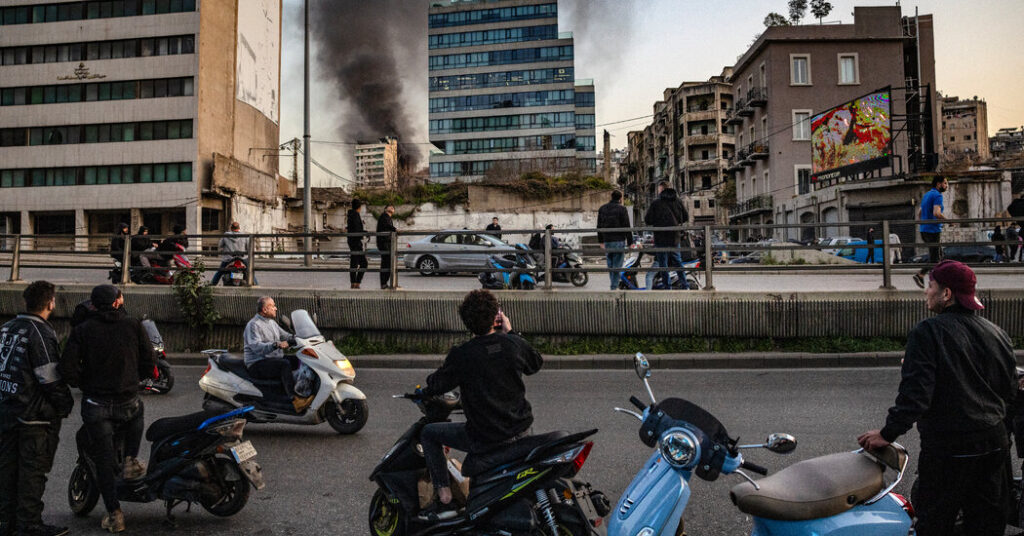
Israel’s second front in the war with Iran
Israel’s war in Lebanon is a second front in the war with Iran. It started after Hezbollah, an Iranian-backed Shiite militant group, fired rockets at Israel in retaliation for the killing of Iran’s supreme leader, Ali Khamenei.
But it’s also, in some ways, its own war. Reporting by our Jerusalem bureau shows that Israel’s plans for a deeper ground incursion into Lebanon predate the fighting in Iran.
Israel has, in effect, been fighting Hezbollah since shortly after the Oct. 7, 2023, attacks, when the group fired rockets at Israel in support of Hamas, another Iranian-backed group. That war left Hezbollah severely weakened. Israeli strikes killed its longtime leader, Hassan Nasrallah, in 2024. His death came shortly after Israel took out scores of other members by blowing up their pagers in a simultaneous attack across Lebanon.
The two parties reached a cease-fire in November 2024, but Israel has continued to attack in the months since, arguing that a steady stream of strikes is necessary to prevent the group from rebuilding.
The Iran war — and Hezbollah’s decision to attack a few days in — gave Israel a new reason to try to finally eliminate a longstanding threat.
Last week, President Trump began talking about negotiations with Tehran. In response, Israel ramped up its attacks on Iran, seeking to deal as much damage as possible before the shooting had to stop.
It’s not clear what role, if any, Lebanon would play in any potential cease-fire negotiations. But when it comes to this war within the war, Israel also seems to be doubling down.
An escalation
This time around, Israel’s goals are more ambitious, and its campaign is more destructive, than in 2024, my colleagues on the ground report.
Since the beginning of the war, more than 1,000 people have been killed by Israeli airstrikes, according to the Lebanese health ministry. Israel has bombarded villages across the south and the east, reducing homes to rubble. More than a million people have been displaced, in a country with a population of 5.8 million. An Israeli ground invasion is underway, and most analysts expect it to expand. Prime Minister Benjamin Netanyahu said yesterday that he had ordered the Israeli military to increase the territory it controls in southern Lebanon.
I spoke to Christina Goldbaum, our Beirut bureau chief. She told me Israeli airstrikes have not just targeted Shiite areas where Hezbollah holds sway. They have also struck central Beirut, at times without warning.
The Israeli military has also issued evacuation warnings for a zone, extending as far as 40 kilometers into southern Lebanon in some places, that goes well beyond the bounds of previous warnings.
“We’re seeing the beginning of a ground invasion of the south, with the Israeli defense minister openly speaking about Israel occupying much of southern Lebanon,” Christina said. “All of this is a big escalation from the last war.”
Israel is doing that as the attention of the world — and the U.S. — is on Iran.
History repeating?
Members of the Israeli government have made direct comparisons between what could potentially happen in Lebanon and what happened in Gaza after the Oct. 7 attacks.
The far-right Israeli finance minister said the southern suburbs of Beirut would soon look like Khan Younis, a city in Gaza that was completely destroyed. The defense minister said that if the Lebanese government could not prevent Hezbollah from firing on Israel, then Israel would take it upon itself to do so from Lebanese territory.
“They see a threat on their border, and they set out to deal with it in a way that was reminiscent of how they dealt with the threat in Gaza,” David Halbfinger, our Jerusalem bureau chief, told me.
“They waited around for the Lebanese government and its army to disarm Hezbollah,” David said. “It didn’t happen fast enough for them, and now they’re taking matters into their own hands,” displacing thousands of Lebanese civilians in the process.
The rocket attack against Israel early on in the Iran war created some backlash against Hezbollah among the Lebanese population, Christina said. Most people in Lebanon are tired of war, and many are tired of Hezbollah’s decades-long grip on the Lebanese state and its willingness to ignite wars that have consumed the country.
But there is a danger, she said, that the ferocity and the scale of Israel’s response will lead Hezbollah to win back support, because people feel it’s the only entity protecting them from invading Israeli forces.
The last time Israel invaded and occupied large swaths of southern Lebanon was in 1982. At the time it was trying to subdue Palestinian groups launching attacks on Israel from Lebanon, which was itself engulfed in a civil war.
Israel’s occupation lasted 18 years, and remains seared into Lebanon’s collective memory. Israel allied itself with Christian militias, which raided Palestinian groups in Muslim areas — a dynamic that deepened the country’s sectarian divides.
The resentment contributed to the birth of a Shiite militant group aimed at resisting the Israeli presence. That group — you might have guessed already — was Hezbollah.
Other developments:
-
About 2,500 U.S. Marines have arrived in the Middle East along with 2,500 sailors, bringing the total number of U.S. troops in the region to more than 50,000.
-
Israel bombarded Iran with an intense wave of airstrikes, and the speaker of Iran’s parliament accused the Trump administration of engaging in a front of diplomacy while “secretly planning a ground invasion.”
-
Hundreds of mourners in Beirut attended the funeral of two Lebanese television journalists and a cameraman killed in an Israeli airstrike.
-
Pakistan hosted talks with the foreign ministers of Saudi Arabia, Turkey and Egypt, in the country’s latest efforts to mediate in the war.
-
The price of jet fuel has almost doubled since the start of the war. In the video below, Niraj Chokshi, who covers aviation, explains what that will mean for flights.
-
Read about the war’s ripple effects around the world, from costlier sugar in Brazil to gas lines in Texas.
MORE TOP NEWS
-
Large crowds took part in “No Kings” rallies across the U.S. on Saturday to protest much of Trump’s agenda. Here are some takeaways from the protests.
-
The French police arrested a man who tried to detonate an explosive outside the Bank of America headquarters in Paris, a foiled attack that is being investigated as possible terrorism.
-
A man tied to a pro-Israel terrorist group was arrested in connection with a plot to kill a pro-Palestinian activist in New York.
-
Ukraine’s president said he had negotiated air defense agreements with Qatar, Saudi Arabia and the United Arab Emirates during a trip to promote anti-drone technology.
-
Members of the Castro family are emerging as possible power brokers as the Trump administration pushes for changes in Cuba.
-
Canada’s main progressive party, the New Democrats, picked a new leader, Avi Lewis, in a bid to rebuild itself.
Top of The World
The most clicked link in your newsletter on Friday was about a surge of new converts in Catholic churches across the U.S.
SPORTS
Formula 1: After finishing eighth in the Japanese Grand Prix in Suzuka, Max Verstappen is rethinking his future.
Football: Tottenham Hotspur’s head coach, Igor Tudor, left the club after just 44 days in charge.
HELPERS OF THE DAY
Sperm whales
Rare footage of a sperm whale birth showed a group of whales all huddled together, taking turns to lift a newborn calf to the surface so it could breathe. Researchers say the teamwork adds to evidence that humans are not the only species whose members help birthing mothers.
MORNING READ
Around 1505, Raphael painted a maiden cradling a baby unicorn. Why is she holding it? For status, perhaps: The mythical beast was an emblem of one of Italy’s grandest dynasties. Or perhaps as a sign of her virtue: Only a virgin could tame a unicorn, according to legend.
The “Portrait of a Young Woman with a Unicorn” has traveled from Rome for a blockbuster exhibition that just opened at the Metropolitan Museum of Art in New York. The show is a beauty, our critic Jason Farago writes, of the sort that “seems to reflect the divine, and make us look puny by contrast.” Read more.
Bonus: Take a look at these three artworks to see Raphael’s brilliance up close.
AROUND THE WORLD
Same Seoul, different worlds
A visit to Guryong Village, a shantytown in Gangnam, Seoul’s wealthiest district, makes South Korea’s stark economic divide painfully clear.
Many residents live in one-room huts, built from salvaged materials, that are too small to include toilets. In gleaming new towers just across the street, a typical three-bedroom apartment costs $2.6 million.
Since 2023, the city has been pushing to clear the settlement for redevelopment. Hundreds of residents have left for subsidized temporary housing, while others have stayed put, demanding better terms of relocation. Some see Guryong’s holdouts as greedy squatters holding prime real estate hostage; others consider them representative of those left behind by South Korea’s meteoric economic growth. Read more.
RECOMMENDATIONS
Watch: A documentary about A.I. gets chief executives on the record.
Listen: In the podcast “The Idiot,” the writer M. Gessen investigates whether a cousin might have planned a murder.
Read: These eight thrillers feature housewives getting revenge.
Consider: Our fashion critic offers tips for deciding when to let your hair go gray.
RECIPE
Traditional Moroccan m’qualli tagines are seasoned with ground ginger and ground turmeric to create a rich, dark yellow sauce. They’re time-consuming to make, but with this quick weeknight recipe you can enjoy all their classic flavors in less than an hour.
WHERE IS THIS?
Where is this gold mine?
TIME TO PLAY
Here are today’s Spelling Bee, Mini Crossword, Wordle and Sudoku. Find all our games here.
That’s it for today — Katrin
We welcome your feedback. Send us your suggestions at [email protected].
Katrin Bennhold is the host of The World, the flagship global newsletter of The New York Times.
The post Israel’s Other War appeared first on New York Times.