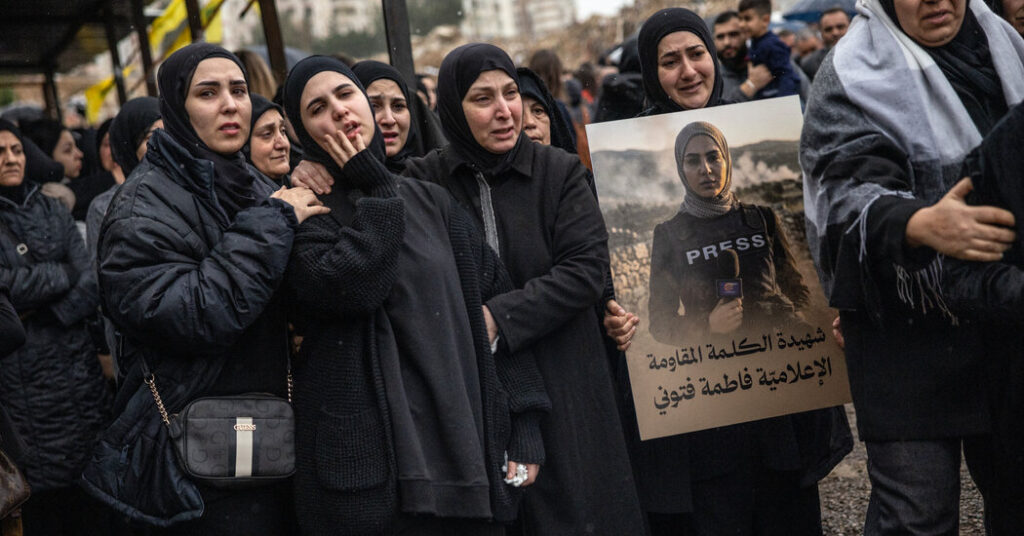
Hundreds of mourners gathered in driving rain in the Lebanese capital, Beirut, on Sunday to bury two prominent Lebanese television journalists and a cameraman killed in an Israeli airstrike a day earlier.
Israel said it had targeted one of the three, Ali Choeib, a correspondent for Lebanese television network Al-Manar, which is owned by Hezbollah, the Iran-backed Lebanese militant group. Israel said he was a member of Hezbollah’s military wing “disguised as a journalist.”
Fatima Ftouni, a correspondent with Al-Mayadeen, a Lebanese broadcaster aligned with Hezbollah, was also killed along with her brother, cameraman Mohammad Ftouni. It was not immediately clear who he was working for at the time of his death.
Avichay Adraee, an Israeli military spokesman, said in a social media post that Mr. Choeib had joined Hezbollah’s military wing in 2020 and had been cooperating with the group since 2013. Mr. Adraee said Mr. Choeib was involved in photographing, collecting intelligence and relaying it to the Radwan Force, an elite Hezbollah unit that has led the group’s conflict with Israel and carried out cross-border attacks.
Lt. Col. Nadav Shoshani, another spokesman for the Israeli military, declined to comment on the killing of Ms. Ftouni and Mr. Ftouni alongside Mr. Choeib.
Hezbollah on Saturday criticized the “deliberate and criminal targeting of journalists.” It dismissed what it called “false claims” by Israel.
Israel and Hezbollah fought a devastating war that ended in a cease-fire in late 2024. But after Israel and the United States began attacking Iran in late February, Hezbollah resumed rocket fire into Israel, prompting a renewed wave of Israeli strikes across Lebanon.
The Israeli airstrike hit the journalists while they were traveling together in a car near the southern town of Jezzine on Saturday. In a statement, Lebanon’s president, Joseph Aoun, condemned the killings as a “blatant crime” that “violated the most basic rules of international law.”
The attack came days after an Israeli strike killed Hussain Hamood, a freelance photojournalist with Al-Manar, and not long after another Israeli strike that killed Mohammed Sherri, an anchor with the television station, according to the Committee to Protect Journalists.
Mr. Choeib and Ms. Ftouni had voiced support for Hezbollah, which the United States designates as a terror organization. But it is also an established political party in Lebanon with a strong base, particularly among Shiite communities. Human rights advocates and legal experts say that expressing support for an armed group does not make someone a lawful target under the laws of war.
At the funeral, families, friends and journalists, most dressed in black, gathered at Rawdat al-Imam al-Sadiq cemetery in southern Beirut to lay the three to rest. Wails and ululations rose as the bodies arrived, wrapped in white shrouds and adorned with roses. Some mourners carried posters featuring the faces of the three.
During the funeral, tears flowed freely, with men and women overcome with grief. Verses from the Quran echoed through loudspeakers.
Mourners then lined up to pray, and as the bodies were carried toward their graves, voices rose in sorrowful farewells.
Mr. Choeib had for years been a household name on Al-Manar, reporting from the south, a region bordering Israel.
As families were displaced — hundreds of thousands are now following evacuation warnings from Israel — they tuned in to watch him report from their towns and villages, some said, hoping he would offer a glimpse of the world they had been forced to leave behind.
“He was our eyes in the south,” said Caroline Kareem, a 32-year-old nurse who was attending the burial in Beirut.
Isabel Kershner contributed reporting.
Abdi Latif Dahir is a Middle East correspondent for The Times, covering Lebanon and Syria. He is based in Beirut.
The post Hundreds Gather for Funeral of 3 Lebanese Killed in Israeli Strike appeared first on New York Times.