The attack on Israel on Saturday morning by the Houthis, an Iranian-backed militia in Yemen, was an escalation in the monthlong U.S.-Israeli conflict with Iran, and threatened to expand the war’s reach across the region.
The Israeli military said early on Saturday that its aerial defense systems had intercepted a missile fired from Yemen. No casualties were immediately reported after the attack.
Israel has been targeting the Houthis for years, and many believed that the group’s military capabilities had been severely degraded.
After the United States and Israel began attacking Iran in late February, expectations grew that the Houthis might enter the conflict, especially as other Iranian proxy groups in Lebanon and Iraq became involved.
The Houthi attack on Israel on Saturday demonstrated that, despite heavy Israeli strikes on its leadership and infrastructure, the group remains capable of responding.
There has also been concern that, if the Houthis were to enter the war, the group could disrupt global shipping through the Red Sea, which it has done previously by attacking passing ships, in some cases sinking them or killing their crew members.
The global economy is already reeling from Iran’s effective closure of the Strait of Hormuz, a crucial choke point for energy shipments in the Persian Gulf. Saudi Arabia, Yemen’s northern neighbor, has been funneling crude oil exports through the port of Yanbu on the Red Sea, using an overland pipeline that was built to bypass the strait.
The Houthis said in a statement on Saturday that they had launched ballistic missiles targeting “sensitive” Israeli military sites, acting in tandem with Iran and with Hezbollah, an Iranian-backed militant group based in Lebanon.
The statement said the attacks would continue “until the aggression on all resistance fronts stops.”
The Houthis are Shiite militants who have been engaged in a conflict with Yemen’s internationally-recognized government for nearly two decades. In 2014, they captured the capital, Sanaa, forcing the government to flee to the southern port city of Aden.
An alliance led by Saudi Arabia to remove the Houthis faltered and led to a devastating civil war that precipitated one of the world’s most severe humanitarian crises.
“It is a very bad day for Yemenis,” said Farea Al-Muslimi, a research fellow focused on Yemen and the wider Gulf region at Chatham House, a policy institute in London. “The Houthis have decided to take a reckless decision to join a war that is not Yemen’s war and to basically respond to their sponsor in Tehran.”
The attack on Saturday was the latest escalation in a yearslong conflict between Israel and the Houthis.
In 2023, shortly after the onset of the Gaza war, the Houthis began launching drones and missiles at Israel and ships in the Red Sea. They described their actions as a campaign to force Israel to halt its bombardment of Gaza and to allow more aid into the enclave.
The attacks disrupted traffic through one of the world’s major maritime corridors, forcing shipping companies to reroute around the southern tip of Africa. This detour, which added thousands of miles and several days to transit times, significantly increased shipping costs and delays.
The United States responded with military action that included more than 1,100 strikes on Houthi targets. Despite the campaign and a 2025 cease-fire agreement between the United States and the Houthis, some major shipping companies continued to avoid the routes as the militia kept up attacks in support of the Palestinian cause.
The Houthis consider themselves part of Iran’s “axis of resistance,” a loose network of groups that includes Hezbollah in Lebanon, Hamas in Gaza and Shiite militias in Iraq.
The axis has weakened in recent years, primarily because Israel has targeted the groups’ leaders with airstrikes, disrupted their operations and struck key infrastructure. In Yemen, Israel has killed senior members of the Houthi cabinet, including the prime minister, Ahmed al-Rahawi. It has also conducted a series of punishing strikes on the country’s main international airport and ports, lifelines for food and medicine entering the country.
The Houthis continued to carry out drone and missile attacks on Israel throughout 2025, but paused after the U.S. brokered a cease-fire between Israel and Hamas last October.
Since the war began in late February, there have been expectations that the Houthis would eventually join. The group’s leader, Abdul-Malik al-Houthi, in a televised address earlier this week, reaffirmed their strong ties with Iran and signaled their readiness to intervene militarily.
“We will take the initiative with full trust and reliance upon God Almighty, just as in previous rounds,” Mr. al-Houthi said in his speech.
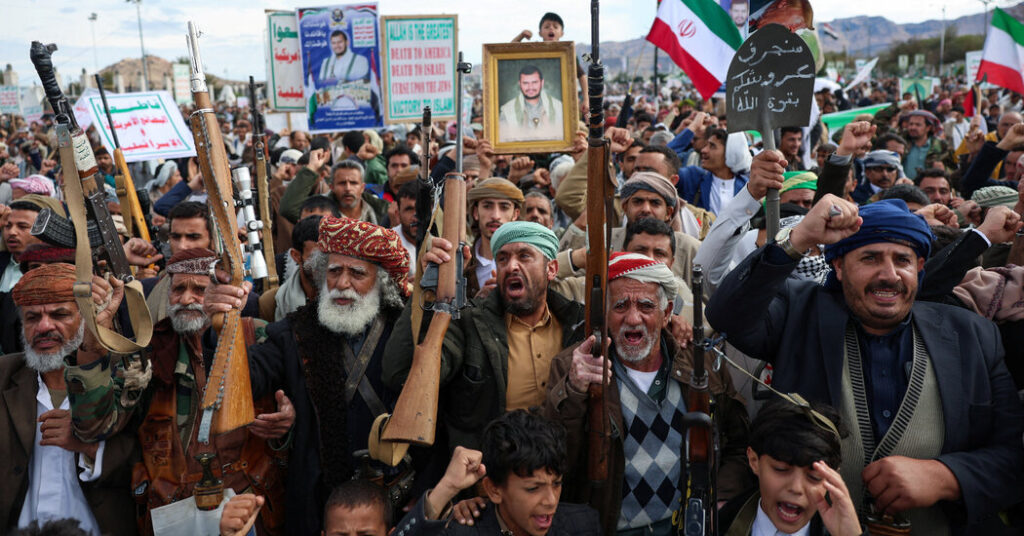
On Friday, large crowds of the group’s loyalists gathered in Sanaa, brandishing weapons and waving the flags of Yemen, Iran and Palestine, as they participated in protests in support of Iran.
It was not immediately clear how far the group might escalate its attacks now that it has joined the war. But Mr. Al-Muslimi, the Chatham House researcher, said there was widespread concern that its involvement could have major implications for regional stability, as well as trade and energy costs.
The Houthis, he added, have “the geographical ability to destabilize not just the Middle East but the entire world.”
On Saturday, some people in Yemen said that they feared the Houthi attack could provoke Israeli strikes on the country, bringing further devastation in one of the world’s poorest countries.
“If anything comes of it, it will bring us nothing but misery,” said Ali Ahmad Hameed, a 65-year-old grocer in Sanaa, referring to the possibility of an Israeli retaliation.
Shuaib Almosawa and Ismaeel Naar contributed reporting.
Abdi Latif Dahir is a Middle East correspondent for The Times, covering Lebanon and Syria. He is based in Beirut.
The post Yemen’s Houthis Fire at Israel and Vow Further Attacks appeared first on New York Times.