To the Editor:
Re “How Minnesota Beat Trump,” by Thomas L. Friedman (column, March 21):
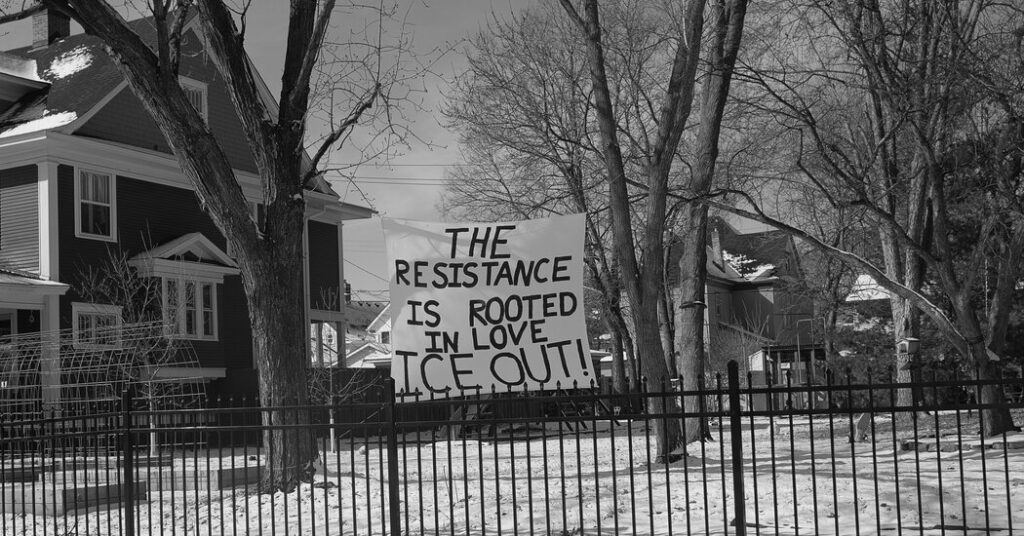
I am a Minnesota native who now lives in the South. Mr. Friedman’s column about the resistance to ICE in Minnesota resonated with me.
A Southern friend of mine — a MAGA believer — recently claimed that Minnesota protesters had hired 50,000 professional agitators to stir dissent against ICE and federal agents conducting raids in the state. I told him plainly, “No mercenary protester would march outside in below-zero weather, sing songs of resistance and then kneel on frozen pavement to pray.”
Living through Minnesota winters teaches both fierceness and compassion. Wind chills in the state can reach 40 below zero. If we don’t look out for one another, someone could freeze in the dark.
I graduated from the once all-white Willmar Senior High School in Minnesota. When I returned years later, I saw a town transformed by Spanish-speaking and Somali immigrants working long hours in sugar beet fields and turkey-processing plants — jobs many of our own children no longer want.
Change can be hard. But Minnesotans understand something essential: Survival in a harsh climate depends on neighborliness, regardless of race or religion. That instinct — to protect one another in hard times — is also what keeps a democracy alive.
Judith Moen Atlanta
To the Editor:
Thank you, Thomas L. Friedman, for your column about “neighboring” in the Twin Cities. I am an 85-year-old retired teacher and a widow. I fear I may go to my grave before we are able to recover from President Trump’s onslaught on so many fronts and in so many arenas.
My three grown children and six adult grandchildren ask if it was worse in the 1960s. I think we had hope then and felt empowered. I am not sure how hopeful I am today.
Your column, though, gives me a glimmer of hope. Thank you for writing such an uplifting piece.
Louise Young Rochester, N.Y.
To the Editor:
In his book “The Imperial Presidency,” the historian Arthur M. Schlesinger Jr. traced the escalation of presidential power that culminated in the Watergate scandal that brought down President Richard M. Nixon and his administration. He noted that Nixon’s usurpation of power would have continued had Congress not finally woken up and asserted its own authority under the Constitution.
In his final paragraphs, Schlesinger warned that “corruption appears to visit the White House in 50-year cycles.” With remarkable insight, he wrote: “Around the year 2023 the American people would be well advised to go on the alert and start nailing down everything in sight.”
As Thomas L. Friedman so elegantly relates in his column, the people in Minnesota took it upon themselves to hammer down some of those nails.
Hopefully more of us will be inspired by the brave Minnesotans and take it upon ourselves to hammer some more of those nails. Then maybe Congress will wake up again.
Jerold D. Cummins Arlington, Va.
To the Editor:
For his column on Minnesota’s response to the ICE operation in our state, Thomas L. Friedman interviewed business executives, nonprofit directors, school leaders and local politicians. What’s missing from his account is the perspective of those who endured the winter in their apartments with the shades pulled down. If Mr. Friedman had spent time in their living rooms, he would not put such a neat bow on this catastrophic story.
Mr. Friedman thanks President Trump for uniting Minnesotans. I know he is being facetious, but for people whose families have been ripped apart by this operation, there is no gratitude for the president.
There is also no epidemic, as Mr. Friedman suggests, of “ICE PTSD.” There is nothing “post” about a federal agent presence that is roughly three times its pre-surge level.
I am part of a suburban Minneapolis group that delivers groceries to neighbors unable to leave their homes. When I see their sparse living rooms, empty walls and minimal furniture, I feel a rush of anger. Why is our government picking on this vulnerable population? People who work so hard for so little reward, who now have to live with such fear?
Dan Forstner Bloomington, Minn.
To the Editor:
Thomas L. Friedman’s column about Minnesotans’ tremendous spirit of “neighboring” reminded me of my time as a reporter in the 1970s for The Forum, a regional newspaper based in Fargo, N.D., that covered nearby Moorhead, Minn., just across the Red River separating the two states. It is still around today.
In particular, I recall a comment made by my managing editor, Cal Olson, after his return from assignment along a two-lane highway during a subzero, dead-of-winter blizzard.
While he was out there he noticed a farmstead light maybe a quarter-mile off the road. “I just knew if I was stalled there and somebody at that farm saw me,” I recall Cal telling me, “they’d bundle up and hike out to ask if I was OK.” He said such gut-level caring was one of the main reasons he worked for The Forum.
All these years later, it is a pleasure to read that Mr. Friedman has found that, yes, it’s still like that.
Ed Maixner Herndon, Va.
To the Editor:
Thomas L. Friedman’s column offers a moving account of the courage and compassion of the people in the Twin Cities who came to the aid of their neighbors and stood up to ICE.
It inspires a thought: The Nobel committee should award its 2026 Peace Prize to the people of Minneapolis-St. Paul.
Steven L. Winter Detroit The writer is professor of constitutional law at Wayne State University Law School.
Calling All Teens: Are you a teenager with something to say? The New York Times’s Learning Network invites you to write a public-facing letter about an issue that matters to you. The Open Letters Contest runs until April 8.
The post What We Have Learned From the Minnesota Resistance appeared first on New York Times.