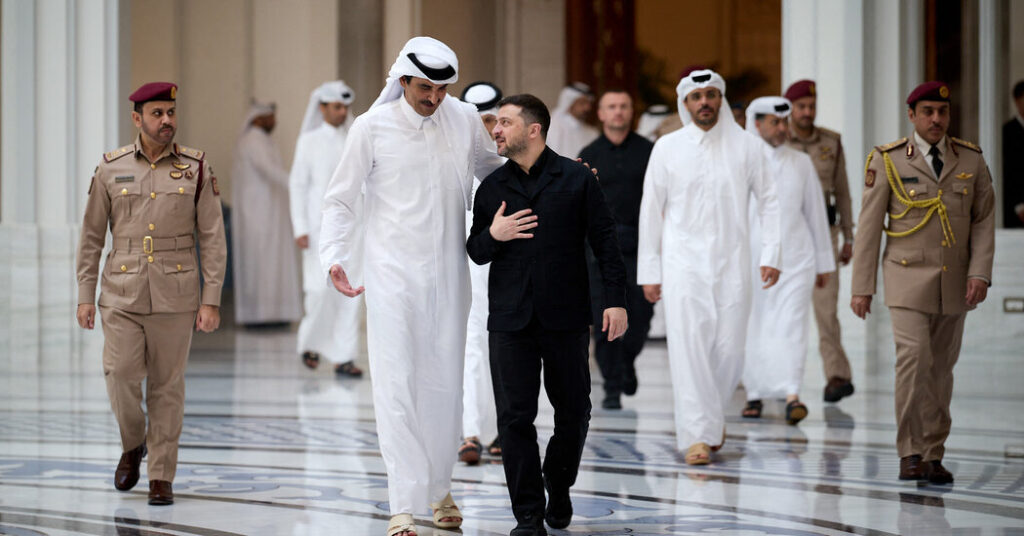
President Volodymyr Zelensky of Ukraine hailed his Middle East tour to promote anti-drone technologies as a success, saying on Saturday that he had negotiated air defense agreements with Saudi Arabia, Qatar and the United Arab Emirates.
In the Mideast conflict, Ukraine has sought to shift its image from a recipient of military aid to a supplier. It sees an opening to export its low-cost, innovative designs created during the war with Russia to compensate for shortages of weapons and ammunition. Ukraine’s military often relies on consumer technologies such as virtual-reality goggles for gamers and off-the-shelf drone components.
The agreements under negotiation with the United Arab Emirates and finalized with Qatar extend for 10 years, Mr. Zelensky told reporters on a conference call, and could be worth “billions.” He spoke from Qatar, one of the Persian Gulf states that has been targeted by Iranian drones.
Mr. Zelensky said he had signed deals with Saudi Arabia and Qatar and expected to finalize an agreement with the United Arab Emirates.
Mr. Zelensky did not announce specific commercial drone sales, but said talks touched on financial support from Gulf nations that could help Ukraine bridge a delay in European funding after Hungary blocked a 90 billion euro loan package. He said he had also discussed future Ukrainian purchases of energy from the Middle East as Ukraine’s own natural gas industry had been battered by Russian strikes.
Qatar’s defense ministry confirmed the deal in a statement, saying it would include an “exchange of expertise in countering missiles and unmanned aerial systems.”
“Everybody understands that no other country than Ukraine can help with its expertise” in shooting down Iranian drones, Mr. Zelensky said. “We are sharing our experience, and they are thankful to us.”
Ukraine faces grave risks from the Israeli and U.S. war against Iran that began on Feb. 28, as rising oil prices prop up Russia’s economy and the United States, Israel and several Mideast countries expend air defense missiles that are sorely needed in Ukraine.
Ukraine’s new class of drone-intercepting weapons are now in demand as a means to counter Iranian exploding drones economically. Over four years, Russia fired tens of thousands of Iranian-designed Shahed drones at Ukraine, forcing the country’s military to hone skills for shooting them down.
Mr. Zelensky’s trip to Saudi Arabia, the United Arab Emirates and Qatar coincided with an Iranian drone and missile attack on the Prince Sultan Air Base in Saudi Arabia that wounded 12 American service members and damaged at least two U.S. KC-135 refueling planes. Iranian drones have also recently hit high-rises in Dubai, Kurdish guerrilla bases in Iraq and oil facilities in Gulf nations.
The long-term agreements, Mr. Zelensky said, foresaw the possibilities for Gulf investments in Ukraine’s drone industry.
As an immediate response to the Mideast war, Ukraine has sent more than 200 air defense experts to the region, Mr. Zelensky said. But on Saturday he said he was not in discussion with Gulf nations about Ukrainian soldiers participating in the conflict. Iran has threatened to retaliate against Ukraine and has provided exploding drones to Russia to fire at Ukraine since 2022.
Mr. Zelensky denied a claim by the Iranians that they had struck a warehouse where a Ukrainian air defense team worked, calling it “misinformation.”
He also criticized a decision by the Trump administration to lift some sanctions on Russian oil exports to ease global shortages as tanker traffic through the Strait of Hormuz slows to a trickle. Russia’s earnings, he said, will aid the Kremlin’s assistance to Iran in targeting American troops.
Mr. Zelensky told reporters on the call that he had been reading intelligence reports on sites surveilled by Russian spy satellites. He noted that Russian missile strikes on cities or facilities in Ukraine often shortly followed the schedule of spy satellites passing over Ukrainian targets.
Mr. Zelensky read a recent schedule of Russian spy satellite flyovers of Diego Garcia, an island base in the Indian Ocean for British and American troops, and of Prince Sultan Air Base in Saudi Arabia. Both bases were targeted by Iranian strikes.
Ukraine has been launching drones at Russian oil-exporting facilities including a refinery and oil port in Ust-Luga, on the Baltic Sea near St. Petersburg. These Ukrainian strikes risk further tightening the global supply of oil, though on a far more limited scale than Iran’s closing of the Strait of Hormuz.
Mr. Zelensky said Ukrainian strikes had knocked out about 60 percent of the oil-exporting capacity of the Ust-Luga port.
Without naming specific nations, Mr. Zelensky said “partners” had questioned Ukraine about the strikes. He replied that Ukraine would halt them only if Russia stops targeting its energy infrastructure.
Ismaeel Naar contributed reporting from Dubai.
Andrew E. Kramer is the Kyiv bureau chief for The Times, who has been covering the war in Ukraine since 2014.
The post Ukraine Finalizes Air Defense Deals With Gulf Nations Amid War in Mideast appeared first on New York Times.