I live in Weehawken, New Jersey, directly across the Hudson River from Manhattan, where I spent 30 years of my life, and where, on any given Saturday, most of the action is. Normally, I’d hop on the ferry, cross the river, and join the hundreds of thousands marching through the streets of Manhattan.
But today, for No Kings 3, I decided to go local.
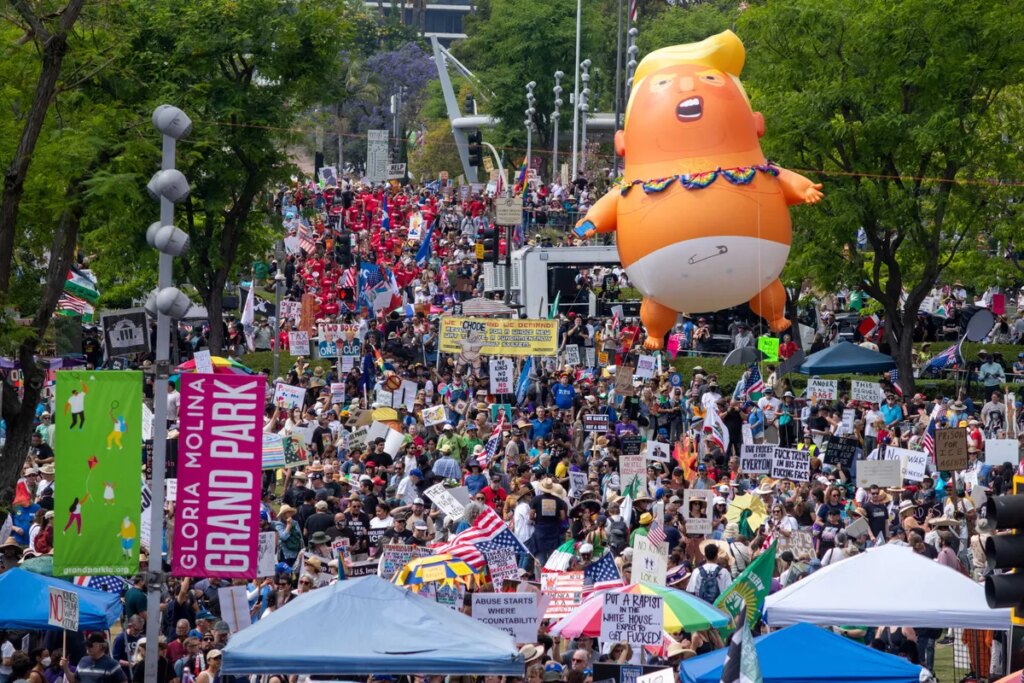
More than 3,300 events were planned across all 50 states as part of what organizers are calling the largest day of domestic political protest in American history. I knew Manhattan would be electric. What I didn’t expect was that tiny Weehawken, with a population of roughly 15,000, perched on the Palisades high above the river, would be electric too.
I walked up to Hamilton Park, with its postcard view of the Manhattan skyline, expecting maybe 100 people. What I found was several hundred, local elected officials standing shoulder to shoulder with their neighbors.
We marched down JFK Boulevard, framed by one of the most spectacular backdrops of any protest in the country.
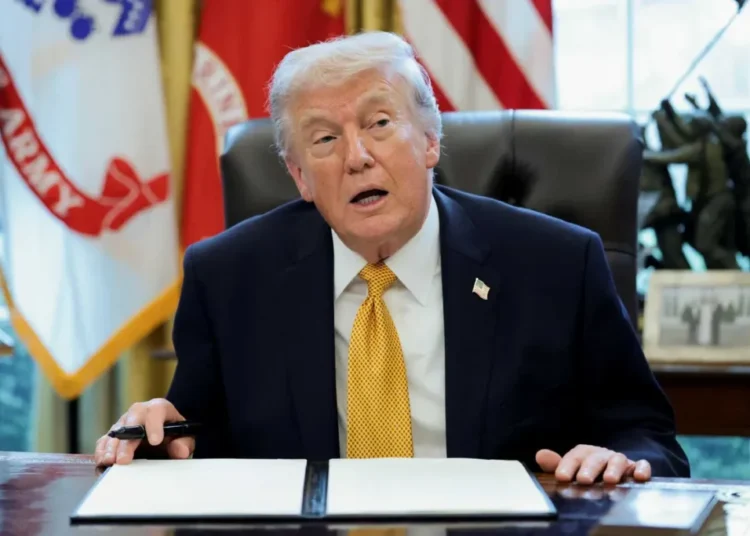
If Donald Trump thinks the No Kings movement is “a joke,” as he’s said, then what I saw in Weehawken should give him serious pause. The message was “No Kings,” but virtually everyone I talked to had a different reason for being there, war, grocery and gas prices, ICE, grifting, airports, and more.
In other words, more reasons why there should be no King Trump.
“I am 62 years old, and I can’t remember the last time I’ve been involved in a protest of any kind,” a gentleman named Al said. “I sit in an office all day. I’m not a political guy. But I’m angry enough that I’ve gotten up off my chair, because I really think our country is going in the wrong direction in a big way.”
He paused, looking at the crowd gathering behind him. “It must be really bad if it got me and all of these other people out here on a really cold day.”
Karen Brady and Gayle Humphrey have been building North Hudson Resistance, one of the local organizers of No Kings, for a year. In that time, they’ve organized four marches, worked to protect immigrant communities, fought cuts to Medicaid and social services, and coordinated “Know Your Rights” trainings for residents who fear ICE.
“We’re doing everything we can to fight the Trump regime,” Gayle told me. “All the ineptitude, the cynicism, the cruelty, the corruption, the chaos. No strategy except getting rich.”
Karen noted the group is growing. “We’re getting stronger in our numbers,” she said. “A lot of people are outraged.”
Weehawken Mayor Richard Turner was there too, not just as a figurehead, but walking the route.
“I’m here for two reasons,” he told me. “One, to express what everyone’s expressing, to put an end to what’s going on in this country, especially with immigration. There are better, safer ways to do things. And secondly, to make sure everybody’s safe.”
Attending his third No Kings event, Turner praised the peaceful nature of the demonstrations and their national impact. “All these demonstrations across the country have an effect,” he said.
New Jersey State Representative Gabriel Rodriguez was also in the crowd, marking his first No Kings march in Weehawken. “There are some strong feelings, lack of safety, lack of protocol and process,” he told me. “That’s not very American.”
He pointed to recent legislation signed by Governor Murphy protecting immigrant communities in Hudson County. “We’re happy that people are on board in the name of safety and for our communities,” he said.
His colleague, Assemblyman Larry Wainstein, was equally direct.
“Everybody deserves to be treated with respect and dignity,” he said. “We’re working very hard to stand up against Trump and ICE because they’re treating our community with a lack of respect.”
What struck me most wasn’t just the anger, though it was real and palpable. It was how many people told me this was their first protest.
Ever.
A woman originally from my hometown of Pittsburgh stopped to talk with her husband.
“This is my first one,” she said. “Me too,” her husband added. “We are not the type of people to protest. But things have gone too far.”
Nearby stood Kathy, who told me she was “almost 80” and had been to “many, many, many” protests over her lifetime, as if passing a torch. Mario, a younger marcher, put it plainly: “We’re tired of the circus. We need this country to get back to what it used to be, a country of freedom. No fascism, no oligarchs.”
Dale, from neighboring West New York, had attended the previous No Kings events in Manhattan but chose Weehawken this time. “I can’t believe what he’s done, not only to us but to the world,” she said, her husband John nodding beside her. “We are the laughingstock of the world. People need to wake up.”
On my walk home, I texted a friend who had been marching in Manhattan.
“Where are you?” he wrote. “Want to meet up?”
He assumed, naturally, that I was in the city.
“I attended the march in Weehawken,” I replied.
“Weehawken had their own rally?” he shot back.
And that’s the point.
If a lifelong Manhattanite is surprised that Weehawken turned out in force, imagine how it looks from places like Indianapolis, Indiana, where upwards of 60 events were held across that red state.
This is not a big city phenomenon. It is now local. Like Weehawken.
What I saw Saturday in Hamilton Park – first-time protesters marching alongside veteran protestors, a mayor walking his own streets, state legislators showing up on a Saturday, and organizers who a year ago had never run a rally now building a real grassroots movement.
That’s not “Trump Derangement Syndrome.”
It’s called democracy, and metaphorically, it’s now playing at a theater near you.
The post This tiny town just sent Trump a massive message appeared first on Raw Story.