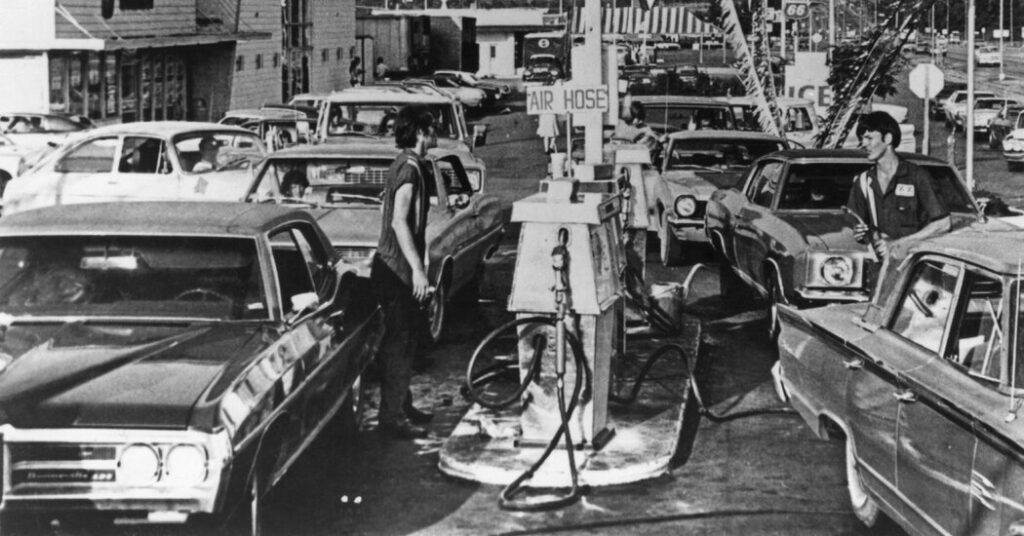
In January 1974, my dad lent me his old gas-guzzling Ford LTD to haul my clothing and books to college in Ithaca, N.Y. A couple of weeks later, when I tried to drive back home to Long Island, I realized that I couldn’t buy enough gas for the 250-mile trip.
The 1973-74 Arab oil embargo was well underway. The price of oil had nearly quadrupled; there were lines at gas stations, and drivers were allowed to queue up only on alternate days. I had picked the wrong day for my trip. No gas for me. So much for freedom of the road.
That was the first of the world’s big oil shocks. By the time of the second one in 1978-79, set off by the Iranian revolution, I was a reporter in New Jersey and it seemed I was constantly interviewing angry motorists stuck in interminable lines. Gas shortages and soaring inflation were just other aspects of life in the United States.
The gas lines ended as the crises ebbed, but it took two recessions, engineered by the formidable Federal Reserve chair Paul Volcker, to bring inflation under control.
What’s less well understood about that period is that the oil shocks reshaped the world’s financial markets. Money flowed around the globe in new ways — and cemented the status of the dollar as the world’s core currency.
We are experiencing what could end up as the third great oil shock. Already, Fatih Birol, the executive director of the International Energy Agency, has said the war in the Persian Gulf has caused the biggest interruption of oil supplies in history. It is creating gasoline shortages in Southeast Asia and raising prices around the world. But in the United States, which is now a net exporter of energy, what we’ve endured so far is minor compared with the big shocks of the 1970s.
A critical question is whether this will be a short-lived conflict or one that alters the underlying economic patterns of the world. No one can answer authoritatively now. But history helps us understand what we may be facing.
Shocks of the ’70s
Edward L. Morse, the deputy assistant secretary of state for energy policy in the Carter and Reagan administrations, recalled the 1973-74 oil shock as the biggest one, a totally unexpected event that freaked out everyone in the United States with gas lines and roaring inflation and that truly changed the world.
“That’s probably the most significant event in triggering a structural change in the nature of the international energy sector that I’ve experienced,” he said.
The 1978-79 shock was, in retrospect, a “continuation” of the first disruption, he said, extending inflation-inducing shifts in power and money from transnational corporations to oil-producing states. Because it involved Iran — the fall of the shah, a revolution, a hostage crisis and an abrupt shortfall in oil from the Gulf — it can be seen as a harbinger of the current war.
The two earlier oil shocks shifted the terms of world trade sharply against U.S. consumers, who had to pay much higher prices. Yet improbably, the crises left the United States at the fulcrum of world trade and finance. “The dollar ended up more important than ever,” Mr. Morse said.
During the 1973-74 shock, oil-producing countries that had banded together as the Organization of the Petroleum Exporting Countries, or OPEC, rose rapidly in power. That came at the expense of the multinational oil companies that had ruled the global oil universe for decades before 1973. Among their successors are Exxon Mobil, Chevron, Shell and BP, which remain formidable moneymakers but have lost control of global oil prices.
After the 1973-74 embargo, energy prices remained high. Consumers in countries like the United States were strapped, while the oil producers were rolling in wealth. A new term became popular: “petrodollars,” for the hoards of offshore dollars that oil states possessed.
What wasn’t obvious at the time was that much of this money would flow back to the United States and then be recycled throughout the world, particularly to emerging market countries through loans by major U.S. banks, especially Citibank. International Money Fund bailouts of emerging market countries in the 1980s were an outgrowth of the globalization of finance engendered by the oil embargo.
Oil and Gold
To understand what happened to world finance in 1973-74 requires going back a little further, to 1971. That was when President Richard M. Nixon overturned the global monetary system that had been in place since the end of World War II.
For decades, the dollar, the essential global currency, had been backed by gold. Oil transactions were priced in dollars, which could, in theory, be exchanged by a sovereign country for gold at a fixed rate of $35 an ounce. But on Aug. 15, Nixon shook up the world by taking the dollar off the gold standard. In successive moves, he devalued the dollar, reducing the real price that oil producers received for petroleum.
Naturally, oil producers hated this shift. Subsequent research showed that when you used gold as your standard of value, as the world had done until 1971, the price increases imposed by the OPEC countries in the 1970s merely held real oil prices steady. “Rather than raising the relative price of oil, OPEC countries were only ‘staying even’ by dramatically raising the dollar price of oil,” a study by two economists, David Hammes and Douglas Wills, points out.
Flush with dollars, in a remarkable transformation, the oil producers became pillars of the global financial system, which, even now, places the dollar at its center. Much as in past crises, the dollar has strengthened in value since the start of the current war.
The dollar’s remarkable resilience, despite the severe disruptions now caused by the United States, can’t be counted on forever. But, for the moment, it seems likely to continue, said Eswar S. Prasad, a Cornell economist and an authority on the dollar.
One reason is that the United States is now a net exporter of petroleum and isn’t hurt as much as other countries by the oil shortfall its war has created. The other, Mr. Prasad said, is that “despite all of the problems of the United States, the dollar has become even more dominant in the global financial system in recent years than it was before.”
Power Plays
Daniel Yergin, the vice chairman of S&P Global, is a historian of oil. His monumental book, “The Prize: The Epic Quest for Oil, Money and Power,” takes the story back to the 19th century.
In a video chat, he told me that the history of energy was also the history of power, in many dimensions — including financial power. “People focus only on the fact that the Gulf countries have exported oil and gas.” he said. “They also export capital.”
“Today they are huge players in the world financial system,” he continued. “Their sovereign wealth funds are really very significant forces.” They are among the most important investors in U.S. private equity funds, and in almost every major endeavor requiring major investments. This has made the global economy “much more entwined,” he said.
Disruption of the flow of energy in the Gulf will eventually disrupt the flow of money throughout the world financial system. For investors in public markets, this conflict couldn’t be more serious.
The United States under President Trump is betting big on fossil fuel. Even so, diversifying energy sources beyond fossil fuel is likely to be one lesson of this war, Mr. Yergin said. So is the amassing of even larger oil reserves. “Countries will want to have more on hand, for the next crisis,” he said.
It’s possible that the war will end soon and the recovery efforts will minimize long-term damage, said Ethan S. Harris, a former chief global economist of Bank of America who now writes a Substack newsletter.
“Duration is the key question,” he told me. “If this goes on for a long time, it’s a big deal. If the war stopped right now, we might not need to talk about it next year.”
Not every conflict in the Middle East necessarily changes global finance in profound ways. The United States fought two Gulf wars — one that started in the early 1990s, the other a decade later. The first was short. The second one, the U.S.-led war with Iraq, stretched from 2003 to 2011, caused scores of thousands of deaths and cost hundreds of billions of dollars. The second war was a big one, but in retrospect, it preserved the status quo in energy markets more than it transformed them.
In every Gulf conflict since the Iranian revolution, U.S. strategists have worried that Iran might one day disrupt the global flow of energy by closing a geographical choke point, the Strait of Hormuz. For the first time, despite the pounding it has received from enormous U.S. and Israeli bombardments, Iran has demonstrated that it can close the strait. Roughly a fifth of the world’s oil and natural gas usually flows through it.
Whether this desperate achievement alters geopolitics substantially may not be known for years.
In the meantime, let’s hope for a short war.
Jeff Sommer writes Strategies, a weekly column on markets, finance and the economy.
The post The Oil Shocks of the ’70s Changed the World. Will the Iran War Do the Same? appeared first on New York Times.