The Senate voted early Friday morning to fund much of the Department of Homeland Security, taking a step to reopen large parts of an agency that has been partially shut down for more than a month.
The vote came hours after President Donald Trump said that he was ordering officials to pay Transportation Security Administration officers even though Congress had not appropriated funds, claiming emergency powers to act during the congressional stalemate.
“Because the Democrats have recklessly created a true National Crisis, I am using my authorities under the Law to protect our Great Country, as I always will do!” Trump wrote on Truth Social on Thursday. “Therefore, I am going to sign an Order instructing the Secretary of Homeland Security, Markwayne Mullin, to immediately pay our TSA Agents in order to address this Emergency Situation.”
The White House did not immediately respond to questions about what legal authority Trump was employing for his order.
The Senate bill would fund TSA and the rest of DHS except for Immigration and Customs Enforcement and Border Patrol. The Senate passed it by voice vote with only a handful of senators in the chamber.
The House still needs to pass the bill before Trump can sign it into law. That could happen as early as Friday. But House Speaker Mike Johnson (R-Louisiana) did not commit Thursday to putting legislation on the House floor along the lines of what Senate Republicans were discussing at the time.
Democrats in Congress had refused to fund DHS until Republicans agreed to impose new restrictions on federal immigration agents after agents killed two U.S. citizens in Minneapolis in January, sparking widespread outrage. The standoff triggered a partial shutdown of DHS starting Feb. 14.
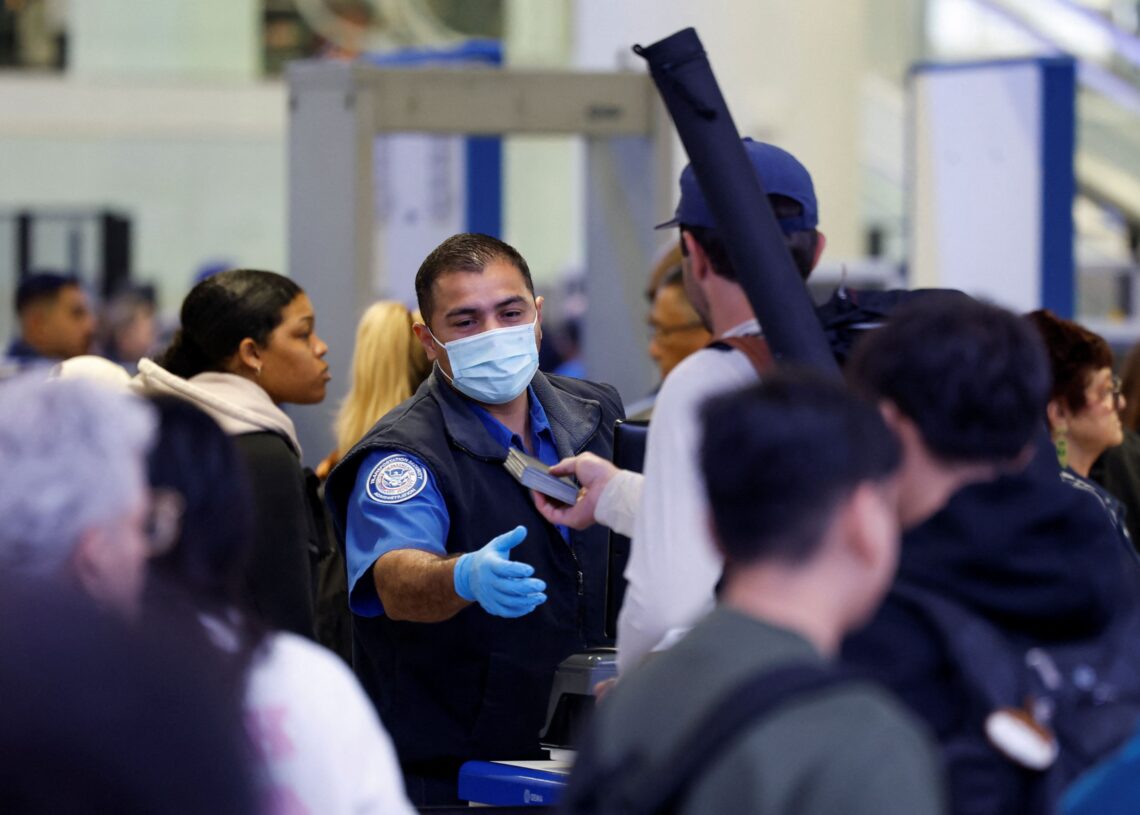
Lawmakers felt increasing pressure to strike a deal as TSA officers went unpaid and delays mounted at security checkpoints in airports across the country, largely because of staffing problems at TSA.
In the end, neither Republicans nor Democrats got what they wanted.
The bill the Senate passed is similar to legislation that Democrats tried to pass weeks ago that would have funded DHS except for ICE, Customs and Border Protection and the secretary’s office. Republicans blocked the bill several times because it did not fund the entirety of DHS.
“This could’ve been accomplished weeks ago if Republicans hadn’t stood in the way,” Senate Minority Leader Charles E. Schumer (D-New York) said on the Senate floor after the bill passed.
But Democrats secured none of the restrictions that they had been seeking, including some provisions that White House officials said they would accept if Democrats agreed to fund ICE, such as requiring federal agents to wear identification and body cameras and restricting them from operating near places such as hospitals and schools. Democrats also wanted to require agents to obtain judicial warrants before entering private property and to bar agents from wearing masks, among other demands.
“They got no reforms on DHS, which they could have had if they had been willing to work with us a little bit on that,” Senate Majority Leader John Thune (R-South Dakota) told reporters.
While the bill does not include funding for ICE or Border Patrol, it will not prevent them from operating because Republicans directed tens of millions of dollars in extra funding to those agencies last year.
Republicans plan to use the reconciliation process — which allows the Senate to pass legislation with a simple majority and avoid a filibuster as long it complies with obscure budget rules — to send even more funding to ICE, according to Sen. Lindsey Graham (R-South Carolina), the chairman of the Senate Budget Committee.
“What’s coming next is going to supercharge deportations,” Sen. Eric Schmitt (R-Missouri) said on the Senate floor.
The Senate passed the bill after a long day of negotiations. Thune outlined Trump’s plan to take unilateral action to Republican senators in a closed-door lunch on Thursday, according to four people familiar with his comments who spoke on the condition of anonymity to describe private conversations.
Sen. John Neely Kennedy (R-Louisiana) said that Senate Republicans were told at the lunch that the White House had decided to move forward with unilateral action, but that he later spoke with White House officials and was told that was not accurate.
He lamented the lack of a strategy.
“I think part of the problem that we have in the Senate Republican Conference is we’ve got a whole lot of chefs, and they apparently don’t know what they’re doing,” Kennedy told reporters.
Trump expressed ambivalence about Senate Republicans’ proposal to reopen DHS earlier this week, and he repeatedly looked for ways to strong-arm Democrats into folding. On Sunday, he wrote on social media that Republicans should not “make any deal” until Democrats support the voting bill known as the Save America Act, which Senate Democrats unanimously oppose. That same day, he ordered ICE agents to deploy to major airports to help manage security lines, but the effort has done little to alleviate delays.
“They need to end the shutdown immediately, or we’ll have to take some very drastic measures,” Trump said during a Cabinet meeting Thursday.
Trump also called Thune on Thursday morning to insist that he get rid of the Senate filibuster, the senator told reporters. Thune has repeatedly ruled out scrapping the filibuster rules, which set a 60-vote threshold to advance most legislation. Republicans control the Senate, 53-47, which forced them to secure the support of at least seven Democrats to pass legislation to reopen DHS.
Democrats have also pledged to use the filibuster to block the Save America Act, a voting bill that Trump has demanded the Senate pass. The bill would require Americans to prove their U.S. citizenship when they register to vote and to show photo identification to vote, among other provisions.
As he left the Capitol around 2:30 a.m., Schumer said Democrats would have more opportunities to fight for the restrictions on federal agents that they have spent weeks demanding.
But Thune suggested those negotiations are over.
“I think that ship has sailed,” Thune said. “They kind of kissed that opportunity goodbye.”
Kadia Goba contributed to this report.
The post Senate passes bill to reopen much of DHS after Trump moves to pay TSA officers appeared first on Washington Post.