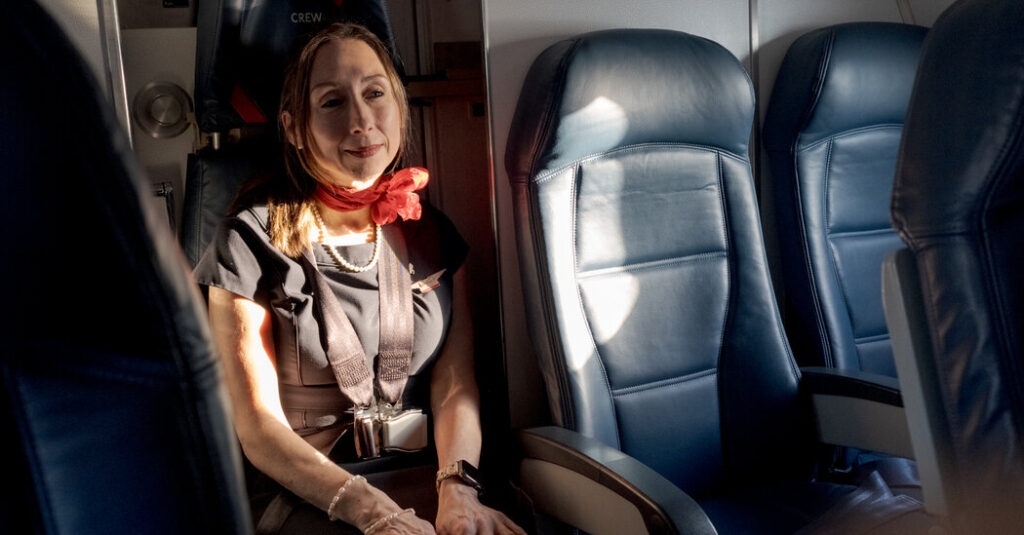
Somewhere over Pennsylvania, Kaela Berg was walking down the darkened aisle of a regional Delta flight carrying a trash bag. But between collecting dirty plastic cups and wrinkled bags of SunChips, the flight attendant turned congressional candidate was trying to process everything she had to do back on the ground.
Before takeoff, her campaign manager had mentioned the possibility of a fourth candidate entering her already crowded Democratic primary in the Minneapolis suburbs. Volunteers wanted talking points. And, as always, there were donors needing to be called. But her long political to-do list would have to wait until she had secured the cabin for landing, with seatbacks and tray tables in their upright positions, and helped the passengers safely disembark.
Ms. Berg, a Minnesota state representative who works as a flight attendant, is trying to jet her way from the galley to the gilded halls of the Capitol.
She is part of a new crop of working-class candidates with atypical backgrounds who Democrats hope can help the party win back blue-collar voters, a key constituency that has been slipping away from them for more than a decade.
“If you look at Congress, there are people there that are independently wealthy,” said Ms. Berg, 52, who earns about $45 an hour as flight attendant. “Some of them are multimillionaires. They’ve been there forever. They haven’t had to worry about a paycheck in decades. But they’re making decisions about people and their lives without a clear understanding of it.”
When Democrats won control of the House in the 2018 midterms during the first Trump administration, they drove a message of diversity, running a record number of women, people of color and L.B.G.T.Q. candidates. This year, in an election where the biggest political buzzwords are authenticity and affordability, many Democrats are campaigning on promises to help voters make ends meet. They hope that candidates like Ms. Berg can convince voters they understand not only their immediate cost-of-living concerns but also the broader anxieties that a middle-class lifestyle has become unachievable for many Americans.
Representative Jason Crow of Colorado, a former Army Ranger who is helping to oversee candidate recruitment for the Democratic Congressional Campaign Committee, said that many voters were angry about a system they felt was failing them. “They want real people,” he said, “who have done real things with their life.”
But balancing work, life and modern campaigning is not easy. For Ms. Berg and her team, scheduling can be particularly unpredictable, subject to not only the weather but also crew availability and the whims of traffic controllers and airport operators .
It was 9 a.m. on a cold January morning in Minneapolis, but before Ms. Berg could grab her black roller bag and head out on a five-day, 15-flight tour, she had one more task to complete. She took a moment and filmed a video thanking Her Bold Move, a progressive political action committee, for its endorsement.
Then she changed into her gray dress, slipped on the black heels that she is required to wear in the concourse, tied a jaunty red scarf around her neck and headed to Minneapolis-St. Paul International Airport.
Ms. Berg has been flying for 30 years. When her sons were young, she would fly about 15 days a month and be home with them the rest of the time. She became active in her union — the Association of Flight Attendants-CWA — campaigning for better wages and learning to lobby lawmakers and organize. In 2016, she was a delegate to the Democratic National Convention for Senator Bernie Sanders of Vermont. And in 2020, she was elected to the Minnesota House of Representatives.
Ms. Berg, who never graduated from college, attributed her political success to her involvement in her union.
“Every opportunity I have ever had and where I am today is because of being in a union,” she said.
Ms. Berg isn’t the only Democratic candidate to come to politics through her work with unions. Sam Forstag, a smokejumper and union leader, is running for the House in a red district in Montana. And Bob Brooks, a retired Bethlehem, Pa., firefighter and union president, is running in a Pennsylvania district seen as one of the most competitive in the country.
“To bring this party back, they have to start running everyday people,” Mr. Brooks said, “or it’s going to continue to be lost and we’ll continue to lose.”
The sun was setting over Westchester County Airport and Ms. Berg, who was starting the next leg of her journey, was demonstrating how to use the seatbelt and oxygen mask for the economy cabin with a polite smile.
During her layover in Westchester, N.Y., Ms. Berg had received an update from a campaign volunteer on calls to local delegates of the Democratic-Farmer-Labor Party, Minnesota’s version of the Democratic Party. The party’s coveted endorsement, which it will announce at its state convention in May, still carries sway in crowded primaries like Ms. Berg’s contest.
She faces multiple opponents in the Aug. 11 primary, including Matt Klein, a physician and state senator, and Matt Little, a former mayor and state senator. They are vying for the chance to replace Representative Angie Craig, who is running for the U.S. Senate.
Ms. Berg believes her experience living paycheck to paycheck — like many voters in her district, she says — would make her the strongest candidate for the party in a general election.
She recounted running for her statehouse seat while living in a friend’s basement during the Covid pandemic. Her income from flying alone, Ms. Berg said, wasn’t enough to qualify for a lease in the district.
She continued flying after entering the state Legislature, taking a leave from Endeavor Air, a Delta subsidiary of regional flights, for the roughly four months when the Statehouse is in session. She increases her days during the remainder of the year to pay her bills, including the rent for her cozy one-bedroom apartment in a suburban housing complex.
Ms. Berg was supposed to fly from Detroit to Birmingham, Ala., where she should have ended her day at what she considered the relatively reasonable time of 9:30 p.m. But with much of the country still recovering from a winter storm, she was placed on a plane that was headed instead to New York City and then to Syracuse, N.Y. — and a much later night.
As she walked through the aisles of the plane, Ms. Berg offered extra cups of water to passengers who were worried about missing their connections. But her thoughts kept turning to shocking events on the ground.
Just before takeoff, her group chat of state lawmakers had exploded with confusing messages about their personal safety. Once the plane was in the air, a fellow flight attendant showed her a news report explaining what was going on: Representative Ilhan Omar, a Minnesota lawmaker, had been attacked at a town-hall meeting in Minneapolis. (A man was later charged with assault for using a syringe to squirt vinegar onto her.)
The detour to Syracuse made it hard to keep up with what was going on back home. But it would mean a bigger paycheck.
Like many flight attendants, Ms. Berg is only paid for the hours she is in the air. Her finances get tighter during campaign years, when it’s harder to find the time to take extra shifts. If she wins a seat in Congress, she’ll retire from flying entirely.
Early in Ms. Berg’s campaign, Representative Betty McCollum, Democrat of Minnesota, gathered some of the candidates for the seat to explain the various costs and practicalities of being a member of Congress.
The congressional salary of $174,000 would be the most money Ms. Berg has ever made, she says. Still, she isn’t quite sure how she’ll afford to maintain the two residences — one in Washington and one in her district — that the job typically demands.
“I was like, ‘Wow, I have never had a paycheck that big’ — which is not why I ran,” she recalled. “And then, it was like, ‘Oh, that sure dwindles fast.’ Good thing I’m used to it.”
Sixteen hours after she left her apartment in Minnesota, and after flying nearly 2,250 miles, Ms. Berg made her way from the small Syracuse terminal to an Embassy Suites hotel. It was around 3 a.m.
By the next morning, she was back at work on her campaign. From her hotel room, Ms. Berg held a morning meeting with her staff over video call and then ran through calls to potential delegates to the convention.
Then it was back to the airport for another long day of safety demonstrations, luggage checks and drink service.
“This is what I have to do,” she said. “There are plenty of people that are in Congress, that will stay in Congress, that can relate and advocate for people of an upper income level. There’s not a lot that can truly say, ‘I’ve lived this.’”
Audio produced by Adrienne Hurst.
Lisa Lerer is a national political reporter for The Times, based in New York. She has covered American politics for nearly two decades.
The post Running for Congress at 30,000 Feet: A Flight Attendant’s Campaign Trail appeared first on New York Times.