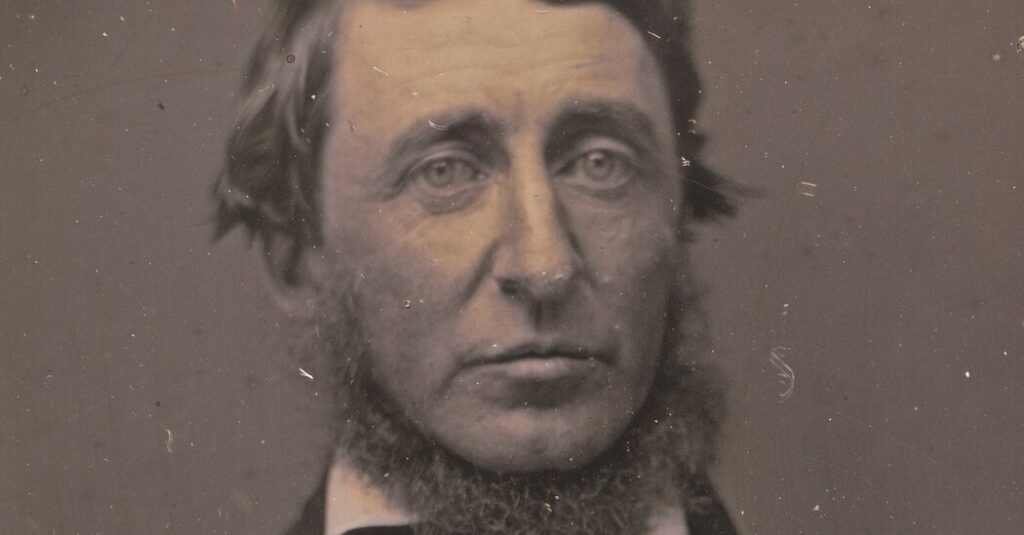
Jeff Goldblum was in the recording studio, voicing the title character for the new PBS documentary “Henry David Thoreau,” when something unsettling happened. The script called for him to utter the great man’s name for the first time. Naturally, he said it in the usual way: “Thu-RO.”
Uh, no. “Let’s do that again,” one of the directors said.
That was when Goldblum learned that, like everyone else, he had been mispronouncing the name of the author of “Walden” and “Civil Disobedience” his whole life. It turns out that the accent does not belong on the second syllable, as in “merlot” or “Poirot.” It rests on the first syllable, like “thorough” — as in, “I am thoroughly confused by this strange turn of events.”
Ruh-roh! Or, actually “THU-ro.”
This front-loaded pronunciation has apparently always been there, hiding in plain sight in the halls of academe, even if no one told us about it. “There is a consensus that “THU-ro” is the correct way to pronounce it,” John J. Kucich, co-president of the nonprofit Thoreau Alliance, said in an interview. “But somehow “Thu-RO” — here Kucich uttered the word the common way — “got into the culture, and it’s in the water to pronounce it that way.”
The three-episode documentary, which premieres on March 30, was produced by Ken Burns and the Eagles musician Don Henley, a lifelong Thoreau-phile and the chairman of the Walden Woods Project. The film focuses not just on Thoreau’s two years at Walden Pond — the famous “I went to the woods because I wished to live deliberately” part of his life — but also on his significance as a canonical figure in American cultural and philosophical history, through his writing and engagement with urgent issues like industrialization, war, slavery, the environment and the individual’s relation to the state.
The film’s directors, the brothers Erik Ewers and Christopher Loren Ewers, were just as surprised as anyone to learn — upon hearing an expert pronounce Thoreau’s surname in their presence — that despite growing up in Massachusetts, they, too, did not know the right way to say it.
It was a bit of a shock, like falling into an alternative reality. Though they had made a short film for the Walden Woods Project several years earlier, they said, the issue had never once come up. “It really wasn’t part of the discussion,” Christopher said.
Then came the new documentary, where the scholars they consulted had strong views about the subject. “Here we were headfirst into a world where people were saying ‘THU-ro,’” Erik said.
Faced with this disturbing new information, they had to impart it in turn to the actors they’d hired for the documentary, including Goldblum; George Clooney, the narrator; and Meryl Streep, who provides the voice for several women in the film.
Being actors, they took the direction. “It was a hotly debated thing, and it came to a head with Meryl Streep,” Erik said. “She said ‘Henry David Thu-RO,’ and we said, ‘The correct pronunciation is ‘THU-ro.’ And she said, ‘Are you going to explain it in the film?,’ and we said, ‘No.’”
He added: “Same with George Clooney. He was like, ‘OK, THU-ro,’ though he slipped a few times.”
How the two dueling pronunciations — the correct one, and the one all of us have always used — came to coexist is the result of an odd confluence of historical events dating back several hundred years.
Thoreau got his name from his grandfather Jean Thoreau, a French Huguenot who was shipwrecked off the coast of New England just before the American Revolution and decided to stay put, settling in Boston and then Concord, Mass. Jean’s surname was duly New England-ified by his neighbors, said Laura Dassow Walls, a professor emerita at the University of Notre Dame and the author of “Henry David Thoreau: A Life.”
“People aren’t used to seeing that name; it’s not a New England name, and they pronounced it THU-ro” she said in an interview. So did the man himself, judging from ample contemporary evidence.
For instance, there’s an 1860 journal entry from Thoreau’s neighbor Bronson Alcott, the father of Louisa May Alcott. “Comes Thoreau and sups with us,” Alcott wrote. “He is rightly named Thorough … the pervading Thor, the sturdy sensibility and force in things.”
And in a 1918 letter from Edward Emerson, son of Thoreau’s friend Ralph Waldo Emerson: “We always called my friend Thórow, the h sounded, and accent on the first syllable,” he wrote.
When Thoreau died, in 1862, his preferred pronunciation reigned supreme, Walls said. But matters were complicated by a surge of foreign interest in his writing in the late 19th and early 20th centuries. This was spurred in part by the attention of a British socialist named Henry Salt, who became a devoted Thoreauvian — firing his staff, selling his property, moving to a small country cottage, giving up meat, and throwing himself into social justice causes — after discovering Thoreau’s essays.
The foreign attention sparked a renewal of interest back in the United States, creating a (false, as it turned out) assumption among new audiences about how to pronounce his name, based on the spelling.
“This is happening through print culture, so people are seeing the name rather than hearing it,” Walls said. “When you see that -eau ending in English, you want to emphasize it — and so people assumed it was pronounced Thu-RO.”
We are not the first generation to grapple with this thorny issue. John McPhee addressed it in a 2003 New Yorker piece. Despite Thoreau’s own declaration that “he who can pronounce my name aright . . . is entitled to my love and service,” McPhee reported, not everyone in his hometown in Concord, Mass., was pronouncing it aright, 150 years later. “Thu-RO,” shouted a resident of Thoreau Street, when McPhee asked her how to say her street name. (Scholars say that if you wander around Concord now, you will still find people saying it the original way.)
The matter arose again in the 2017 documentary “Henry David Thoreau: Surveyor of the Soul.” “Here in Concord, we say THU-ro, like ‘furrow,’ but most people say ‘Thu-RO,’” J. Walter Brain, a Concord landscape architect, and Thoreau scholar, explains in the film. (Both pronunciations are actually technically incorrect, at least from the French perspective, he adds; the proper French pronunciation would be “tu-row,” with the “th” pronounced as a hard T and an accent on neither syllable.)
But here we are now, confronting news akin to learning that our first president was called George Washing-TONE or that Marcel Marceau pronounced his last name (to the extent he pronounced anything) “MAR-so.”
Thoreauvians know that this is hard for us. Their response often takes the form of a kind of nimble code-switching — using one pronunciation when speaking to general audiences, and another when speaking to scholars.
“I think it depends on where your first loyalty lies,” said Kristen Case, whose writings on Thoreau include, most recently, “Henry David Thoreau’s Kalendar: Charts and Observations of Natural Phenomena.” She has opted to take the road less traveled, at least by academics. “I put my stock in the regular way,” she said — “Thoreau” like a layperson would say it.
Hearing people say “THU-ro” reminds her, she said, of the scene in the film “Manhattan” when Diane Keaton loftily pronounces Van Gogh not “Van Go,” the way most English speakers say it, but the Dutch way — “Van Gough,” as in “cough,” but more phlegmy.
The issue also arises when English speakers drop the name of a foreign city into their conversations. Do you say you are going to Florence, or to Firenze? What about the classic Barcelona conundrum — to use, or not to use, a “th” sound in place of the “c” as a way to show off your cursory command of one form of Spanish pronunciation?
And if you find yourself in a theater courtesy of Samuel Beckett, who would you rather wait for — God-OH, or GOD-oh?
“How to pronounce words that are derived from another country — it can sound quite pretentious,” Goldblum said. “But it depends on who’s using or misusing it.” He used as an example his wife, a Frenchwoman who is eager to pass her language on to their children, even in the midst of an English sentence. “Whenever she comes upon a word like ‘genre’ or ‘chaise longue’ she pronounces it in her native way,” he said.
If you watch the new documentary, you will hear “Thoreau” pronounced both ways, even though the Ewers brothers established “THU-ro” as the house style, so to speak. No one is being sent to pronunciation prison over this issue.
“The purpose of the film is to celebrate the man and his experiences and his contributions,” Erik Ewers said. “The point is the relevance of Thoreau” — here he fudged it a bit — “of Henry, and what he’s able to enlighten us about, 150 years later.”
Sarah Lyall is a writer at large for The Times, writing news, features and analysis across a wide range of sections.
The post Rethinking Thoreau: We’ve Been Mispronouncing His Name for Centuries appeared first on New York Times.