Alexander Wooley, a former British Royal Navy officer, is a director of the research lab AidData at William & Mary. He is the author of “Battleship Yamato: The Ship, The Myth, The Legend,” forthcoming in August.
President Donald Trump may get his wish of a reopened Strait of Hormuz, but that doesn’t mean the waterway will be safe for transit. The reason: It’s likely lined with mines that take ages to clear.
Consider the best historical analogue, the Suez Canal, circa 1974. For seven years, Egypt had closed the passage owing to wars with Israel, trapping at least 14 ships and impairing the global flow of oil. Once Egyptian President Anwar Sadat agreed to reopen it, the physical project took a year and an international fleet of minesweeping ships, helicopters and explosive ordnance divers led by the U.S. The moment finally came in June 1975, when Sadat cut a thin chain across the waterway’s entry. He called it “the happiest day in my life.”
Trump is looking for such a day with limited success. Last week he gave the Iranians 48 hours to “FULLY OPEN” the strait “WITHOUT THREAT” or else have their power plants obliterated. The regime replied by threatening to lay “various types of naval mines” throughout the Persian Gulf. U.S. intelligence officials reportedly suspect there are at least a dozen Maham 3 and Maham 7 limpet mines under the Strait of Hormuz.
The president has now given Iran until April 6 to open the strait, but it’ll take longer still. Doing so without sweeping would be dangerous. Shipping companies will doubtless want reassurance that the job is complete before running their tankers through the passage. Getting holed below the waterline presents a greater possibility of sinking than getting hit by a drone or missile does. Not to mention the potential environmental catastrophe.
Sea mines had gotten used to being overlooked. While increasingly high-tech and deadly, they are uncool and unsexy, unlikely to feature in a White House war-porn sizzle reel. They are small, silent, sitting on or tethered to the seabed, where they wait, about as active as a sea urchin. They are usually autonomous, leave-and-forget, indiscriminate weapons. Less shock and awe, more sloth and yawn.
Like their land equivalent, sea mines linger long after conflicts conclude. More than 80 years later, unexploded German sea mines from two world wars regularly wash ashore in Britain. Others are caught by fishermen’s nets. I remember one instance aboard a minesweeper in the Irish Sea when we sent divers to locate a dummy mine only for them to resurface saying they’d discovered the exercise mine and an unexploded German one.
After World War II, a ragtag group of Japanese seamen and small naval vessels spent years clearing the country’s coastline. Many were killed in the process, while survivors felt abandoned by their deposed imperial government and the U.S. occupation force, which offered little assistance. It is a well-known episode in Japan, and features as subtle, pointed commentary in the Oscar-winning “Godzilla Minus One,” in which a group of sailors tries to defeat the monster by rolling mines into its mouth.
The weapon has always been an unpleasant surprise, but it has been around for years, possibly first deployed by the Chinese more than six centuries ago and later by the Europeans in the 16th century.
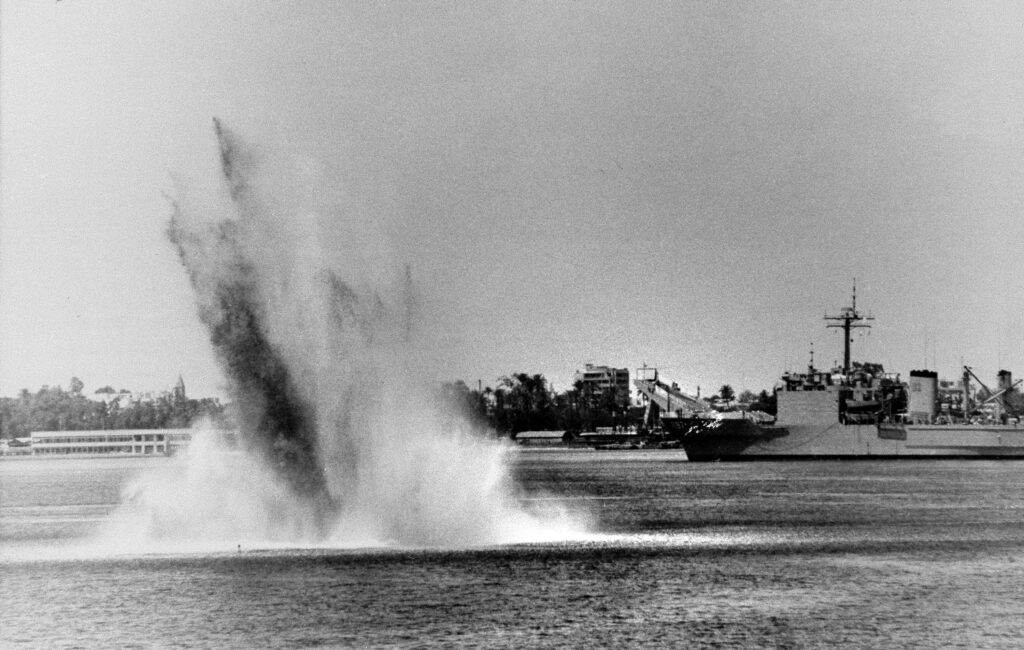
Militaries use mines because they’re asymmetrical. Scatter a hundred across the Strait of Hormuz, and neither the USS Gerald R. Ford aircraft carrier nor a giant LNG tanker will likely chance to come close. Even bluffing or simulating mine-laying can be enough to instill fear or caution and draw inordinate resources from an enemy. Ships may try to run through, but it would an enormous risk. Aircraft carriers and guided-missile destroyers are helpless in the face of them. Historically, vessels that go to the assistance of a mined ship frequently end up damaged or sunk too.
For decades, clearing the weapon was blue-collar work, one part “Hurt Locker,” another part “Deadliest Catch.” Today it is done by ships with specialized, sophisticated remotely operated systems that detect, locate, classify and neutralize mines. In an era of hyperactive geopolitics, the work is slow and tedious. Seawater is notoriously difficult to see through, making it hard to find a small object sometimes buried into the seabed like a flounder.
If mines are unsexy, so are the means to counter them. Naval officers don’t become admirals by spending their careers in minesweepers. Mine warfare is an orphan, receiving the floor sweepings of defense budgets. This may soon come to haunt governments and shipping companies, which depend on the flow of oil, gas and commodities.
If you are a defense contractor building something for today’s Navy, it’s important your weapons system has a “U” in its acronym. UUVs, USVs, UAS, MUM-T, XLUUV — future conflicts will feature unmanned, or uncrewed, platforms in the air, on the ocean’s surface and underwater.
But many of these new capabilities can also claim another “U” — unproven, at least in combat. The Iran war has caught the United States and NATO navies at a bad time, short on ships and transitioning from old technologies to new. The longtime guarantors of freedom of navigation have made valiant efforts but appear overstretched, ready to snap. All this, moreover, against so-called second- and third-rate enemies.
During World War II, the U.S. Navy built hundreds of minesweepers. It’s now down to a handful. The service has retired most of its Avenger-class conventional ships, some of which were deployed to the Persian Gulf before their decommissioning last year. Four remain stationed in Japan.
In their stead for the Mideast are untested platforms and technologies. After years of delays, the Pentagon managed to equip Freedom and Independence-class littoral combat ships with mine countermeasure capabilities — unmanned air, surface and undersea vehicles that can detect and destroy naval mines at a distance. As I and many others have written, to date the LCS have been disastrous. The ships combine a lack of weaponry of the sort a frigate or destroyer would have with serious defensive vulnerabilities, structural defects and routine and embarrassing mechanical breakdowns. The Navy has even admitted the ship would be overmatched against a peer competitor like China, noting that it “does not provide the lethality or survivability needed in a high-end fight.”
The U.S. operates three LCS with countermeasure packages in the Mideast, intended to replace the retired Avenger-class. Except those ships seem to have been heading in the opposite direction. As the defense news outlet the War Zone recently reported, two of the three assigned to the Middle East aren’t in the region — as of March 18, they were in Singapore, after having first stopped in Malaysia, apparently for routine maintenance. The third was reportedly the Indian Ocean. The upshot: Until the U.S. recruits minesweeping assets from elsewhere, it won’t have a lot of options in the Gulf.
In some ways, then, Trump was right to demand that the Europeans clear the strait. During the Cold War, mine clearance was considered too dull and unglamorous for the Americans. It thus fell to the Europeans, who built sizable fleets and expertise. The Belgians, Dutch, French and British continued to push minesweeping technologies and experimentation into the 1990s, even as their fleets contracted.
Yet their capabilities have mostly mirrored those of the U.S. in recent years. In late 2025, the British Royal Navy decided to stop its permanent deployment in the Persian Gulf, a mission it had carried out for decades, and abandoned its last standing frigate in the region to rot in Bahrain. It also recently sent home its last remaining minehunter in the region.
This month London indicated it has aerial minesweeping drones, also untested in combat, and is considering deploying them to the strait. British officials have also met with counterparts from France, Germany, Italy, Japan, Canada and the Netherlands to discuss re-opening the strait.
Meanwhile, potential adversaries like China, Russia and North Korea can learn much from U.S. and allied unpreparedness for mine warfare. The West has tipped its hand about a vulnerability in its otherwise impressive and comprehensive war-making ability. In the future, enemies could lay defensive minefields to protect themselves or weaponize a key chokepoint — say, the approaches to either end of the Panama Canal. They could lay offensive barrages around Taiwan as a precursor to an invasion or install offensive fields around Guam, Pearl Harbor or a U.S. base in Japan at Yokosuka or Sasebo.
The Iranians appear to have done so to great effect. The Strait of Hormuz has become a political, diplomatic and economic minefield. Trump is keen to bluster through it. He’ll find that even once it’s open for business, merchant ships will tiptoe — until someone comes along to clean up the mess.
The post Opening the Strait of Hormuz is the easy part appeared first on Washington Post.