DUBAI — The World Food Program says 10,000 tons of food meant for hundreds of thousands of children in Afghanistan has yet to arrive. The World Health Organization has been held up in sending a $6 million shipment of medicine to Gaza. And Save the Children warns that 90 primary health care facilities in Sudan could be left without essential supplies.
As the war in the Middle East hits the one-month mark, it has upended the global economy and caused an acute energy crisis. It has also wrought mayhem in the already battered humanitarian aid sector, which supports hundreds of millions of the world’s most vulnerable people.
That global aid system depends on the United Arab Emirates, especially Dubai, as a massive government-backed humanitarian hub — a logistical linchpin that is home to a sprawling tax-free port and, under normal circumstances, one of the world’s busiest airports.
Now, Dubai’s location on the Persian Gulf has become a vulnerability, as the UAE has borne the bruntof Iran’s retaliatory strikes. Iranian drones and missiles have hit key infrastructure, including at the port and airport, and the Strait of Hormuz, the narrow waterway through which most of the goods from Dubai transit, remains mostly closed.
The result has been havoc in the aid sector, which was decimated by funding cuts from the United States and Europe last year and is now straining to meet demand that grows with each additional day of war.
“It’s like a storm closing in on us, and every week brings a new cloud,” said John Aylieff, WFP’s country director in Afghanistan. “The latest big, dark cloud is the Iran crisis.”
With typical supply chains shattered, logisticians are going back to the drawing board when it comes to route planning. And suddenly there is recognition that despite the many benefits of Dubai’s location, it could also “prove to be its Achilles’ heel,” said Sam Vigersky, an international affairs fellow at the Council on Foreign Relations who has written about the war’s impact on aid.
There are currently 70,000 tons of food delayed on cargo ships, said WFP’s director of supply chain, Corinne Fleischer, who is helping devise new routes to avoid closures and backlogs. If the war continues until June, Fleischer said, WFP estimates that 45 million more people globally will face acute hunger — up from 318 million now.
Already, WFP has rerouted 10 vessels containing food intended for Ethiopia, Sudan and South Sudan from their regular route through the Bab el-Mandeb Strait, which connects the Red Sea with the Gulf of Aden and where traffic has slowed to a crawl because of fear the Houthis will strike. Instead, the boats are sailing around the Cape of Good Hope, which takes 25 percent longer and is 40 percent more expensive.
“We are very, very concerned about all of our large operations,” she said. “These are people who do not have a buffer.”
Even before the war, there was anxiety about the impact that funding cuts would have across the Horn of Africa in countries that are at risk of experiencing famine, including Somalia, but also South Sudan, Sudan and parts of Kenya, said Murithi Mutiga, the Africa program director at the International Crisis Group. The logistical obstacles posed by the war have now compounded that stress.
“It’s worrisome,” Mutiga said, “and it potentially could end up being catastrophic.”
In Afghanistan, WFP used to bring some of its food overland from neighboring Pakistan. But as tensions between Afghanistan and Pakistan began escalating, WFP in October started sending food via Iran. That, however, became impossible once U.S. and Israeli military strikes began Feb. 28.
Now, WFP’s office has thousands of tons of high-density nutritious food intended for children sitting in warehouses in Dubai and Pakistan. Those supplies, Aylieff said, “would save the lives of 600,000 children for two months if I had them.”
WFP is driving some of the food on trucks from Dubai, transiting through seven countries — Saudi Arabia, Jordan, Syria, Turkey, Georgia and Azerbaijan, across the Caspian Sea by ferry, and then through Turkmenistan — to get the food to nutrition centers in Afghanistan. Even before the war, those centers were only able to feed 1 out of every 4 children that are acutely malnourished, Aylieff said. Until that food arrives, Aylieff said, they will be down to zero.
“I have never been more worried about a situation in my 32-year career with WFP than I am now, because this is unprecedented in terms of the layered sort of problems that are hitting the population at the same time,” he said. “We simply don’t have the means to respond.”
Aylieff said more than 2,000 nutrition centers in Afghanistan are already running out of food from WFP.
“Imagine the mother that carries her malnourished child in her arms for four to five hours to the nearest clinic, and they show up with the child,” he said. “The child is listless and weak, emaciated, and the mother is told, ‘sorry … we don’t have food to help treat your child.’ It is absolutely heartbreaking for us, but tragic for them, even on an exponential scale.”
Marc Schakal, the head of Doctors Without Borders’ Middle East programs, said that he is trying to figure out how to get 110 tons of food and medicine stuck at Dubai’s port, which normally would have transited through the Strait of Hormuz to Yemen. Now, he’s looking at other ports and overland routes to get the supplies to the conflict-ridden country.
Insurance costs across the region have shot up, making all transport more expensive than before. Airspace closures are routine. And aid agencies know that time is running out.
The season in which rates of malnutrition and measles shoot up is approaching, Schakal said, and already Doctors Without Borders is seeing an increased number of children in their clinics.
“For medicine, we can try to find local alternatives, but we would not be able to guarantee their quality,” Schakal said. “For food, there are no alternatives. Without food, malnourished children suffering from a lack of food would die.”
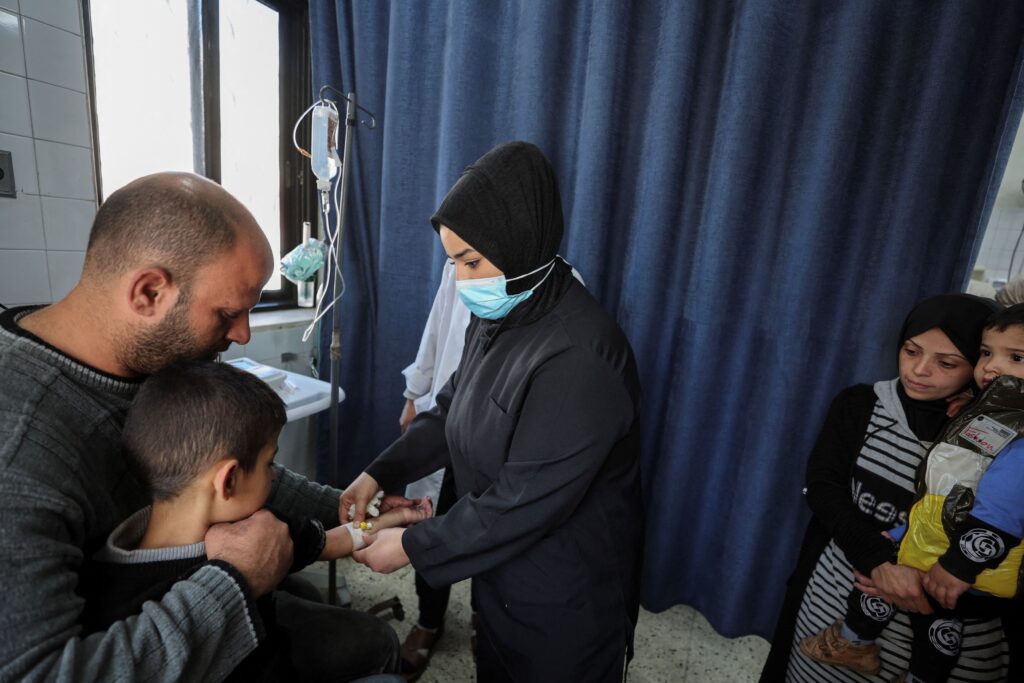
For the WHO, which typically sends about 500 shipments of medicine and emergency medical kits annually from Dubai, operations have dramatically slowed, said Paul Molinaro, its chief of operations support and logistics.
So far, the WHO’s suppliers have not reported shortages, Molinaro said, but that risk looms.
Experience has shown that needs will only rise. When heavy weaponry is used in wars worldwide, he said the requests from countries in conflict tend to be the same: for blood and blood plasma, for treatment of broken bones and burns.
The challenge now, he said, will be getting any of these supplies and services to where they are needed.
In Lebanon, an Israeli military offensive that the government says is intended to eliminate Hezbollah has killed more than 1,000 people and displaced more than 1 million. It has also disrupted supply chains, fueling a surge in prices. Nora Ingdal, Save the Children’s country director for Lebanon, said that price increases on dietary staples occur daily.
“Nutritious food — fruits, vegetables — it will run out,” she said. “We don’t know when, but it is a massive issue here.”
Even far from the Middle East, the war’s impact is felt.
In Somalia, where 2 million children are at risk of acute malnutrition, UNICEF says it is already seeing a rise in transport costs of food, medicine, fuel and water. In some areas, said Christopher Tidey, a spokesman for UNICEF, the cost of water “has more than doubled.”
“This is the exact kind of extremely fragile situation that could be disproportionately affected by what is happening in the Middle East,” Tidey said.
Experts predict that the shortages of fertilizer — much of which is produced in the Persian Gulf — will hit especially hard in countries that are reliant on subsistence farming.
The effect is starting to be seen in war-torn Sudan, where fuel prices are going up, according to Mercy Corps, an American aid organization.
Sudan gets about 50 percent of its fertilizer from Gulf countries. Summer planting season begins in June.
Grace Wairima, Africa communications manager at Mercy Corps, said if fertilizer doesn’t arrive, the next harvest will be threatened. That would mean escalating levels of hunger in a country where half the population is already undernourished.
“We cannot afford any other shock now, because we are already in a catastrophic situation,” she said. “It cannot get worse than this.”
The post Iran’s attacks on Gulf neighbors cut off food and medicine for millions appeared first on Washington Post.