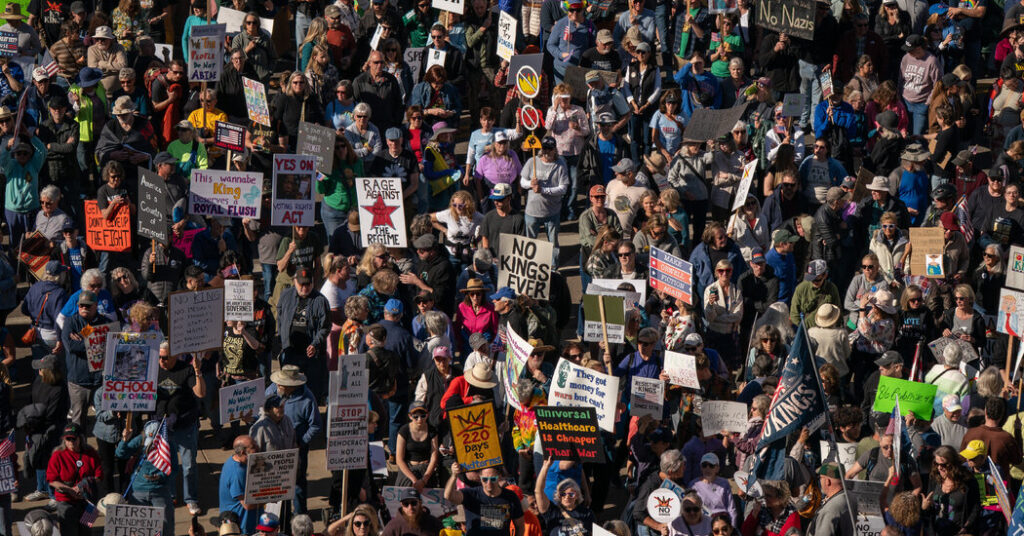
In the Twin Cities, thousands of people converged on the State Capitol, invoking the memories of Renee Good and Alex Pretti. Hundreds swarmed intersections around Portland, Ore., motivated by what one protester called a “national crisis” that has “escalated to a whole other level.” In Little Rock, Ark., where more than 2,000 people marched across the Arkansas River, one woman carried her own MAGA sign: “Morons Are Governing America.”
Protesters filled streets and town squares across the United States on Saturday at thousands of rallies, the third in a sequence of nationwide, loosely coordinated demonstrations under the banner of “No Kings.” They came to denounce President Trump and much of his second-term agenda, wielding signs and chants about issues including mass deportation, restrictions on voting, attacks on diversity and two matters that have suddenly moved to the fore: the war in Iran and the soaring gas prices that have resulted.
“Prices are going up, and it feels like we can’t even afford to live anymore,” said John Moes, a resident of Minneapolis who was dressed in a 15-foot puppetlike costume resembling the singer Prince, a local icon.
“This is one of the ways we can say we’re fed up,” said Mr. Moes, who described himself as an independent who leans Democratic.
The marches and demonstrations stretched across the country, from above the Arctic Circle (Kotzebue, Alaska: population 3,000) to the tropics, with Puerto Rico holding multiple events. There were also 39 international No Kings rallies, according to organizers.
The Twin Cities were a focal point of the day’s protests after tumultuous months of an immigration crackdown that included the killing of two protesters, Ms. Good and Mr. Pretti, by federal agents. On a windy and cold day, protesters marched in orderly waves toward the Capitol in St. Paul, flying Minnesota state and American flags, chanting and singing.
The nationwide marches under mostly bright skies came amid an unpopular war in Iran, months of fury by progressives over sweeping federal immigration enforcement raids, falling stock markets and sustained frustration over the cost of living, especially rising gasoline prices.
They also came as lawmakers on Capitol Hill remain at loggerheads in a protracted fight over funding for immigration enforcement by the Department of Homeland Security. The resulting partial government shutdown has led to hourslong waits at the security checkpoints of some airports after many unpaid security agents stopped showing up for work. On Thursday, Mr. Trump announced he would pay them through another funding source.
A Reuters/Ipsos poll published Tuesday found Mr. Trump’s approval rating had fallen to 36 percent, the lowest point since he returned to the White House. Just 35 percent of respondents approved of the U.S. strikes on Iran, the poll found.
Valerie Tirado, the mother of a Marine who is headed to Middle East, marched in Brooklyn on Saturday with a sign that said “Bring My Son Home.”
“Trump is using these military men as pawns, just to flex,” said Ms. Tirado, 60.
With the midterm elections seven months away, the protests are being scrutinized as a barometer of possible political shifts. Though the protesters were largely Democrats, dozens more No Kings events were held in Republican-dominated or battleground states on Saturday than during the last marches in October, according to the organizers. But overall the shift was marginal: Forty-nine percent of events were held in red or battleground states on Saturday, compared with 48 percent in October, according to data provided by the organizers.
Protests took place in deeply Republican enclaves such as Shelbyville, Ky., and Midland, Texas.
One twilight march was to traverse the district where on Tuesday, Emily Gregory, a Democrat, beat her Republican rival, Mike Caruso, in a special election for a seat in the Florida House of Representatives.
The district, which includes Mr. Trump’s Mar-a-Lago residence in Palm Beach, had been won by the Republican candidate by 19 percentage points in 2024. The march was to head toward Mar-a-Lago, following a route that included the newly named President Donald J. Trump Boulevard.
The White House has reacted to No Kings rallies with mockery. On Thursday, a spokeswoman for the White House, Abigail Jackson, said in a statement that “the only people who care about these Trump derangement therapy sessions are the reporters who are paid to cover them.”
At a time when conservative control of Washington remains complete, in the White House, Congress and the Supreme Court, the marches were a chance for Democrats to make their voices heard and to try to portray Republican domination as teetering.
At a small protest in Richmond, Ky., Missy Manet, 29, donned a red yarn hat and said she had attended the gathering as a show of frustration with the direction of the country.
“I feel somewhat powerless,” she said of being a Democratic voter in a staunchly Republican part of the country. “I feel like my vote doesn’t do a lot most of the times.”
The marches had no shortage of skeptics.
In Oxford, Miss., Cass Rutledge, a first-year law student at the University of Mississippi, walked through the No Kings protest and around the town square on Saturday and questioned why people thought Mr. Trump was acting like a king.
“He is, you know, a duly elected president who won the popular vote and the electoral college in a landslide,” Mr. Rutledge said. “And so I’m a little bit confused on how he’s acting differently than any other president.”
He pointed to the impasse in Congress over the SAVE America Act, the Republican bill to tighten voter identification and registration rules, which Democrats have called an attempt to suppress turnout based on false claims of voting fraud. Mr. Rutledge said that Mr. Trump was “going through the process” to try to get the legislation passed.
Saturday’s events were organized by national and local groups, including well-known progressive coalitions such as Indivisible, 50501 and MoveOn, as well as hundreds of smaller ones, like American Atheists, the Transgender Law Center and the Michigan Climate Action Network.
In June, the first No Kings demonstrations took place on the same day that Mr. Trump scheduled a military parade in Washington for the Army’s 250th anniversary, coinciding with the president’s 79th birthday.
In October, more than seven million people attended No Kings demonstrations in all 50 states, according to organizers. (The New York Times has not verified the crowd numbers, which encompassed thousands of rallies.)
The No Kings protests are not focused on any particular issue, but are meant to serve as a unifying umbrella for people with various grievances about the Trump administration. In the long history of protest movements in the United States, many have achieved remarkable change, but they tended to be more focused, on women’s suffrage or civil rights, to name two.
In Atlanta, the unofficial capital of the civil rights movement, thousands poured out of the Memorial Drive Greenway to march across an overpass toward Georgia’s statehouse. Led by a phalanx of labor union organizers, demonstrators demanded a $25-an-hour minimum wage. “We work! We sweat!” they chanted. “Put 25 on our check!”
Joseph Hayden Jr., 81, a lawyer, came to the demonstration on Saturday in Hoboken, N.J., six decades after he marched in civil rights protests in Selma, Ala.
“The protests I participated in during the 1960s mattered then,” he said, “and they sure matter now.”
Reporting was contributed by Ernesto Londoño, Miles G. Cohen, Mark Bonamo, Rob Moritz, Aaron West, Sheila M. Eldred, Tricia Fulks Kelley, Nate Schweber, LaReeca Rucker, Robb Murray, Sean Keenan and Wesley Parnell.
Thomas Fuller, a Page One Correspondent for The Times, writes and rewrites stories for the front page.
The post Iran and Immigration Frustrations Fuel New Wave of ‘No Kings’ Rallies appeared first on New York Times.