Jennifer Murtazashvili is a professor at the School of Public and International Affairs at the University of Pittsburgh.
Something strange is in the air. I wake up every morning in Tel Aviv having survived another day. Sirens go off in the middle of the night; we go back to bed countless times. We wake to news that the Iron Dome intercepted the vast majority — 92 percent by official counts — of incoming rockets.
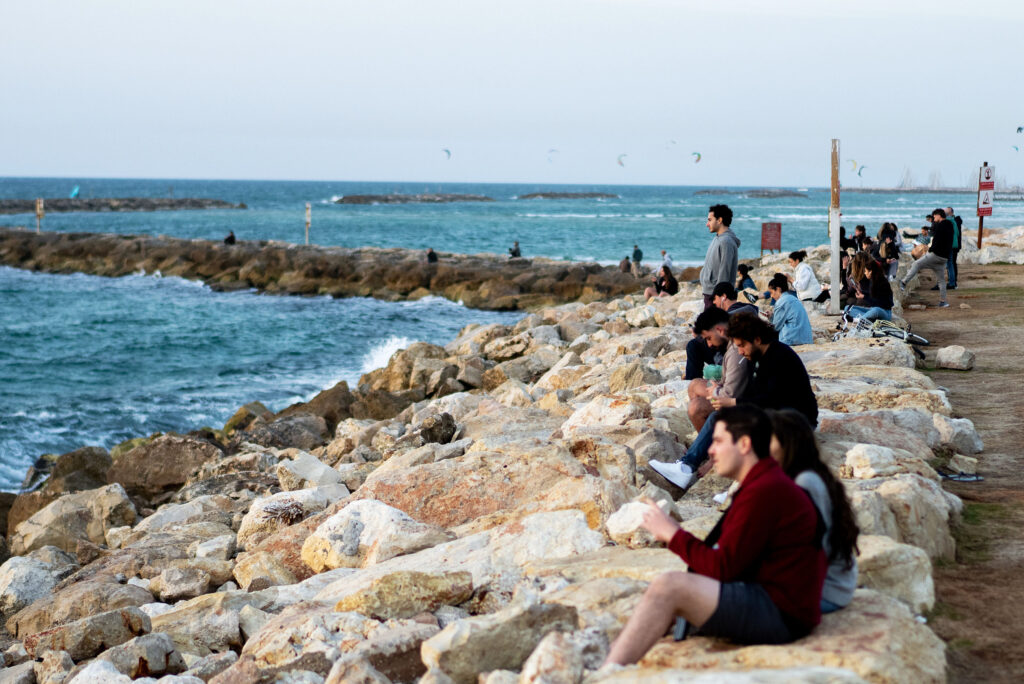
I step onto my balcony and hear the never-ending construction. An Israeli economist I know says, “We are always building and rebuilding the Jewish state.” I sip my coffee, get my kids into their remote school lessons and then open my email and direct messages to see what happened in the imagination of the United States the day before.
I moved my husband and four kids to Israel in late January for a Fulbright Fellowship, arriving weeks before the war began. Since then, I have become a most accidental correspondent: the person everyone back home texts when they cannot tell the difference between what is on their feed and reality on the ground.
We are living through the first alt-war: a conflict in which the war fought online and the war fought in reality have diverged so completely that they might as well be happening on different planets. It’s not that people lack information, it’s more that they are constructing an entirely different alternate reality — one that confirms what they already believe.
Most mornings, my phone is full of panicked messages. A friend in Pittsburgh. A colleague in Central Asia. A relative in New York. They have all seen the videos of intense missile barrages ravaging Tel Aviv. One video sent to me featured what were ostensibly Israelis marching in droves, on foot across what appeared to be the Judaean mountains escaping the country as it collapsed behind them.
The videos I’ve been sent are all fake. They are either generated by artificial intelligence or simply old footage from somewhere else. I know, because I am here.
The first night of the war was the most frightening. A missile struck about a quarter of a mile from our apartment. The noise shook our building. One person was killed — a woman who did not reach a shelter in time.
That tragic event lodged the importance of the shelters in the mind of my children like no lecture of mine ever could. But after that first night, my kids saw that life continued. In shelters across Tel Aviv, I have found myself alongside Muslims, Jews, Christians and recent arrivals. The furious debate consuming the American internet feels distant in these spaces. People are mostly tired but hopeful that a better future is on the horizon.
What worries me more than the fake videos are the people who cannot fathom that this war is going well for the United States, for Israel and maybe even for the long-suffering people of Iran. The strategic picture is more favorable than the online narrative suggests. Iranian options are narrowing to outcomes that all leave Israel better positioned than before, whether that is regime change in Tehran, a negotiated arrangement under American pressure or a ceasefire along the lines of the Houthi deal.
Markets know this even when pundits refuse to acknowledge it. Kobby Barda, a political analyst at Holon Institute of Technology, pointed me to what he considers the most telling indicator: Israel’s stock market surged when the fighting began and has remained near all-time highs. “Markets don’t lie,” he told me. “They price in everything and right now they’re telling you Israel comes out of this stronger.”
You would not know any of this from Washington. Two weeks into the war, I watch otherwise reasonable analysts sprint to catastrophe. Former officials, thinktank scholars, credentialed professionals who are supposed to know how to read a conflict. Within days they had written the obituary: quagmire, overreach, disaster. And that narrative has continued unabated.
The liberal internationalist left and the isolationist right — two camps that have agreed on almost nothing for decades — have suddenly found themselves in lockstep, racing to declare the war a failure before it had barely begun. This is the new blob: not the old foreign-policy establishment that the term originally described but a new amalgamation that has arrived at the same conclusion from opposite directions. Together they are the most powerful engine of the alt-war.
I asked Golan Shahar, a prominent clinical psychologist at Ben-Gurion University and self-described liberal turned centrist, to help me understand. Why do otherwise intelligent people send me AI-generated videos and refuse to believe my firsthand account?
“They don’t want this to work,” he said. “They want it to fail.” Analysts in the U.S., he explained, “cannot have it that Trump and Bibi are the ones defending the West.” People send me these videos because they need me to confirm what they need to be true.
This is the defining feature of the alt-war. It is not that people lack information, but that the success of the war conflicts with their priors and so they have constructed an alternative war: one in which Tel Aviv is burning, Washington never heard of the Strait of Hormuz before last week and the whole enterprise is doomed. Because that is the only version they can psychologically accept.
The new blob has found its common cause not in a policy position but in a psychological need. That need is feeding an alternative reality more vivid and viral than anything the enemy could produce.
Meanwhile, in the real war, I step onto my balcony each morning. The construction crews are already at work. My kids log in to school. Israel, bruised and tired, keeps building toward a better future for itself, and the region.
The post In Israel, wartime reality doesn’t match what you see on the internet appeared first on Washington Post.