House Republicans angrily rejected a bipartisan deal to reopen the Department of Homeland Security and pushed through their own plan late Friday, putting themselves on a collision course with the Senate and extending the agency shutdown that has crippled U.S. airports.
Revolting over an agreement their own party struck with Senate Democrats to end the crisis, which had passed the Senate before dawn on Friday, House Republican leaders — with President Trump’s backing — refused to take it up. They derided the Senate plan for hewing too closely to Democrats’ position by omitting money for Immigration and Customs Enforcement and Border Patrol, the two agencies responsible for carrying out Mr. Trump’s deportation crackdown, which are operating under previously approved funds.
“House Republicans are not going to be any part of any effort to reopen our borders or to stop immigration enforcement,” Speaker Mike Johnson said at a news conference on Friday afternoon. “This gambit that was done last night is a joke.”
Mr. Johnson called the Senate-passed deal engineered by Senator John Thune, Republican of South Dakota and the majority leader, “ridiculousness,” and instead teed up a stopgap measure to fund the entire department until May 22.
The House passed that measure on a 213 to 203 vote late Friday night, before leaving Washington for a scheduled two-week break.
The vote left funding for the Department of Homeland Security up in the air, with competing bills pending in each chamber — both controlled by Republicans — and neither apparently willing to approve the other’s proposal.
House Democrats had been ready to join with Republicans and back the Senate-passed measure, clearing it for Mr. Trump to sign it into law and end the shutdown. But the House bill is dead on arrival in the Senate, where Democrats have been rejecting similar proposals for more than a month. It was unclear late on Friday whether senators, who have now scattered to their states for the two-week recess, would return to Washington and vote again.
Mr. Thune did not weigh in on the backlash to the agreement he negotiated, and Mr. Johnson tried to shift the blame to Senate Democrats. But Representative Jim McGovern of Massachusetts, the senior Democrat on the Rules Committee, said the House Republican opposition left no question which party was responsible for the lapse in agency funding.
“If you woke up this morning not knowing who to blame for this shutdown, you will go to bed tonight with no doubt on who to blame,” Mr. McGovern said. “It’s House Republicans and Speaker Johnson.”
Mr. Trump, who had waffled all week about whether he would support a deal to end the shutdown, also removed any doubt about where he stood, telling Fox News in an interview that the Senate-passed bill “wasn’t appropriate.” He urged Senate Republicans to eliminate the filibuster, a move he has long demanded, and force through a funding measure over Democratic opposition.
Senate Democrats have insisted for weeks that they would not support new funding for the Department of Homeland Security unless the Trump administration agreed to significant restrictions on ICE tactics and officer conduct after federal immigration agents fatally shot two U.S. citizens in Minneapolis in January.
Despite Mr. Trump’s initial commitment to negotiate over such limits, the White House and Republicans in Congress resisted major changes such as a ban on officers wearing masks and new warrant requirements. The prolonged stalemate has in recent days led to long lines and chaos at some airport screening points on the eve of spring break as Transportation Security Administration officers went unpaid and began calling out in significant numbers.
After last-ditch talks again proved fruitless on Thursday, Mr. Trump announced he would go around Congress to pay T.S.A. workers, which administration officials said would be possible using a pot of agency money that was approved last year as part of the tax cut and domestic policy law. Hours later, senators announced bipartisan legislation that would fund most of the agency, excepting immigration enforcement operations, through Sept. 30. That measure was approved by unanimous agreement without a recorded vote before dawn on Friday and sent to the House.
But the agreement — and the way senators lobbed it to the House overnight before departing for their recess — infuriated hard-right House Republicans. Adding to the anger on the right, the Senate also departed without action on an election identification and registration bill that is a top priority of Mr. Trump and is also being blocked by a Democratic filibuster.
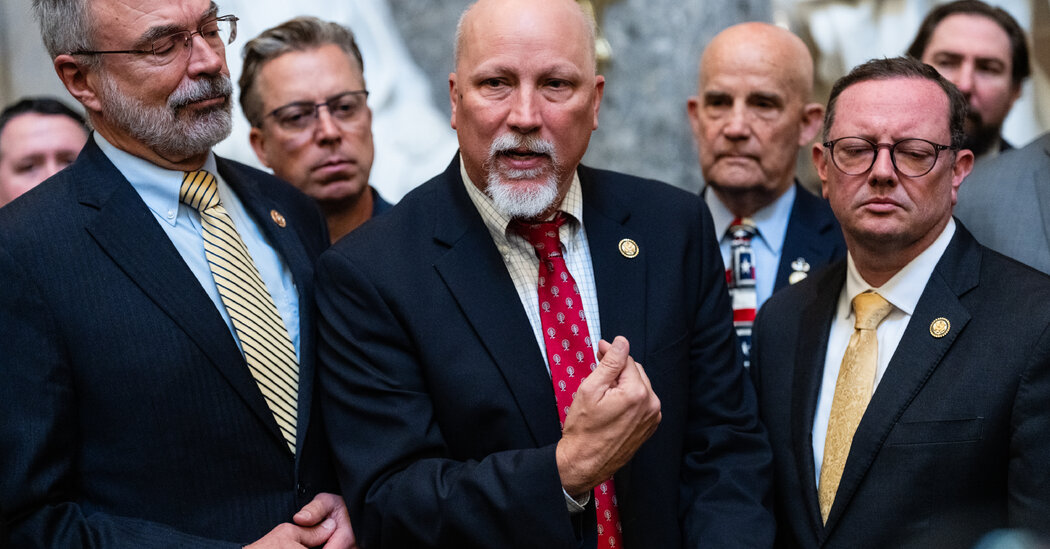
“It is absolutely offensive to the people that we represent that the Senate would send over a bill that doesn’t fund Border Patrol and the core components of ICE,” said Representative Chip Roy, Republican of Texas. “Could the Senate be any more lazy than to send to us a bill that doesn’t do the job and then leave town? We are going to stand up and say no to that.”
But the stopgap measure the House passed instead has no chance of winning the 60 votes necessary to advance in the Senate, and senators are already scattered and would have to be called back to approve the alternative the House passed.
Senator Chuck Schumer of New York, the minority leader, said Democrats would oppose the temporary spending bill, known as a continuing resolution or C.R.
“A 60-day C.R. that locks in status quo is dead on arrival in the Senate, and Republicans know it,” he said.
In the House, Representative Hakeem Jeffries, Democrat of New York and the minority leader, said his party had been ready to back the Senate measure and end the partial shutdown.
“This should end, and could end today,” he said.
The stalemate between the Senate and the House left unclear the path forward for the legislation after it seemed for a few hours that the longest partial government shutdown might finally be settled. It also resulted in the exact situation senators had been hoping to avoid: leaving the agency responsible for airport and other security unfunded while lawmakers were off for their Easter break.
On Friday afternoon, the White House released Mr. Trump’s memorandum directing that T.S.A. employees be paid, though it was unclear how quickly that would occur or how swiftly agents might return to their jobs after weeks without compensation.
As they assembled their legislation, Republican senators had portrayed it as the quickest way to resolve the spending impasse and they promised to substantially beef up immigration enforcement funding in a future party-line bill that could skirt a Democratic filibuster. They were also exploring adding elements of the election bill to that measure, though whether they could do so was an open question.
But even though the administration has a large slush fund it is using to pay for immigration enforcement during the shutdown, House Republicans said they could not accept a homeland security funding bill that lacked money for ICE and Border Patrol.
“House Republicans will not fund a half-baked idea that leaves our borders open and our communities at risk,” Representative Michelle Fischbach of Minnesota said on the floor.
Carl Hulse is the chief Washington correspondent for The Times, primarily writing about Congress and national political races and issues. He has nearly four decades of experience reporting in the nation’s capital.
The post House Vote Sets Up Clash With the Senate on D.H.S. Funding, Prolonging Shutdown appeared first on New York Times.