Spring has sprung and love is in the air at the Smithsonian’s National Zoo in D.C., where its two giant pandas — Bao Li and Qing Bao — are flirting, a sign that zookeepers said means the two bears could successfully mate in the coming years.
Both pandas are 4 years old — equivalent to humans in their early teens — so not quite mature enough to breed, zoo officials said.
Giant pandas reach adulthood between 5 and 7 years of age, and keepers said they are hopeful they’ll be able to breed the two naturally. If the pair had a cub, it would be a major milestone and mark the first time in decades that a pair of giant pandas has successfully bred naturally at the facility.
“It’s great they’re showing interest in each other,” said Mariel Lally, the zoo’s giant-panda keeper, in an interview Friday. “The hope is that, with everything we’re seeing, in a few years when they’re sexually mature and we put them together that we will have a successful, natural breeding pair of giant pandas.”
The zoo’s last pair of adult giant pandas — Mei Xiang and Tian Tian — are now living in China. They never had success at natural breeding; their cubs, four of which survived, were conceived via artificial insemination.
Bao Li and Qing Bao live in separate enclosures at the zoo because, in the wild, pandas are solitary animals. But they’re neighbors, and two “howdy” windows — mesh screens built into the fence between their habitats — allow them to “see, smell and vocalize” to each other, zookeepers said.
In the past few weeks, the bears have been showing some changes in their behaviors — signs of what keepers call “positive interest” in each other.
Bao Li is in rut, a period when male giant pandas prepare themselves for breeding, keepers said. Usually the more outgoing of the pair, Bao Li has been even more playful recently.
He rolls, runs and shimmies when Qing Bao pays him a visit at the “howdy” window. Whenever he sees even a glimpse of her in her yard, he vocalizes frequently and loudly to try to grab her attention.
“He’s bleating at her,” Lally said. “It’s him saying: ‘I’m friendly. I like you. I’m not a threat.’”
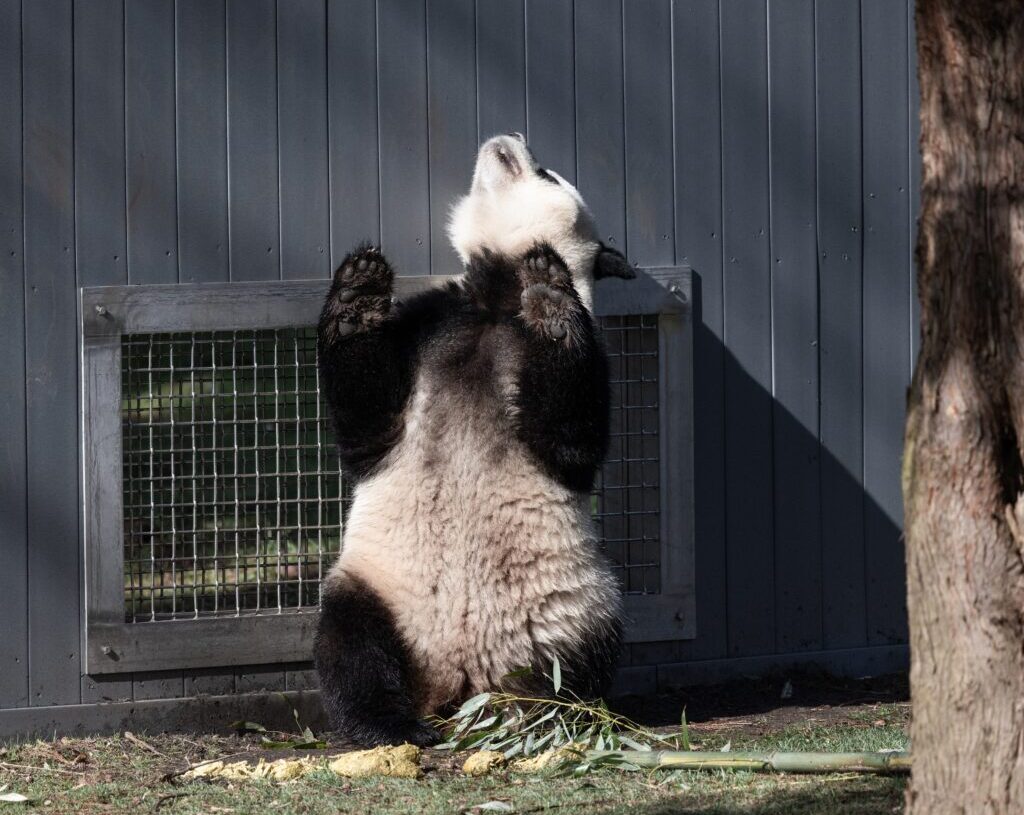
Sometimes, he’ll get on his hind legs and rub his back against the howdy window, or he’ll jump on all four legs as if to say, “Hi, I want to play with you,” Lally said.
Other times, he’ll power walk, taking heavy, marching-like steps around his enclosure. “He’s saying,” Lally said, “that he’s essentially looking for the ladies.”
But Qing Bao, the more reserved of the two, is a bit hard to get. She usually doesn’t respond. Female giant pandas’ interest in males is driven by their hormones, which ramp up for only a brief window for a few consecutive weeks in a year. For female giant pandas, estrus, the period when they’re able to conceive a cub, is extremely short, lasting 48 to 72 hours.
Zookeepers said they’ve started to see in Qing Bao “some physiological changes in her reproductive area,” according to a recent online update about the bears. And she’s acting differently.
“Ninety percent of the time, she sees him saying hi through the fence and she ignores him,” Lally said. “But now she’s starting to be more into him. She’s getting closer to her howdy window to watch him. We jokingly call it ‘Bao Li TV.’”
Qing Bao is also changing her usual daily routine: eat, sleep, play and repeat. Keepers said she’s spending more time wandering around her habitat and leaving her scent by rubbing her backside against a rock or log or raising her tail. Giant pandas have a gland under their tail that secretes an oily substance that reveals details about them, including their age, sex and fertility.
Occasionally, Qing Bao happily chirps back at Bao Li. When she’s not in the mood to socialize with her suitor next door, she moans. Zookeepers said they’re waiting for her to bleat back at him — like a sheep’s “baa” sound, but with a higher pitch and longer trill — which is a sign that she has reached peak estrus.
Both bears do daily training sessions with keepers — although when Bao Li is “very amped up,” as he is when Qing Bao is in estrus, his attention span is short. He’ll let keepers do some basic checkups in exchange for treats and then go back to his power walking while looking for Qing Bao at the howdy window, zoo officials said. Qing Bao is more willing to engage in training, lured by pineapple and apple juices diluted with water in exchange for an exam.
Last year, Qing Bao had her first estrus cycle in March and April, and a few months later she had what’s known as a pseudopregnancy — a phenomenon in which, though a panda has not bred, the bear goes through hormonal and behavioral changes that mimic an actual pregnancy, according to zoo experts.
Lally said Qing Bao and Bao Li “seem pretty compatible,” and officials are hoping that once they’re sexually mature they’ll be successful at naturally breeding cubs.
“When you put any large carnivores together, things can go wrong,” Lally said. “The more time we have to see how they interact with each other over the fence, it gives us a sense of what that plan will look like when we do put them together.”
“Once they’re older and we open the door, there shouldn’t be any aggression,” she said. “They should just get down to business.”
The post Giant pandas at the National Zoo flirt with romance as spring heats up appeared first on Washington Post.