TAIPEI, Taiwan — Allies and partners of the United States in Asia are steeling themselves for what they see as the nightmare scenario of a long American war in the Middle East that would distract from their own security concerns about China.
From Tokyo to Manila to Taipei to Seoul, officials say they have watched with dread over the last month as the U.S. escalated its conflict against Iran. Beyond the spiking oil prices and natural gas shortages, which are already inflicting economic damage, the war is drawing military assets and tactical focus away from the Indo-Pacific and the challenge of China’s expanding ambitions in the region, officials warn.
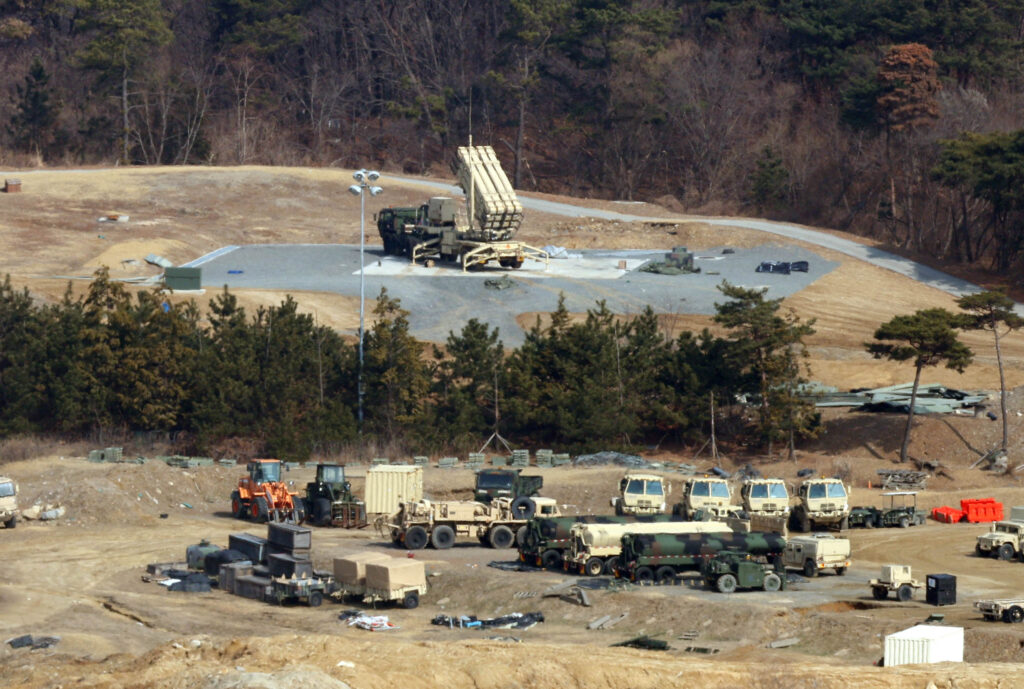
Parts of a U.S. missile defense system were relocated from South Korea to the Persian Gulf — even as North Korea remains a threat.
Thousands of Marines stationed in Japan were ordered to sail West.
A meeting between President Donald Trump and Chinese leader Xi Jinping, originally scheduled for this month, was postponed, stalling plans to announce more U.S. arms sales to Taiwan that had been set to follow, according to U.S. defense contractors and Taiwanese officials. The White House on Wednesday said Trump would now travel to Beijing on May 14-15, with press secretary Karoline Leavitt suggesting the war could be wrapped up by then.
Leaders in Asia say they are waiting nervously for the Trump administration to find an exit ramp from Iran. There had been hope Trump would declare victory after killing the supreme leader, Ayatollah Ali Khamenei. “But that wasn’t the case,” said Kuan-ting Chen, chair of the Taiwan legislature’s Foreign Affairs and National Defense Committee. “So now we don’t know.”
Trump on Monday said the U.S. is negotiating a “TOTAL RESOLUTION” with Iran. But this was rejected by Iran’s Foreign Ministry, which said Trump’s remarks were part of “efforts to reduce energy prices and gain time to implement his military plans,” according to the semiofficial Mehr News Agency. The Pentagon has sent thousands of paratroopers to the Middle East, possibly in preparation for a ground invasion.
U.S. diplomats have tried to reassure governments that the Trump administration is committed to serving as a guarantor of Indo-Pacific security and that removing Iran as a threat eventually will free up more resources for a strategic “pivot to Asia.”
Anna Kelly, a White House spokeswoman, said Trump has been “in close contact with all our partners” throughout the war in Iran. “The United States continues to project power and maintain a strong defensive posture around the world,” she said.
When Undersecretary of Defense Elbridge Colby met Philippine President Ferdinand Marcos Jr. in New York this month, he said there would be “no change” to the U.S.-Philippine defense alliance, according to Jose Manuel “Babe” Romualdez, the Philippine ambassador to the U.S. “We were told there’s no immediate concern,” Romualdez said. “But we may have to review that depending on how long this Iran crisis continues.”
Some analysts say the joint U.S.-Israeli attacks on Iran, along with the U.S. capture of Venezuelan strongman leader Nicolás Maduro, have been a show of American military might that could deter China from attempting to forcibly retake Taiwan or expand its claims over contested territory in the South China and East China Seas. That deterrence only works, however, if U.S. capabilities are readily available in Asia, said Chen, the Taiwanese legislator.
“Military assets cannot be deployed at two places at the same time … Even though United States is a very resourceful country, there is a limit,” he said from his office in Taipei.
Chen said he is worried that if the U.S. sends troops into Iran, it could be the start of a complicated, drawn-out occupation like in Iraq or Afghanistan. Another concern is Taiwan’s dependence on Middle Eastern fuel, which has been choked off by Iran. If the conflict extends another month, Chen said, Taiwan’s leaders will be wholly absorbed by an energy crisis, with little time to focus on China’s military buildup or its increasing efforts to infiltrate Taiwanese society.
The Philippines this week declared a national energy emergency. Japan said it would dig into its oil stockpiles.
“We need our allies to understand: The only peer that is the strength of the United States is China,” Chen said, adding that Venezuela, Iran and Cuba pale in comparison.
“We need,” he said, “to focus.”
Delayed progress
Before the bombing of Iran began, Taiwan’s defense preparations were climbing to new heights. Taiwan’s leader, Lai Ching-te, said in November that he would push for an unprecedented $40 billion special defense budget. A month later, the Trump administration approved a record $11 billion in weapons sales to Taiwan.
More was expected this year. U.S. officials had notified Taiwan they were planning to announce the approval of a second tranche of weapons that would exceed $11 billion and include advanced interceptor missiles near the start of this year, according to U.S. defense contractors and Taiwanese officials who spoke on the condition of anonymity to share details of private negotiations.
That announcement now has been put on hold by the White House.
“Things that are meant to happen, aren’t happening,” said a U.S. defense contractor.
Some analysts say postponing the Xi meeting gives Trump time to resolve the Middle East crisis, which otherwise could be exploited by Xi as leverage in negotiations. But William Yang, who researches Northeast Asia for the International Crisis Group, said the delay will have the opposite effect — giving Xi more time to firm up demands that “dilute U.S. support for Taiwan.”
Any sense that the Trump administration sees itself as overstretched by military operations in Latin America and the Middle East could signal to Beijing that the White House is willing to step back from its support of Taiwan in exchange for a trade deal that eases domestic U.S. economic pressures.
It is an area where the slightest adjustments could portend major shifts. Trump, for example, could make subtle changes to official statements, saying the U.S. “opposes” instead of “does not support” Taiwan’s independence. Trump could also agree to limit arms sales.
“Any kind of passive decline in support of Taiwan would be seen as conceding to Beijing,” said Liang-chih Evans Chen of the Institute for National Defense and Security Research, a government-funded think tank in Taiwan. If Trump chooses not to mention Taiwan following the Xi summit, Taiwan’s leaders would be “very nervous,” Chen said.
A retreat in Taiwan’s defense could also allow Chinese forces to be more assertive elsewhere.
Satellite imagery shows China has been building new islands in the South China Sea despite the opposition of countries such as Vietnam and the Philippines. On Tuesday, Chinese coast guard vessels carried out what the Philippines called a “clearing operation” against fishing vessels near a shoal 140 miles from the Philippine coast.
China’s coast guard presence also reached a record high in 2025 near the disputed Senkaku Islands off Japan, which the Chinese call Diaoyu, say Japanese authorities.
While Japan faces some constitutional restrictions in deploying its military forces in situations not directly related to Japan’s security, leaders in Tokyo increasingly worry that resisting Trump’s demands for allied support against Iran could jeopardize U.S. commitment to protecting their territories.
“It is crucial to avoid a situation where the U.S. and China form a G-2 [Group of Two] and ignore Japan or Taiwan,” said Tetsuo Kotani, a security expert at the Japan Institute of International Affairs. “But to prevent that, Japan must cooperate on the Iran and Hormuz issue.”
‘Let history repeat’
Asian officials have tried to remind Washington that the U.S. has vital interests in the region.
Japan is key to helping break the Chinese chokehold on rare earth minerals. The Philippines borders busy waterways that allow essential goods to reach American shores.
A majority of the advanced semiconductors that the U.S. needs for critical technologies, including artificial intelligence, are made in Taiwan and South Korea. At the World Economic Forum in January, Treasury Secretary Scott Bessent noted that disruption to Asia’s semiconductor sector would trigger an “economic apocalypse.”
“Peace in this region is core to American national interest,” said Wang Ting-yu, a Taiwanese legislator and senior-ranking member of the ruling Democratic Progressive Party (DPP). Wang expressed confidence that the U.S. arms sales to Taiwan will proceed, he said, because they are based on “thousands of meetings over more than two years.”
But Kurt Campbell, a former U.S. official and architect of President Joe Biden’s Asia policy, said he’s skeptical that the distraction from the Indo-Pacific will be short-lived. “Experience tells us that once drawn into the quagmire of an ill-defined conflict, American strategists have had difficulty extracting themselves from the morass,” Campbell wrote this week.
Even if U.S. attention eventually returns to Asia, the war has already created an opportunity for China to amplify its message that the U.S. is an unreliable partner, analysts said.
In Taiwan, China responded to anxiety over fuel shortages with rhetoric that joining “the motherland” would provide stable energy supplies.
After South Korean President Lee Jae Myung said he was unable to stop the U.S. from removing air defenses from the country, Chinese state media published articles questioning if South Korea should allow the U.S. to locate defense systems there.
“Whether the ROK should continue to bear the diplomatic, security, and social costs associated with hosting the THAAD system deserves serious consideration,” a professor at Shanghai University of International Business and Economics wrote, referring to South Korea, in an op-ed reposted by the Chinese military.
Ultimately, however, Chinese leaders recognize they don’t have to make much effort to benefit strategically from the war, said George Chen, a partner at The Asia Group, an advisory firm.
“The general attitude of the Chinese government is let’s wait and see. This is not our war … So let the U.S. be dragged down,” Chen said. “Let history repeat.”
Chie Tanaka in Tokyo and Rudy Lu in Taipei contributed to this report.
The post Dread deepens among U.S. allies in Asia over a protracted Mideast war appeared first on Washington Post.