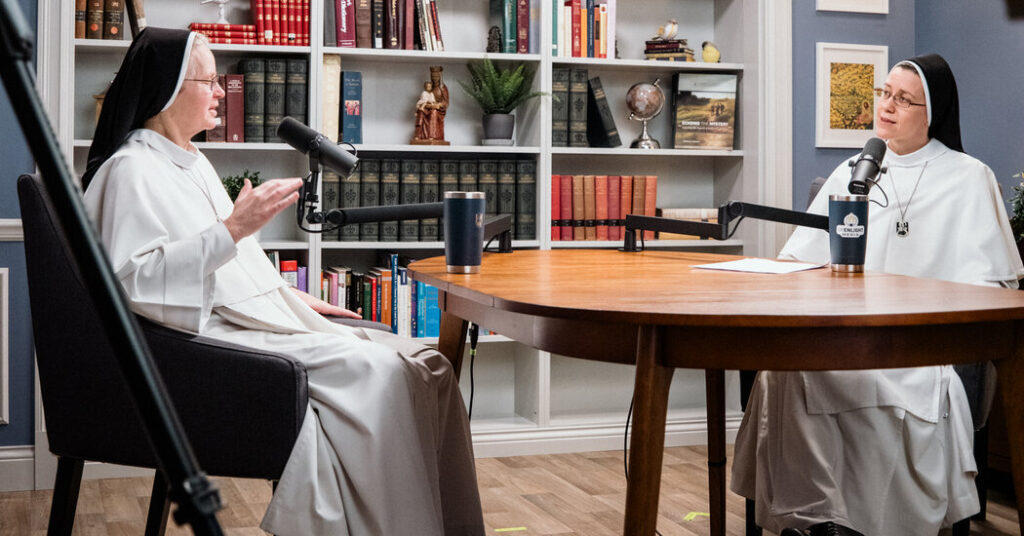
Sister Miriam Holzman’s white habit was crisp and clean as she settled in beside her microphone on a Wednesday morning in late March, her wire frame glasses tucked into her black veil. A silver pendant depicting the Virgin Mary holding baby Jesus gleamed around her neck under the bright lights of a recording studio in Michigan. Behind her, a well-styled bookshelf bore a Bible dictionary, a set of Catholic encyclopedias and several fake plants.
Across the table, Sister John Dominic Rasmussen sat ready to record an upcoming episode of “Dominican Sisters Open Mic,” a new podcast produced by the Dominican Sisters of Mary, Mother of the Eucharist, in Ann Arbor. (The women are referred to as sisters, not nuns, who are cloistered.)
In each episode, a host, typically Sister Miriam, 44, interviews a guest, usually another sister, about her life, covering subjects like her education — several of the women have Ph.D.s — or her conversion journey. While the topics themselves might sound weighty, the conversations are often quite wide-ranging, like a dialogue between two, well, sisters.
The show is just one of several efforts the sisters have undertaken in recent years to spread their religious message to a wider audience in “the new public square,” Sister John Dominic, 61, said. In 2010, she was among several sisters who appeared on “The Oprah Winfrey Show” in a segment about convent life.
Since the podcast debuted in January, the sisters have found viral success on TikTok, where clips from the show have garnered millions of views and comments from fans, both Catholic and non-Catholic, who find themselves mesmerized by the sisters’ soothing timbres and unrelenting positivity.
In their most popular clip, Sister Miriam and another sister are discussing playing ultimate Frisbee.
“Sister, and you are so good at that,” Sister Miriam says to her guest, complimenting her skills on the field. At the time, she thought she was offering up nothing more than an honest assessment of athleticism, she said.
Online, however, the line took on a life of its own.
Perhaps it was the A.S.M.R.-like quality of Sister Miriam’s voice or that it was a rare moment of sincerity online. Or maybe it was the converging of several seemingly disparate communities through the word sister itself, a term used not only by religious women but also by many in L.G.B.T.Q. communities.
“Wait, I’m lowkey obsessed with this,” the model Vivian Wilson, who is Elon Musk’s daughter, wrote in the comments on the Frisbee video.
There’s something arresting about the visual language of the show, too.
At first glance, there are familiar podcasting tropes: two microphones facing each other, coffee mugs with the show’s logo and a bookshelf full of personalized touches. Remove the religious iconography and swap in a football, and it could easily be the set of Jason and Travis Kelce’s “New Heights.” A pink couch, and it might become “Call Her Daddy.”
But even behind the scenes, it’s clear this is a different kind of podcast. In the studio, taped beneath a jumble of cameras and monitors, was a printed picture of St. Thomas Aquinas demonstrating how to position a microphone for optimal sound. (Before each taping, Sister Miriam said, she likes to call on the Holy Spirit.)
“I think that the novelty of two sisters doing a podcast is enough to hold people’s attention for a second, which is what you need for TikTok,” Paul Dailey, the show’s director of marketing, said. Commenters sometimes question whether the women are “real,” accusing them of being A.I., Vicki Powers, the team’s social media manager, said.
In another viral clip, the sisters discuss giving up driving over the speed limit for Lent, the weeks leading up to Easter in which some Christians abstain from foods or activities as a show of sacrifice. In a third, they discuss Wingspan, a popular board game about birds.
The production team said it looked for moments like these, which are noticeably divorced from the more religious themes of the full episodes, to spotlight on social media alongside the more expected fodder.
“It’s not something that you need to have a theology degree to understand the sort of funniness of it, you know?” Mr. Dailey said.
Mr. Dailey is one of around 50 full-time employees at Openlight Media, a production company founded after the sisters began producing and selling educational video programs for children in 2014.
In addition to “Dominican Sisters Open Mic,” the company posts a range of other offerings on YouTube, from “Manners Monday,” a cutesy etiquette series, to content that is much more traditionally Catholic, like a set of anti-abortion videos. Openlight Media also recently started a prayer app, Torch, which it advertises as an “answer to the distractions of social media.”
These efforts are part of a much longer tradition in the Catholic Church. Since 1967, the church has observed World Communications Day, a day devoted to using evolving media formats to reach people, said Kristin Peterson, an associate communications professor at Boston College whose work focuses on religion and media. More recently, prayer apps like Hallow and podcasts like “The Bible in a Year” have become popular, and there are a number of Catholic priests and other sisters making videos on TikTok, too. Recent reports show the Catholic Church has seen a surge of new converts of late.
The Dominican Sisters in Ann Arbor, who have previously released albums that have appeared on Billboard’s traditional classical chart, are no strangers to the spotlight. During the pandemic, said Sister John Dominic, who is also the executive director of Openlight Media, they temporarily started broadcasting Mass on YouTube, which helped grow their following online.
Their headquarters has two full studios, complete with sets designed by a parent at a local Catholic school run by the sisters.
“When the writers were on strike, he didn’t have anything to do,” Sister John Dominic said of the set builder, who has also done work for the University of Michigan.
While they have surrounded themselves with professionals who have an innate understanding of online media, the sisters said they had no idea when they were recording what clips would make for future viral material.
“Something that’s really beautiful about our life is we don’t have a lot of screen time,” said Sister Miriam, a pharmacist by training, who teaches high school biology and chemistry. “We don’t have personal phones unless we might need it for a work-related reason.”
The sisters do not maintain individual social media accounts, Sister John Dominic said, and the only way they know if they’ve made a splash online is if the laypeople on their team let them know.
The sisters said they were fine with the setup.
“They want us to pray and to do the work and to prepare the content,” Sister Miriam said. “And then they say, ‘OK, go home, sisters, and do what you do best, which is praying and living your life, and we’ll do this for you.’”
During that day’s taping, Sister John Dominic told Sister Miriam a story about sneaking a small television onto a religious retreat as a teenager to watch “Saturday Night Live.”
Behind the cameras, Mr. Dailey and his team made a note to be sure to clip that section for TikTok.
Madison Malone Kircher is a Times reporter covering internet culture.
The post Don’t Call Them Nuns. They’re Podcasters. appeared first on New York Times.