It was Aug. 22, 1990, when Garland Atkinson, who had recently started dating Cheryl Henry, met her and her sister at a Houston bar, Bayou Mama’s, for drinks.
Around 10:45 p.m., the sister, Shane Henry, left the couple to enjoy the rest of their night.
It was the last time anyone saw them alive.
The next day, their bodies were discovered in a wooded area near a cul-de-sac. Both had been killed the same way: Their throats had been cut, according to court records.
For years, there were no arrests in the killings, which came to be known as the Lovers Lane Murders. The case slipped unresolved into the files of the Houston Police Department.
Almost 36 years later came a turn familiar to cold cases: An old tip was reconsidered, a name resurfaced and DNA pointed investigators in a clearer direction.
Evidence pointed back across the years to a man who, in 1990, lived and worked about a mile from where the bodies were found and whose past included arrests.
On Thursday, prosecutors charged the man, Floyd William Parrott, 64, of Lincoln, Neb., with capital murder. The authorities said they believed he might be tied to unspecified “numerous different types of crimes” in the Harris County, Texas, area.
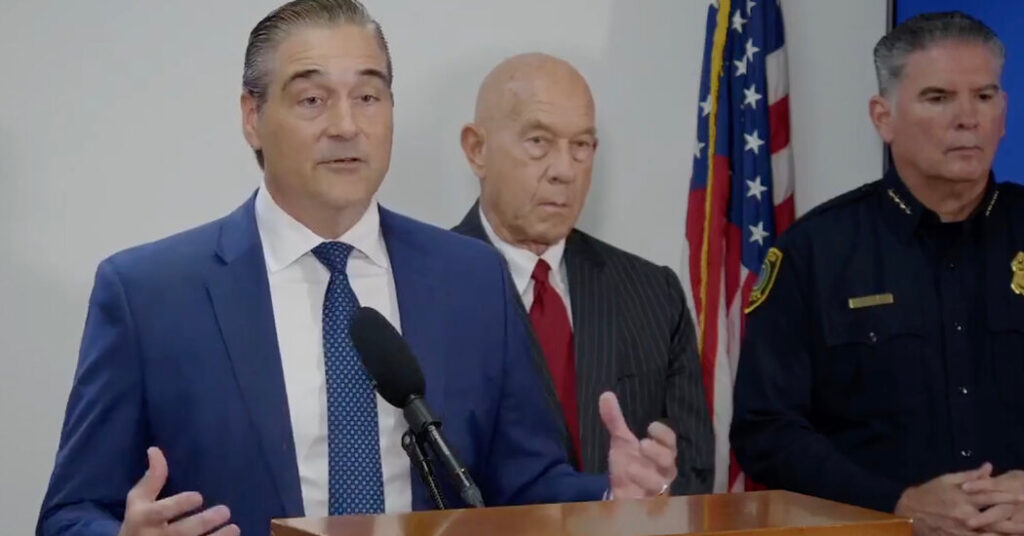
“A monumental chapter has been closed, but the work cannot and will not stop now,” Sean Teare, the county district attorney, said at a news conference on Friday.
In 1990, the first signs of trouble came the day after the couple’s visit to the bar.
When Ms. Henry, 22, failed to show up for work, her family reported her missing. Later that day, a security guard noticed a white Honda Civic sitting for hours in a cul-de-sac.
Inside was a purse on the passenger-side floorboard with Ms. Henry’s driver’s license.
The police searched a nearby wooded area and found her body, unclothed and partly covered with wooden boards. She had been sexually assaulted, according to court records.
Roughly 150 yards away, the police found Mr. Atkinson, 21, who was known as Andy, seated against a tree. His hands were bound behind his back, a rope going across his neck and binding him to the tree. He was killed in the same manner as Ms. Henry.
A break in the case began with an old tip.
While reviewing the case file in late 2025, an investigator learned that a caller in 1990 had identified Mr. Parrott as a potential suspect in Ms. Henry and Mr. Atkinson’s deaths.
It was not known on Friday what the police did with the information or whether they interviewed Mr. Parrott. The authorities on Friday did not immediately respond to requests for comment.
In 1988, Mr. Parrott was arrested in Harris County and placed on probation for impersonating a police officer. That same year, he was arrested and convicted in the county on a weapons charge.
In late 2025, the police revisited a 1996 Houston police report involving a sexual assault in which Mr. Parrott was the suspect.
He told the police at the time that the encounter was consensual, according to court records. The case was dismissed after a grand jury declined to indict Mr. Parrott, Mr. Teare said.
A DNA sample from that case had recently been entered into CODIS, the Combined DNA Index System database that allows law enforcement agencies to compare genetic profiles across jurisdictions.
Investigators found that DNA from the 1996 case matched genetic material collected during Ms. Henry’s autopsy. It also matched an unknown male profile from a separate sexual assault in June 1990.
Cases that had long stood apart now shared the same signature.
In a statement, Ms. Henry’s family called the arrest “bittersweet.” The statement described Ms. Henry and Mr. Atkinson as “kind, loving and with so much life ahead of them,” and said the family had never given up hope that someone would be held accountable.
The family noted that Ms. Henry’s mother, Barbara Craig, died last year, and Mr. Atkinson’s father, Garland Atkinson, died in 2024.
In 2022, on his son’s birthday, Mr. Atkinson wrote on Facebook that after 32 years, “we know nothing new” and that he still prayed this would be the year for answers.
The authorities were releasing photos from Mr. Parrott’s 1988 and 1996 arrests in hopes that the public might provide more information about his past.
“We need to know the full picture of what Floyd William Parrott was doing in our community,” Mr. Teare said.
Alain Delaquérière contributed research.
Mark Walker is a Times reporter who covers breaking news and culture.
The post Arrest Made in ‘Lovers Lane Murders,’ a 1990 Cold Case in Houston appeared first on New York Times.