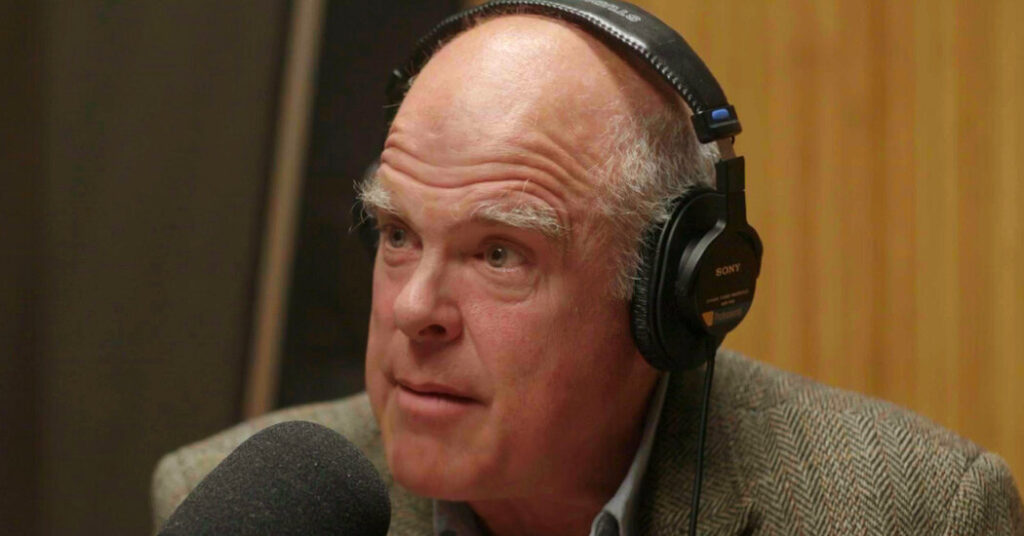
This is an edited transcript of “The Ezra Klein Show.” You can listen to the episode wherever you get your podcasts.
Is Trumpism crashing on the shoals of the Iran war? That is what Christopher Caldwell thinks.
Caldwell is on the right. He’s a contributing editor at Claremont Review of Books.
Caldwell has been trying to define and, even, craft a coherent Trumpism. But in a recent piece in The Spectator titled “The End of Trumpism,” he seems pretty dispirited. He writes: “The attack on Iran is so wildly inconsistent with the wishes of his own base, so diametrically opposed to their reading of the national interest, that it is likely to mark the end of Trumpism as a project.”
It wasn’t just Iran that led Caldwell to that point. It was also Trump’s brazen self-dealing, the waves of influence peddling, the sense that this man who was supposed to represent the will of the people in some way was doing something very different.
This has led to a debate on the right. Many noted a very obvious counterargument: Polls show that Trump’s base is largely sticking with him.
So this gets to questions that I think are important yet somehow still unsettled — despite Trump’s decade-long dominance in American political life: What is Trumpism? Is there a Trumpism — or is there just Donald Trump?
Caldwell has also spent a long time writing about right-wing populism in Europe. So he has a set of comparisons for what a program for that might look like here, and I think that’s what he sees coming apart now. So I wanted to ask him why.
Caldwell is a contributing writer for the New York Times Opinion section. He’s also the author of the book “The Age of Entitlement: America Since the Sixties.”
Ezra Klein: Chris Caldwell, welcome to the show.
Christopher Caldwell: Well, thank you, Ezra.
So you just wrote this piece for The Spectator that created a lot of conversation called “The End of Trumpism.” Before we get to why you think it’s ending, what do you think Trumpism was or is?
Well, it’s a good question. When I talk about Trumpism, I’m not talking about MAGA. I’m not talking about the group of hard-core supporters who will back him, whatever he does. You could call them orthodox Trumpians or something like that.
I’m talking about the governing project that has a real chance of changing things and did so by picking up people outside of that hard core. And it’s a hard thing to talk about because Trump is notoriously disinclined to really lay out a governing project in any kind of, let’s say, programmatic way.
So what was Trumpism? I think at the heart of Trumpism were a few issues. One of them was inequality — the sense that the society was unfair. One element of the unfairness was just the working of the global economy, where the people who ran it were advancing, and the people who built it at a lower level were falling behind.
Another was certain government programs — you could talk about affirmative action. So there was unfairness.
I think there were a lot of freedom of speech issues. I think that “woke” was a big part of what Trumpism was, certainly his second time around. And I think there were certain cultural issues — trans, for instance, just to take one.
But tying them all together was this issue of war. It’s very interesting, I think, that in the last 20 years we’ve had two presidents whose claim to the presidency was built very largely on their opposition to the Iraq war. And for some reason, it’s really very important in our politics.
I think for Trump, it was especially important. Because as long as the president was committed to not going to war in a major way, there’s a kind of limit to how far you could expect him to take his program. And I think that, having gone to war now, the limit is sort of off.
When people try to extract a governing agenda out of Trumpism, there’s a tendency to extract their governing agenda out of Trumpism. Is there actually this agenda that can be violated? Or as Donald Trump often says: There’s just him?
He is MAGA. He is Trumpism. That’s why it’s got Trump in the name. And the fact that his people follow him where he goes means that he’s right about that.
Well, a lot of the people who have criticized the piece have said: Well, look, Trumpism is not ending. Because if you poll people who call themselves MAGA about this recent war with Iran, 80 to 90 percent of them say they’re all behind it. They really love Trump.
The real question is: How big is MAGA? If you look at polls that measure it, or the people who have been asking that question for quite a while, like NBC has, it kind of peaked after the election at around 36 percent. So I think that gives him a lot less leeway to, let’s just say, feel that his base will follow him anywhere.
In your essay, you give a different definition of what Trumpism was than you’ve given here. You describe it as a project of democratic restoration.
Yes.
What do you mean by that?
I don’t know that’s different from what I’m describing here. That is part of what I describe here as the inequality problem.
There are many dimensions to inequality, as I said. There’s the income inequality, there’s the influence, and things like that. But I think there’s also the deep state.
This idea at the heart of Trumpism, which sounds a little bit occult, but it is a set of informal powers that kind of winds up claiming governing prerogatives, and they sort of replace the literal democracy through which we would like to believe we’re led — you know: One man, one vote.
So you have the growing influence of elite universities — where basically everyone on the Supreme Court has gone to either Harvard or Yale law schools. I think you have the role of civil rights law in circumscribing what people feel they can say and how they feel they can interact.
This wasn’t explicit, but I think that everyone felt it: Trump promised a country in which you’d get the stuff you voted for and not the permanent state. He was sort of promising a return to a more 19th-century state that you can criticize as being based on patronage. But what it means is when you vote for a president, he cleans out the whole executive branch, and now the government is oriented around your voters’ wishes.
So you’re sounding very disenchanted with Trumpism. Is there a moment when you were more enchanted? If we were sitting here talking about the success of Trumpism and the continuation of it, what story would you be telling me?
I really try not to be enchanted or disenchanted with any politician. It’s not a good way to look at things if you have to write about it.
But I think there are certain really promising things that he did in terms of his own agenda, where he seemed to be really delivering to those who had voted for him. One is that whole series of executive orders that sort of took apart the D.E.I. state and removed affirmative action from American life.
I think they really brought a palpable change in the lives of the people who had voted for him. Although it wasn’t a change — it was an absence. And you don’t notice when you go from a presence to an absence the way you do when ——
What was the palpable change that they brought?
What was the palpable change?
Yes.
There was just less talk about ethnic categories, gender — that sort of thing. The culture of the country, I think, has changed quite a lot. You know what I mean?
I do a bit. Although, I guess it’s interesting for me to hear you describe it in terms of inequality.
Here you have a billionaire whose major, signature legislative achievements are very unpopular tax cuts that redistributed money upward; who was elected with the help of the world’s richest man, Elon Musk; who seems to be, you note this in your piece, enriching himself, rapidly, to the tune of, in one count I’ve seen, over $1 billion, and another count, billions of dollars, since being in office — and who also seems to exist to many as a response to efforts at equality.
You have a dimmer view of efforts at diversity and equity and inclusion than I do. But when you say wokeness was a big part of it: There was a progressive push to rectify old inequalities, and Trump came in and said: We’re going to stop all that — and has been, I will say, very successful at stopping that.
But what is inequality — and who is it harming? And also: Is Trump an agent of it, or is he an agent against it? These questions seem at least contestable.
Oh, absolutely. He wouldn’t be the first populist who has been rich. And many populists have gotten rich practicing populism, as well.
It’s a good business.
Yes, yes. It’s a good business. But yes, I agree that there’s been something in the second term that’s really a change of emphasis. And I would agree that it’s hurting him.
I don’t know if you saw the Kennedy Center press conference that he had the other week where it was just a whole bunch of shoutouts to the billionaire donors in the audience.
Archival clip of Donald Trump: I’m looking at Mr. Steve Wynn, who’s over there. He built a spectacular building, and he knows Trump builds a spectacular building. I built better buildings than him. I don’t care what he said.
Archival clip of Trump: It’s like Bob Kraft. If a football player doesn’t perform well, typically you will fire him immediately. Bob, do you ever let them stay around for four or five years if they’re bad? Not too many times, right?
Archival clip of Trump: Under the leadership of this exceptionally talented and rich board — it’s a very rich board. Not everybody, but most of you are loaded. Ike Perlmutter has got so much money. Look at Ike Perlmutter. He ended up being the largest owner of Disney. Started with — was it a $100 or less? It was a little less Ike, right? He didn’t speak English, and he became the largest owner of Disney, right?
And I just can’t imagine it played terribly well. So, yes, that’s there.
I want to zoom in on what you’re describing here as democratic. What you’re saying, as I understand it, is that at least an appeal of Trumpism is that we are governed in practice by institutions we do not have control over. For some definition of “we,” call it the electorate.
And the appeal of Trump, of maybe DOGE, at a certain point, to you, is that, by ripping all of that out, you are restoring the possibility that the public gets what they vote for?
Yes, I think that’s part of Trump’s theory. And no one put this on the platform or anything, but I would say that, probably, most Trump followers believe a version of that.
So one reason I was interested in both the piece you wrote about Trump and more broadly talking to you about this, is that you’ve been tracking these kinds of movements for some time. You’ve written a lot about Europe. And you wrote a piece in 2018 that I think connects to this conversation we’re having about what populism is.
And the final sentences of that piece were: “Liberalism and democracy have come into conflict. ‘Populist’ is what those loyal to the former call those loyal to the latter.”
So populism, you’re saying, is what those loyal to liberalism call those loyal to democracy.
Describe what you’re saying there. Describe your definition of “populism,” which is maybe different than the way you feel the media or the broader conversation defines populism.
Yes. I think that if we start with the idea of progressivism — that is, the early 20th-century scientific recognition or claim that the ordinary working of government creates inefficiencies and injustices, even in government — that there are certain ways that you can just predictably make it run better and more responsibly. That’s progressivism.
So the way you carry it out is you create inviolable rules at the heart of government. You create protections for the people who are enforcing those rules through sort of a permanent professional civil service. You probably create a larger role for the judiciary, inevitably.
It does a lot of good things. It gives us product-safety laws and stuff like that. But it means that when you vote for things, the government is not as responsive as it was back in the old days of 19th-century mob democracy.
So Trump seemed to be a solution to the opacity and the bureaucratic complication and the obfuscation of the way we were ruled. Here’s a guy whom we elect, he’s going to be the boss, and then we’re going to have a country that’s more congruent with our wishes.
When I say liberalism, I mean progressivism. I mean the rule-making instinct versus the popular-sovereignty instinct.
So you mentioned that the administrative state is an alternative to 19th-century mob democracy.
How do you understand what it was? What was 19th-century mob democracy, and what problems do you understand that the state is trying to solve?
My understanding of it comes probably directly out of a history book I read, like, 30 years ago by a guy named Robert Wiebe, a great champion of the drunken political parties carrying banners through cities, a big mass-movement–type democracy — you might even call it a Tammany-type democracy — which had maybe less in the way of individual rights than we have but a lot more in the way of popular will.
So then why is Iran such a particular threat to this vision of Trumpism? You write in this piece: “The attack on Iran is so wildly inconsistent with the wishes of his own base, so diametrically opposed to their reading of the national interest, that it is likely to mark the end of Trumpism as a project.”
You’ve already mentioned that in polls, at least, what we might describe as a base is not breaking over this. If you look at the overall Trump approval polling, if you did not know there was a war in Iran, you would not know something unusual was happening.
He’s at about 40 percent now in the New York Times approval polls. He was at 41 percent a little bit ago. So what about this to you is such a rupture?
I think that the promise of no wars was a kind of ruling out. And Trump has a particular need to make this a campaign promise. There are certain things that you have to commit to not doing.
So I think that people thought: Yes, he’s going to do a lot of crazy stuff — I think people know him — but he’s not going to do that. He’s not going to bring the country into a war lasting years. There are limits somewhere.
But once he does that, once he turns around and does that, your sense of the limits is gone. Then suddenly, being a Trump supporter is a whole different proposition.
One thing that brings up is who the base is.
You mentioned before this the distinction you’re making between the people who will follow Trump anywhere and the people who maybe represent the way Trump’s appeal or his coalition was expanding into something that had enduring majority potential.
You wrote: “Those with claims to speak for Trumpism — Joe Rogan, Tucker Carlson, Megyn Kelly — have reacted to the invasion with incredulity.”
Tell me about why you see those three as avatars of Trumpism.
I don’t know that there’s anything particularly qualitative about them. They’re just really famous.
[Laughs.] Which actually, in a weird way, does reflect something about Trumpism.
Oh, well, I don’t know. I was just struck by the way all three of them were saying: I can’t believe it.
I mean, incredulity is really what I meant.
Well, maybe let me suggest something that I thought about when reading that and trying to think through it. Many in the Republican Party are perfectly comfortable with this move by Donald Trump. If you watch Fox News — and Donald Trump is a big Fox News watcher — Fox News has been, I would say, beating the shield for a war with Iran for a very long time.
Whether they started there, as Joe Rogan did, or ended up there, as Megyn Kelly did, or got further along there, as Tucker Carlson did — all three of those people are very anti-institutional figures. Their politics have become very, very skeptical of what you’d call the deep state and institutions in American life more broadly. And a lot of the angriest and most unnerved commentary from the right toward Trump has taken the form at least of: Wait, who’s really in charge here?
And so it feels to me like there’s this question of: Does Donald Trump now represent the institutions — and as such, what he does is fine because he leads the institutions? Or is there still a lingering sense that Trump himself can be turned by the institutions — talked into something by Benjamin Netanyahu and Lindsey Graham — and as such, now even Trump himself cannot be fully trusted?
Oh, I don’t know.
I don’t think any of those people have really turned on Trump, but I could be mistaken. I don’t think it has brought a wholesale distrust of him on their part. But they are incredulous about the Iran war.
But why do you think they’re incredulous about it?
I don’t really know. You know?
I feel like you’re offering a softer critique here than in your piece.
You do?
I do! I think the idea that this was going to break Trumpism is a pretty bold claim.
Mm-hmm. Yeah.
So your feeling is just that the cost of the war will get higher over time?
No. Did I say the cost would get higher over time?
I think there’s a lot in my piece. I don’t really understand how this is softer. There are other things that I say in the piece about self-enrichment and kleptocracy and that type of rule.
Tell me a bit about that set of arguments and how they relate to this broader concern.
It has, again, to do with our populism and progressivism thing. I mean, one thing that progressivism does is it protects these offices against a certain kind of malfeasance.
So what did we do before progressivism? We only elected people of really sterling moral character. You’re supposed to be a worthy inheritor to what Abraham Lincoln was and that sort of thing. It didn’t always work, right? We got people like Warren Harding.
The other thing was that there were elements of the Constitution that you had to follow. That is, you had to nominate people for positions in a certain way, and they had to be checked out by the Senate.
None of that is happening with Trump. And with the Iran war, we get a really clear sense of what the problems with that can be. Because it seems to me that a great deal of the preparation for the war was done by Trump’s son-in-law and by one of Trump’s close business associates, both of whom have a lot of business dealings in the Middle East, and other deals that are at least potentially compromising, such as with crypto and that sort of thing.
There’s a lot of focus on the role of Israel — quite understandably, because they’re the other main partner in the war — but there has also been quite a bit of reporting, including new reporting by The Times, that Saudi Arabia has been pushing for this confrontation.
And broadly speaking, you note that there has been a lot of investment from the Gulf States into Trump-related enterprises: Saudi Arabia investing in Jared Kushner’s private equity fund, and the U.A.E. and others putting a lot of money into Trump-related crypto projects.
Now it’s not at all clear to me all the Gulf States wanted this war in the way that they got it — and in fact, many of them are suffering quite badly inside of it. But the question of who is wielding influence and how, has been, I think, among other things, at the very least, opaque.
If they’re just sitting around enriching themselves, I think that it’s probably a problem that the people who really wanted to see a change in American life can put up with. But if it goes so far as bringing the country into a war, it might be giving too much responsibility to people who have been brought to power in such an irregular way.
I guess one explanation that would cut through some of this is simply to say: Trump is a decider, and this is what he wants.
The conservative writer Matthew Schmitz had put together this long list of Trump quotes on Iran. I was actually surprised by the specificity of some of these. In 1988, Trump told The Guardian: “I’d be harsh on Iran. They’ve been beating us psychologically, making us look a bunch of fools. One bullet shot at one of our men or ships, and I’d do a number on Kharg Island.”
I probably would not have guessed Trump was talking about Kharg Island in 1988 — most people weren’t — but I think this gets to a bigger question about Trump, which is the way you just put it a second ago: You elect this guy, and he’s the boss, unrestrained by the bureaucracy, the process, the factions, unrestrained by going to Congress for a declaration of war, the U.N. for a Security Council resolution ——
Oh, I’m not talking about that kind of lack of restraint. When I say he’s the boss — I mean, this is the missing piece, maybe, that voters didn’t see, OK? They expected him to be a boss within constitutional limits. You see?
And you feel that’s what they’re not getting from him? That they actually would have wanted him to go to Congress just to slow things down, to make sure things got worked through?
I don’t know if to slow things down. I don’t think they wanted this war. And I think that until he gives them an explanation of what the war is for, it’s kind of unlikely that their support for it is going to grow.
But I think with Trump, he has always framed himself as the boss: his distaste for, his impatience with the processes and the niceties, his desire.
Certainly, from the more liberal or progressive standpoint, the idea that Trump wanted to be a ruler, wanted to be a strongman, envied in some ways what Putin or Xi could do, has been a standard-issue view of him.
I’m not sure I accept it. I’m not sure I accept that progressive view of Trump. I don’t really know that there’s a populist template into which you can fit Trump and Putin and Xi.
They’re about specific things. Xi is a son of a Chinese Maoist revolutionary who was badly treated, and he has a lot to prove. He’s a builder. And Putin rose through the bureaucracy of a defeated and humiliated country and wants to restore something of that greatness to it. Trump is a person with just a tremendous ego who kind of blossomed in New York in the 1980s.
I think that their idea of being the big man is quite different psychologically. And so what you can expect of them is going to be different.
Let me ask you more about your theory of Trump and this kind of movement as fundamentally democratic.
So you’re dealing with Trump, with someone who lost the popular vote his first time running, lost the election his second time running, has very rarely been popular. His big tax cut bills have been unpopular.
He did try to overturn a legitimate election after 2020. He has not seemed like a person who is himself committed to democratic will — or who represents it.
Something threaded through your writing and other people’s writing has been that he represents democratic will. Whereas people like me look at him and think: He tends to be very unpopular. His biggest electoral win is a point and a half in the popular vote.
How is this an answer to a problem of democracy?
I think that he was democratically elected by a lot of people who care about democracy and who speak about democracy a lot. That’s what I think a lot of those people at those rallies were doing, and that’s what I think they were voting for.
But I have a hard time distinguishing different presidents as symbolizing democracy more than others. They’re all elected, you know, but he was chosen by people who cared a lot about — who felt, let’s say, excluded from the decision-making process and picked him for that reason.
I agree that they felt that he was an answer to making sure their will was done. I think the tension I’m trying to get you to sort of think through here with me is, if what you see before you as a country where the will of the people is not being done: How is this president who tends to be either voted for or approved of by — certainly less than majority — he’s never won a popular vote majority — how is he an answer to that?
I’m sorry, I just don’t think that’s a problem at all. We have a system. It’s a republic. The executive is elected by a sort of a filtered majoritarian, which is filtered through the electoral college. Sometimes that system produces presidents who only have a plurality, and sometimes it produces presidents who have lost the popular vote.
Clinton from 1992 to 1996 had 42 percent or 43 percent. He, too, was in very difficult straits until, I would say, the Oklahoma City bombings of 1995. That is, he was really underwater for the first three years of his presidency. But no one said he wasn’t democratically legitimate.
I’m not saying he’s illegitimate. That’s not my view.
The thing that interested me about the piece, to lay out my theory, was that you have a long-running argument that the forms of right-wing populism we are seeing here and across Europe are efforts at small-D democratic restoration.
And tell me which part of this I have wrong, because I’m genuinely interested — I saw you as basically saying in this piece: The reason this will break what Trumpism is or means or could mean is that Trump is supposed to be an element of the popular will, but he is pursuing this unpopular war that nobody in this country really, in any broad sense, has asked for.
On the one hand, I sort of agree with that. And on the other hand, not because he’s illegitimate, but because he is typically unpopular and his major initiatives have often been quite unpopular, I find it strange to understand him as an instrument of popular will.
He is a very divisive person and president and leader who represents some people very well and others very, very poorly. But in your vision of populism as sort of small-D democratic, he seems an awkward fit.
I think that we, unfortunately, are passing through a period when presidents have a hard time pleasing everybody. There are a few broadly popular presidents, but I think that what I said was that this was the end of Trumpism, of this coalition as something that really had an opportunity to sort of shift the conversation or the direction of the country.
It really had nothing to do with thinking that he symbolizes something democratic for the whole country. Although I think he probably does for his followers.
You’ve described Trump as a populist. I think the Democratic view of Trump is he’s a wannabe authoritarian posing as a populist.
I’m curious what you think of that.
He’s certainly shown more of that affect lately, but he’s so shaped by a totally different industry than politics that I have a hard time seeing it.
In fact, I’m always struck, looking at Trump, by the way a lot of his actions are not those of a rule maker but those of a guy who still thinks that the rules are actually being made somewhere else, and that he needs to get something out of it. Like: I’m going to get something out of the U.A.E. on this deal. I’m going to get something out of Qatar.
You can sell it as saving the country money, but: It’s going to get me a plane — and things like that. He often seems more like someone ringing concessions out of someone than someone ordering someone around.
I think there’s some truth to that, more than he wants to engage in a structured, deliberate effort to cohere power around him. He wants to have people pay him tribute.
He sort of acts like he has more power than he has, but in acting that way, he’s able to ring a lot out of the system, out of people who might be engaging in business deals — at least with his family — and from other countries, in the way he has pursued his tariffs. He’s not setting up a bunch of complex bilateral trade deals and passing them through Congress. He’s just coming to a deal with the country and then announcing the deal.
In his attacks on universities, he has not pushed a comprehensive higher-ed reform through the House and the Senate. He is coming to individual deals with individual universities.
Yuval Levin, the conservative intellectual, whom I’m sure you know, has this line that I like: Trump governs retail, not wholesale.
And I think there’s real truth to that.
Yes. Obama’s deal with Iran, I believe, was done in a similar way. It was just: You go and you bargain with the leaders, and you come back, and here’s the deal. I don’t think that was ever ratified as a treaty, you know? So Trump is not alone in that.
I think that the instance you mentioned of the universities: He really got a lot of results out of that a year ago, but I think that strategy is really reaching its limits. I think the universities that have stood up to him have fared fairly well.
But I also think one reason it’s appealing to Trump is that it allows him to act — as opposed to having to wait on all these other institutions to act.
You sort of frame the issue of the broader state, what can get called the deep state, as being undemocratic. Whereas, I think Trump’s issue with it is that it is restraining and slow.
I wrote a book called “Abundance,” which is very much about the way this kind of state often holds Democrats back from doing things because they get caught up in proceduralism that they themselves might even support, but they still are not getting what they want done.
And I think you see this tendency with Trump quite a bit. After the 12-day bombing of Iran last summer, when he was getting criticized from some of these figures we’ve been talking about in MAGA, he said: “Well, considering that I’m the one that developed ‘America first,’ and considering that the term wasn’t used until I came along, I think I’m the one that decides that.”
“That” being what it actually means.
I think Trump’s tendency to not want to have complex frameworks around him, and instead to just be the decider himself, on the one hand — and I think you’re agreeing with this — does not feel like democratic restoration to me. And on the other hand, it feels very intrinsic to who he is and who he has been.
Oh, yes. I think that when Trump brought the United States into that war — it seems like nothing now — the United States was famously only in that war for 40 minutes — but none of us, or at least certainly not me, assumes that you can enter a war and then get out at will.
I think that’s why you don’t go into a war. They’re really, really much more complex to get out of than anyone ever thinks.
But he ended that war and said: OK, we’re done. We’re done. And it seemed like a kind of magical thing. If he hadn’t been able to do that, we could have had this whole conversation a year ago, but he was able to do that.
The worrisome thing, though, at the time, was that was the second episode where he had made the whole decision for the whole world himself. But it was really an illusion that decision was all in his hands. Because at that moment, at the end of 12 days, Israel was kind of reaching the point that it’s reaching now, where it seems to be — if it’s not running out of anti-rocket suppressant ammunition, it’s at least conserving them. So it’s getting very vulnerable to Iranian attacks. And so they could have kept going if they had been of a mind to.
I think the same is true of the Chinese with the Liberation Day tariffs. The threat to cut off its trade of rare earths with us was really perceived as quite a grave threat in Washington. It’s nothing you’d want to try if you weren’t 100 percent sure it was going to work.
So that was the worrisome thing about Trump in 2025. He was a little bit overconfident in his ability to do this kind of unilateral governing without placing the country’s fate in someone else’s hands.
I think this gets to a philosophically quite complicated place, which is: I take seriously the conservative critique — and sometimes the liberal critique — that the administrative state comes at some cost of democratic oversight.
On the other hand, the world operates at a sufficient level of complexity and vastness that it is hard to imagine how you would effectively apprehend it without these deep reservoirs of experience that persist across administrations, that are not meant to be wholly political, whose advice is partially there and whose procedures are partially there to keep presidents and countries from getting into trouble they did not necessarily want to be in.
Yes. And there is a certain tendency to take things for granted. If they persist for too long, there’s a tendency to take them as laws of nature. Like, we sort of thought this expertise was something that was inherent in American government, and it’s inherent in the administrative state part of the government.
So is there some part of you that is feeling more warmly toward that state than you were two years ago?
I don’t think I have ever felt totally warmly or totally coldly toward anything. I recognize the virtues of the administrative state, although I share the sense that it had been developed to the point where a lot of ordinary Americans felt that it was maybe futile to try to influence the direction of the state.
I had seen a round table you did with Chris Rufo, Patrick Deneen and Curtis Yarvin around DOGE.
Archival clip of Chris Rufo: DOGE was ill-defined from the beginning, vaguely defined certainly, but people latched on particular hopes to DOGE.
You all were higher at that moment on sort of taking the administrative state apart, or at least that’s the impression I got. And you said then that efficiency was a necessary smokescreen for DOGE, because ——
Archival clip of Christopher Caldwell: The only alternative was to say that this operation is an ideological purge. That’s what it was. Which is what it was. It’s a much less acceptable story to present to the public than: We’re saving money.
I don’t think I said that in any kind of collusive way, but I don’t think DOGE was primarily about efficiency. Do you?
I don’t think DOGE was about efficiency at all.
I don’t think the savings were significant.
Well, the savings weren’t significant. What I understood DOGE as, in real time, and what I still understand it as now, was an effort to break the will of the administrative state to resist Donald Trump. I think Russ Vought talked about it as traumatizing the civil servants.
And I understood the arguments that people around Trump made for doing this, their feeling that they were slowed down in the first term, that there were things that they were elected to do that they were not able to do.
On the other hand, the way it was done and the ideology behind it came with an almost dismissal of the idea that there was expertise, procedure, knowledge that was needed and necessary — and maybe, in fact, had stopped terrible things from happening in the first term. I think we’re sort of living through some of the aftermath of that now.
Yes. I would say just probably the way they primarily looked at it was as a source of permanent political advantage for their opponents, as a place where progressives could be parked when Democrats were out of power.
I think that’s the way they looked at it. I’m not sure they had a theory of expertise, but they may well have.
Let me ask you, as somebody who has done a lot of work on European right-wing movements: How do you think Trump and MAGA or the Republican Party under Trump is similar and how it is different to what gets called the populist right in Europe?
A mistake we might make here, I think, is to see Trump as one of one.
Yes.
But there are other movements that have echoes and have predated him and have changed since him, and you’ve done a lot of work writing about them.
So how do you see Trump as being similar, and how do you see him as being different than his analogues in Europe?
I think the German case is very interesting to look at — the AfD — because that really is a populist party. They have a different system. The populist wing of their right is a separate party. It’s not a two-party system.
It would be like if MAGA here were not part of the Republican Party but was its own party.
That’s right. The one thing that struck me as very similar about Germany is that Germany has a whole set of constraints on democracy that have come down as a result of World War II, and of the Holocaust, more than anything. Just as a lot of our constraints on free association and things come from our experience with slavery and segregation.
One thing that struck me in studying Germany is that we have a tendency, because their misdeeds are not ours, and we can face them more squarely, to look at the AfD as being a more radical party than Trump’s. I would say, if I had to name the main impulse behind the AfD, it would be something that I’ve heard Donald Trump say a lot, which is: Can’t we talk about the good part of our country, too? We’ve produced a lot of great composers, etc. So I do think that is something culturally that the Germans have in common with Donald Trump.
When I look at France, it’s sort of the opposite issue. Everyone in France, because fascism is such a horrifying proposition to them, and because they did have a collaborationist movement during World War II, everyone tends to call anyone they think is unduly conservative a fascist.
But I don’t see the National Rally really as fascist at all. They have very few fascist traits. They’ve never called for coming to power through anything except elective democracy.
What’s really motivating them is immigration. I think that’s the heart and soul of their movement. In a way, I think that’s true — maybe not in every state — of Trump’s movement. But that’s true of Donald Trump, too. And then Brexit is — Nigel Farage’s Reform U.K. party.
Even though it seems like we have no analogy to the European Union, we actually do. The European Union plays the same role, I think, in European thinking about populism that our administrative state does. It’s a kind of outside authority to which decisions — which we formally think should be decided through democracy — get shunted off onto experts.
When you look at these movements, and you look at these arguments, do you see them as fundamentally procedural — it’s about democracy, it’s about the administrative state, it’s about the deep state?
Or do you see them as trying to achieve an end, that it’s really about what goals you can achieve?
Maybe in some of the European cases, and actually here, too, it’s about immigration. It’s about the demographic composition of the country; it’s about the religious composition of the country. And the feeling is that there is a will that is, maybe not even majoritarian, but maybe it is stronger among the people who traditionally were the majority in a state or in a country. It is about their feeling of being foiled and being up against a force that they cannot quite vote out of office — but is leading to a country they no longer recognize.
Yes — and it comes up particularly with nationalism and immigration and things like that. People who are roughly post-World War II tend to look at things very procedurally, as you say. So, yes, I do tend to look for procedural commonalities in these movements.
And to the extent that these movements are made up of baby boomers and Gen X-ers, I think they tend to be procedural, too. So, in fact, when you talk to people in the National Rally about how they want to restrict immigration, and you say: What? You mean you want to restrict immigration from Africa or something? They say: No, no, no. And they’re very defensive and, as you say, procedural.
There used to be a whole variety of goals that you could say you wanted your country to achieve, right? The greater glory of God, or whatever. People tend to look at them only as nationalistic.
But there are two exceptions to this, I think, where people are less procedural. One is in Eastern Europe. In Eastern Europe, because people didn’t have as much control over the political system at all, they haven’t acquired the habit of thinking about politics in terms of political procedure the way we have. And the other is among young people — people who are too young to have drawn big benefits from just obeying the rules and following the order the way boomers and Gen X-ers did.
One thing that struck me about that is that Trump is, by his nature, very unprocedural. I know less about the European context than you do, but he’s been very straightforward. At least part of his immigration goals has to do with where people come from. He’s talked about not wanting people from “shithole countries.”
And whether Gen X and the boomers are procedural — it has seemed to me that one of the things that many of Trump’s supporters, at the very least, like about him is that he is an answered procedure. I don’t think that what appeals to people about him is that they think that he is a small-D democratic.
I think what appeals to people about him is that he just does things, and he tells you what he thinks. He doesn’t seem to be talking to you in the language of media training or bureaucracy, or the sort of institutional grammar that you hear from both Democrats and Republicans, actually. And in his second term, much more than in his first, the way he understands it is that he’s in charge, and he’s going to do what he thinks is best.
For some it’s repellent, but for others there is something very compelling about that action-oriented, power-oriented leadership that feels, in a very deep way, like a throwback to another time. You actually mentioned in, I think it was in this piece, that Trump is a kind of Hegelian great man of history.
Yes. I mentioned a tremendous essay by John Judis, who talks about Trump as a historic catalyst ——
And as a sort of rupture between orders.
Yes.
And as a rupture of this liberal institutionalist order into something else.
Right. By which he does not mean to say that Trump necessarily knows he’s playing this role or understands the transformation he’s bringing about.
What do you take from that? What do you think he’s a rupture into?
Oh, goodness gracious. These are the things that seem to be sometimes forming before our eyes. Sometimes you get the impression that there’s an actual shift of power from governments to corporations, and things like that.
There was an article in The Times about how more and more tech companies are producing their own power, right? They’re not on the grid. They’re owning a grid, they’re taking on yet another attribute of a government. So it’s been possible to imagine that we’re going from states to corporations.
So I don’t know. Things form and unform. I don’t really see the final version of where we are heading yet.
There’s another piece that you wrote in 2021, working off a book by a French political theorist, that I think maybe offers another dimension of this.
The argument of that piece was that America and the West were repaganizing. Walk me through some of that argument.
I think that was Chantal Delsol’s book, which was a very provocative essay. She’s a Catholic philosopher, but her basic way of proceeding is: Look, we had all these institutions that were built around religion and, specifically, Christianity. And in France, specifically, Catholicism. They’re now being undone. What does this mean to a civilization?
And she said that the best way to look at it is the last time this happened, which is when these institutions were being constructed out through the undoing of the pagan institutions. And so it was basically a typological comparative history of, let’s say, the fourth century A.D. to the 21st century. And, I confess, I forget what I drew from that.
I’ll read you the paragraph that caught my eye. You wrote:
Ms. Delsol’s ingenious approach is to examine the civilizational change underway in light of that last one, 1,600 years ago. Christians brought what she calls a ‘normative inversion’ to pagan Rome. That is, they prized much that the Romans held in contempt and condemned much that the Romans prized, particularly in matters related to sex and family. Today, the Christian overlay on Western cultural life is being removed, revealing a lot of the pagan urges that it covered up.
I’ll leave scholars of Paganism and Christianity to debate if these are the right terms — and I’m not thinking about things 1,600 years ago — but, to me, that actually describes a lot of what Trump is: this normative inversion of the values that dominated before him.
He’s this return to this much more highly masculine patrimonial: The great man takes what he wants, and grabs what he wants, and says what he wants. And all these postwar institutions and ways of talking and niceties — when he violates them, that’s very much part of his appeal. He’s this inversion, and every time he violates them, he is proving himself free of them.
When Trump talks about his ability to shoot somebody on Fifth Avenue and not lose his supporters — when he says: I am MAGA, and what I say goes — I do think that part of his appeal is that we have pushed down, in American politics, the desire for a certain kind of strongman leader. We’ve tamed many of those ideas in institutions and rules and this beautiful constitution.
Part of what Trump is able to do and part of his appeal — certainly to his most hard-core supporters — which is why I don’t think they break with him over this issue or that issue — is that he’s more about a form of leadership and will and strength and impulse that he’s representative of, on an almost mythopoetic level, than he is about any kind of individual set of policies.
It’s interesting. I see where you’re going with it. And I think he does like to be strong. He has an idea of strength.
I tend not to agree with you that’s what his followers are looking for from him. I think that it costs him followers slowly but surely. And I think that if you’re going to — as Bob Dylan said, “But to live outside the law, you must be honest.”
And, in fact, to live as a roving sort of man who makes his own rules, you have to have a kind of a code. And so when Trump does things like what he wrote on Truth Social about Rob Reiner —
Archival clip of CNN [reading Trump’s Truth Social post]: A very sad thing happened last night in Hollywood. Rob Reiner, a tortured and struggling, but once very talented, movie director and comedy star, has passed away, together with his wife, Michele, reportedly due to the anger he caused others through his massive, unyielding and incurable affliction with a mind-crippling disease known as TRUMP DERANGEMENT SYNDROME, sometimes referred to as T.D.S. He was known to have driven people CRAZY by his raging obsession of President Donald J. Trump, with his obvious paranoia reaching new heights as the Trump Administration surpassed all goals and expectations of greatness, and with the Golden Age of America upon us, perhaps like never before. May Rob and Michele rest in peace.
Archival clip of White House press event:
Journalist: A number of Republicans have denounced your statement on Truth Social after the murder of Rob Reiner. Do you stand by that post?
Trump: Well, I wasn’t a fan of his at all. He was, uh, a deranged person as far as Trump is concerned.
Which, I actually think, might be the hinge moment of his entire presidency. If that’s your idea of life and death, if that’s your idea of how much respect human life deserves, then the public kind of has to reassess its idea of where it can follow you in matters that involve life and death, including war.
And the fact that he’s done this again and again — he did it a second time with Reiner. He did it with Robert Mueller over the past weekend, when he died. That’s really transgressive, and I don’t think it’s clicking with anybody.
But it doesn’t seem to cost him much support. And it has always felt like part of him.
I remember the things he said about Gold Star families, when one opposed him at the Democratic National Convention, Trump’s talking about John McCain and saying he prefers heroes who weren’t captured. I mean, the transgression.
Look, what I think Donald Trump says routinely, and certainly what he said about Reiner, is vicious and repulsive. But I have to admit, I cannot see on a poll that it changed anything for him.
It’s so interesting.
Why is that for you such a hinge?
I say it’s interesting because I have talked to progressive friends about this, too, and they don’t see it.
They just think Trump is saying crazy things all the time. I think this is very different from the Gold Star family thing, which had to do with the Democratic National Convention in 2016, where the Democrats brought up a family, and they were trying to use the death of this family’s son to run down Trump.
And it was a kind of political trick, the way the Trump campaign did the same thing with the deaths at the Benghazi consulate in Libya.
But that was very different. I think that was just Trump standing up to a political trick. This is actually a kind of irreverence. Do you know what I mean?
So your argument is not so much that these things are hurting him in the polls now, because they’re clearly not with his own base in any significant way.
I mean, if you look from Rob Reiner to now, his polling is extremely similar. You’re saying, though, that there is some set of moral policy corruption, transgression, in some cumulative way. That you feel he is building a pressure and that at some point, and maybe it’s doing so in a slow way, he is going down slowly.
But there is the real possibility of a crackup — that people don’t want this, that his people don’t want this.
Yes, I think that his people don’t want this.
And so — just because I know I’m a weird, polling-obsessed former Washingtonian — why do you think then that we don’t see it there?
In the polls?
In the polls.
Well, I think there’s maybe a qualitative realignment, and we do live in a polarized country. Where are they going to go? To what other tendency in the Republican Party, or outside the Republican Party, are people going to go?
It’s very hard for people to move along an ideological spectrum the way they could in the older days. There’s a big gap between different visions of politics now that no one represents. I think it will be more of a quantum movement when that movement makes itself apparent.
I also wonder, as Trump pulls at the bonds of this movement — I think he is able to hold quite a lot together through people’s personal commitment to him, their personal fear of him, to some degree, in the Republican Party.
The question is: What is “America first”? It ranges now from Tucker Carlson to Marco Rubio to Mark Levin to all the other people who, on some level, claim to speak for it — or whom Trump, at some point, has allowed to speak for it.
You did a very interesting profile of JD Vance, when he was running for Senate in Ohio. I wonder, as somebody who is sort of more on the intellectual side of the new right, if you think this is something anybody else can hold together outside of this one leader.
A lot of politicians are really helped by having no resume whatsoever and to arrive in politics without owing anyone anything.
Or without having stepped on anybody’s toes or without having accumulated resentments from voters. Obama is an obvious example of that. Trump lucked out in landing on the Republican Party when it had been brought into such a crisis by George W. Bush.
But, no, I don’t really see the principle on which the party is being held together. And an interesting thing — it’s a much larger subject, probably, than we have time to deal with — but there doesn’t seem to be a replacement for the economic theory that kept a lot of largely apolitical middle class people attached to the Republican Party throughout the Ronald Reagan years.
I don’t see the replacement ideology, because I don’t really see the replacement system quite yet. I don’t see what the system is going to look like after this transformation.
If you told me by October Trump had really fallen, that he was at 34 or 32 percent — this to me is where it would come from. I do think that among the many parts of Trump’s appeal was that he was understood to be a businessman, understood to be somebody who could work within a system that he told you, and you believed, was corrupt.
And after losing in 2020, Joe Biden came in, and inflation went up, and people were furious, and they remembered the Trump economy. They saw the prepandemic one as pretty good.
We’ll see what happens, but if this war keeps going on, and we get to oil at $175 a barrel, and things begin breaking — I don’t think people are willing to pay a cost for Trump’s impulse here. And to have him create a surge of inflation and scarcity, I’m not sure is survivable for a war that very, very few people were asking for.
I think that’s right. And I think that’s why he’s been moving so gingerly and trying to sweet-talk the markets so much.
I think we’ll know a lot more in a couple of weeks about whether we’re heading to that point that you described.
What would recovery look like to you if in a year we’re sitting here and it turns out that Trumpism is very much not over.
What do you think you will have seen? Or what would be the signals of revived health?
What I think a revival would look like? It would be an economic thing. That is, the economic part of the closed-border-type politics would click for some reason that it hasn’t already. And you would have a tight labor market, you would have dramatic wage growth in the lower quintiles of the labor market.
And you might even have a tariff regime, where tariffs were being used to collect a certain amount of the national revenue, that they were creating a slight preference for manufacturing in America, but without distorting international trade unduly.
And that would probably mean that they would have to return to something like a uniform tariff. I mean, I’m not suggesting this as a policy, but I’m saying that if you had a Trump revival, that would be a big part of it, probably.
I think that’s a good place to end. Always our final question: What are three books you would recommend to the audience?
I think everyone should read “The Gulag Archipelago.” It’s such a wonderful book. This is Aleksandr Solzhenitsyn. It’s a story of his time in a Soviet prison camp. But it’s so much more than that.
It’s three volumes. It’s got a history of Russia; it’s got a history of the Soviet Union; it’s got poetry. It’s a very capacious book in a way that James Boswell’s “Life of Samuel Johnson, L.L.D.” is.
Since we’re talking about politics, I think if you ask me to name the best political book, it would probably be J. Anthony Lukas’s “Common Ground,” which is a book about busing in Boston, and which is the first political event that I have any memory of as a child.
And then I guess if I could recommend a baseball book, a book that really sort of changed the way I look at both sports and writing, it’s “Ball Four” by Jim Bouton. I don’t know if you know that book, but Jim Bouton was a 20-game winner with the Yankees in the early 1960s. And he had two great years, went into the World Series, blew his arm out, and six years later he fought and tried to make a comeback.
He had taught himself the knuckleball, and he came back with an expansion team, the Seattle Pilots, which are now the Milwaukee Brewers. And he kept a diary.
He was a very, very weird guy, and kind of an intellectual and an opponent of the Vietnam War. He wrote about the drugs that the players were taking. It was a very salacious book, but it’s a really beautifully written book with a great plot at the heart of it, actually, even though it’s just a baseball season diary.
Chris Caldwell, thank you very much.
Thank you, Ezra.
You can listen to this conversation by following “The Ezra Klein Show” on the NYTimes app, Apple, Spotify, Amazon Music, YouTube, iHeartRadio or wherever you get your podcasts. View a list of book recommendations from our guests here.
This episode of “The Ezra Klein Show” was produced by Jack McCordick. Fact-checking by Michelle Harris with Kate Sinclair and Mary Marge Locker. Our senior engineer is Jeff Geld, with additional mixing by Aman Sahota. Our executive producer is Claire Gordon. The show’s production team also includes Marie Cascione, Annie Galvin, Rollin Hu, Kristin Lin, Emma Kehlbeck, Marina King and Jan Kobal. Original music by Pat McCusker. Audience strategy by Kristina Samulewski and Shannon Busta. The director of New York Times Opinion Audio is Annie-Rose Strasser. Transcript editing by Andrea Gutierrez, Filipa Pajevic and Marlaine Glicksman.
The Times is committed to publishing a diversity of letters to the editor. We’d like to hear what you think about this or any of our articles. Here are some tips. And here’s our email: [email protected].
Follow the New York Times Opinion section on Facebook, Instagram, TikTok, Bluesky, WhatsApp and Threads.
The post Will Iran Break Trumpism? appeared first on New York Times.