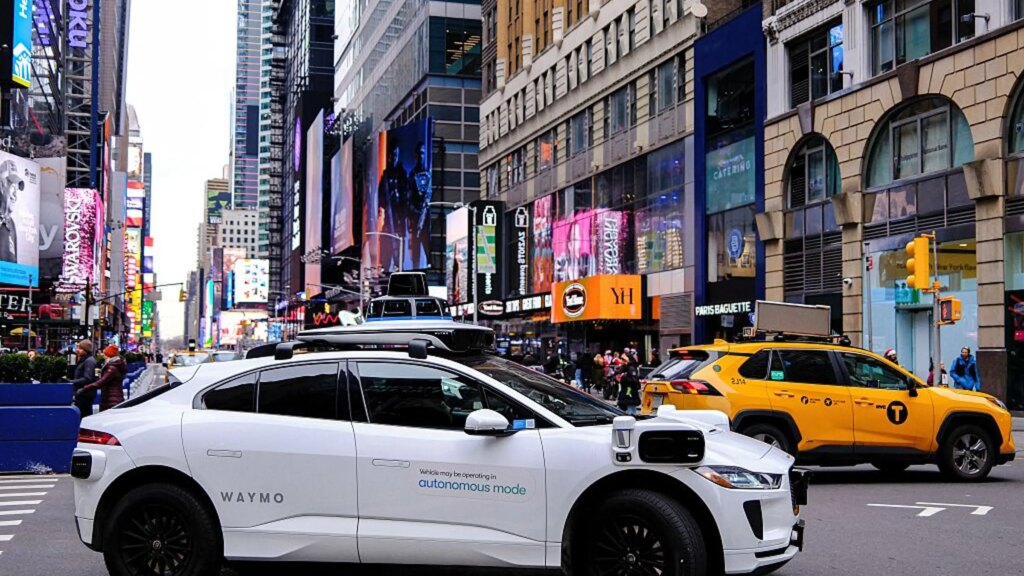
The quiet arrival of Waymo driverless vehicles in Chicago raises one of the most consequential questions facing modern cities: How do we balance embracing transformative technology while ensuring public safety?
The debate over these autonomous vehicles often collapses into two camps: One side treats any regulation whatsoever as an obstacle to progress, the other argues we should pause on innovation until every future risk is resolved.
Both instincts may be rooted in good intentions, but both are woefully insufficient for governing a big city like Chicago, especially as the regulatory framework is still taking shape.
The truth is that cities don’t need to choose between innovation and safety. But if Chicago is going to welcome self-driving technology, the municipal government and the private sector must work in true partnership and stop treating public safety as something that gets bolted on only after a crisis or tragedy strikes.
For public safety officials, the problem with autonomous vehicles isn’t theoretical; there are real cases that consume their day-to-day work. In San Francisco, a power outage caused Waymos to stall in the middle of intersections and streets, blocking traffic and hindering emergency vehicles from getting through. In Los Angeles and Atlanta, they were driven into a felony stop and an active crime scene, seemingly unable to recognize the police vehicles or changes in traffic patterns.
While tech companies treat these examples as rare anomalies, in public safety, they are the use case. City officials are trained to operate as if nothing will go as it should. Any technology introduced into the public domain must be evaluated not just when everything goes right, but when everything goes wrong.
We know how this goes.
Days after being sworn in as FDNY Commissioner in 2022, fire marshals arrived at my office with grim news. E-bikes and the lithium-ion batteries that power them—devices that had only recently been introduced in New York City—suddenly became a top cause of fire deaths. While these batteries had been deemed safe in a lab setting, everything about city living made them more dangerous and more prone to fire, from potholes and salt-covered streets that damaged their protective casing to small apartments where bike storage is blocking the exit, to the growing demand for fast delivery that led to bad actors selling unsafe devices for a profit. It was so alarming that I went to Congress, and testified before the Consumer Product Safety Commission to warn others about what was happening in New York.
It didn’t have to be this way. Online retailers could have been seen as partners in the rollout of this new technology, and companies could have worked with the city to build best practices and outdoor infrastructure that would protect residents from the fires these batteries were causing. There’s nothing about the danger these bikes presented that couldn’t have been solved by working more closely together.
Some might see this as a reason to never try anything new, but I don’t agree. Building a city infrastructure that allows for innovation in mobility opens up all kinds of new avenues for manufacturing, job growth, and how services are delivered.
That is the model we should be aiming for: where technology companies and public-safety institutions are not adversaries, but partners. Where they recognize success can be achieved in both spheres using what already exists as best practice in tech: iterative design, rigorous testing, and user feedback.
Before any municipality allows autonomous vehicles onto its streets, officials should require three things:
There must be clear operational protocols for emergency conditions
Autonomous vehicle systems must be designed, tested, and validated in coordination with first responders. That means understanding how vehicles behave during blackouts, natural disasters, and large-scale emergencies—and ensuring responders can override, disable, or safely move them when seconds matter.
Success requires shared accountability
When autonomous systems fail, responsibility cannot be unclear or allow endless finger-pointing. Cities need enforceable agreements that specifically define who is responsible for risk mitigation, incident response, data sharing, and remediation. Innovation without accountability is not progress; it’s offloading risk onto cities and first responders while companies reap the rewards.
Collaboration must be ongoing, not a one-time approval
Technology evolves faster than regulation, and often the way humans interact with these devices changes how they operate. Cities should require continuous engagement between developers, regulators, and public-safety leaders to review driverless car incidents, update standards, and adapt to real-world conditions.
Autonomous vehicles, like many emerging technologies, have vast potential to reduce traffic fatalities, expand mobility, and improve quality of life. But they can also displace jobs, impede emergency services, and have unintended or unpredictable consequences. This balance can only be realized if trust is built through true partnership with city government.
The future of urban innovation cannot continue to be a standoff between Silicon Valley and City Hall. It has to be a working relationship grounded in shared responsibility for the people who live, work, and respond to emergencies in our cities every day.
This isn’t about slowing innovation, it’s about creating lasting and durable innovation that doesn’t crash and burn.
The post What Cities Need To Consider Before Allowing Self-Driving Cars appeared first on TIME.