The Trump administration is weighing designating Brazil’s two biggest drug gangs as terrorist groups, after lobbying by two sons of jailed former President Jair Bolsonaro, an ally of President Trump, according to U.S. and Brazilian officials.
Security has become a major concern for Brazilian voters, and a designation could put a bigger spotlight on the issue and help one of Mr. Bolsonaro’s sons, Flávio Bolsonaro.
He is challenging President Luiz Inácio Lula da Silva of Brazil, a leftist, in national elections this October and has accused Mr. Lula of being soft on crime.
The proposal, discussed in recent weeks within the State Department, has raised concerns among Brazilian officials that the United States may try to puts its thumb on the electoral scale to help another Bolsonaro.
Last year Mr. Trump used tariffs and sanctions to try to keep Mr. Bolsonaro out of prison on charges of overseeing a coup after losing the last election in 2022, to Mr. Lula. Mr. Bolsonaro was ultimately convicted and sentenced to prison.
The Trump administration has labeled more than a dozen Latin American gangs terrorist organizations as part of a campaign to target criminal groups that American officials say threaten the United States, including major Mexican drug cartels. The designations mean the U.S. government can impose financial restrictions on the groups and their associates.
Yet the Brazilian gangs, the First Capital Command and the Red Command, do not play a major role in trafficking drugs to the United States. They mostly send cocaine to Europe and other parts of the world.
But Secretary of State Marco Rubio made a push earlier this month. On March 8, a day after Mr. Trump hosted a summit of conservative Latin American leaders to talk about crime and drugs, Mr. Rubio told Brazil’s foreign minister that the Trump administration planned to make the designation, according to officials with knowledge of the conversation.
Mr. Rubio also asked the foreign minister, Mauro Vieira, to label the gangs as terrorist groups, but Mr. Vieira said his government would not do so, the officials said.
The officials spoke on condition of anonymity to discuss private conversations.
Mr. Rubio is expected to see Mr. Vieira at a diplomatic gathering of the Group of 7 nations in France on Friday, and the topic of designations may come up if they meet one-on-one.
The State Department has not finalized the designations, and any internal decision could still be reversed.
The department declined to comment on the possible designations, but acknowledged that the two Brazilian gangs were on its radar.
The groups pose “significant threats to regional security due to their involvement in drug trafficking, violence and transnational crime,” the State Department said in a statement.
Mr. Lula’s office also declined to comment on the U.S. designations.
A Brazilian official said Mr. Lula and Mr. Trump have negotiated on measures to combat money laundering and arms trafficking by the two gangs in recent weeks. The designations could jeopardize those talks, said the official, who asked for anonymity to talk about internal policy discussions.
In a statement to The New York Times, Flávio Bolsonaro said he does not support foreign interference to solve Brazil’s problems with drug gangs, but is in “favor of international cooperation” on the issue. Eduardo Bolsonaro did not respond to a request for comment.
Behind the scenes, the closest allies of the former president have worked for months to convince U.S. officials that the Brazilian drug gangs pose a direct threat to American security and interests, according to two people with knowledge of the situation who spoke anonymously to describe sensitive discussions.
Flávio Bolsonaro, who in addition to running for president is also a Brazilian senator, traveled to Washington last spring to meet with White House and State Department officials, according to the people.
He was joined by his brother, Eduardo Bolsonaro, they said, who has been living in the United States while lobbying Mr. Trump to help his father and the family’s conservative movement.
During the visit, Flávio Bolsonaro, who led a security committee in Brazil’s Senate at the time, presented American officials with a report on the activities of gangs in Brazil and the United States, according to a person at the meeting. The dossier included details of alleged arms trafficking and money laundering, the person said.
Mr. Lula’s government worries that the terror label could allow the United States to impose sanctions on Brazilian banks that may have unwittingly done business with the gangs, the Brazilian official said.
The Brazilian government also fears the designation could open the door to unilateral U.S. military operations in the country, the official said.
Mr. Trump has used the designation of drug gangs to justify a series of military actions in Latin America, including dozens of lethal strikes on boats that he said, without presenting evidence, were carrying drugs to the United States. The designation of Venezuelan groups also factored into the Trump administration’s public rationale for the U.S. military operation in January to seize Venezuela’s president, Nicolás Maduro.
Earlier this month, U.S. officials said they had bombed a drug trafficker’s training camp in Ecuador, but that turned out to be a farm, according to a New York Times investigation.
Brazil has counterterrorism laws on the books but does not classify drug trafficking as terrorism or keep its own list of terrorist groups. Instead, it acts in step with the U.N. Security Council, applying sanctions on groups the international body designates as terrorist organizations.
If the Brazilian government were to label drug gangs as terrorists, that would be a major policy departure. And yielding to American pressure would contradict Mr. Lula’s stance against U.S. meddling in his country’s affairs, which he has called a threat to Brazil’s sovereignty.
On the U.S. side, Darren Beattie, the Trump administration’s newly appointed envoy for Brazil, and Ricardo Pita, a State Department adviser, have been leading voices pushing for the designation, according to two officials.
Mr. Beattie, who has claimed Brazil’s last election was stolen from Mr. Bolsonaro, stirred diplomatic tensions this month when he sought to visit Mr. Bolsonaro in prison. That led Brazilian officials to revoke his visa.
Mr. Beattie, who until recently oversaw public diplomacy at the State Department, has tried to forge closer ties between the Trump administration and hard-right political parties abroad. In the first Trump administration, Mr. Beattie was fired from a White House speechwriting job after he spoke at a conference attended by white nationalists.
During a trip to Brazil in May 2025, Mr. Pita visited Mr. Bolsonaro as he awaited trial and snapped photos with the former president, according to social media posts by Eduardo Bolsonaro.
Mr. Bolsonaro was sentenced to 27 years in prison for planning a coup, though he is expected to soon move to house arrest because of his poor health.
Even as Mr. Lula has resisted U.S. pressure to cast drug gangs as terrorist groups, he has tried to signal to Mr. Trump that he shares his concerns.
Mr. Lula’s office said he plans to discuss drug trafficking with Mr. Trump during a coming visit to the White House.
Fighting drug cartels has become a major political issue across Latin America, energizing right-wing political parties that cast the left as weak on crime.
In Brazil, Flávio Bolsonaro and other right-wing lawmakers have tried to advance legislation that would classify drug gangs as terrorist organizations, although these efforts have stalled
“Clearly, the right wants to politically exploit this issue,” said Fábio Kerche, a professor of political science at the Federal University of the State of Rio de Janeiro. “They are trying to sell this idea that the left protects the criminals.”
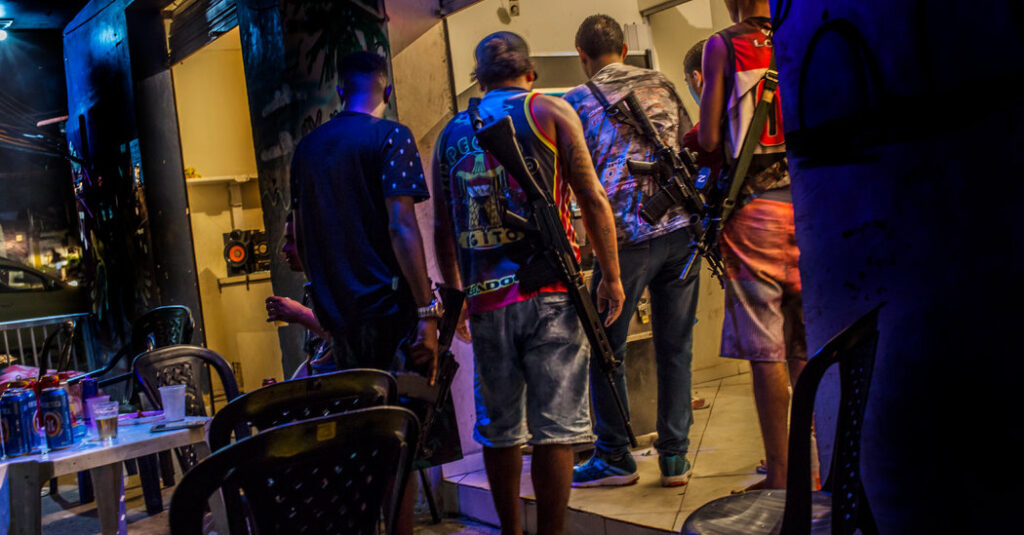
The First Capital Command and the Red Command have expanded across Brazil and menace even remote Amazonian communities through violence and extortion. Brazilian authorities say the groups have also infiltrated the financial system, amassing stakes in gas distribution, real estate and cryptocurrency.
Policing drug trafficking is mostly the responsibility of Brazilian states and cities, but Mr. Lula has responded to political pressure by increasing the powers of the federal police to fight organized crime and seize financial assets.
Now, the issue of organized crime could prove decisive come election time: a new survey showed that crime and violence were the top concern of nearly half of Brazilians.
“The reality is Lula finds himself between a rock and a hard place,” said Thomas Traumann, a political analyst and press secretary for a leftist former Brazilian president.
Jack Nicas contributed reporting from Mexico City, and Lis Moriconi contributed research from Rio de Janeiro.
Ana Ionova is a contributor to The Times based in Rio de Janeiro, covering Brazil and neighboring countries.
The post U.S. May Label Brazilian Gangs as Terror Groups, After Push by the Bolsonaros appeared first on New York Times.