President Donald Trump said Thursday that progress has been made in negotiations with Tehran aimed at ending the Iran war. Talks “are going very well,” he wrote in a post on social media.
In the same post, Trump said he would delay attacks on Iran’s energy infrastructure by an additional 10 days. Trump issued a 48-hour ultimatum to Iran last weekend, saying he would “obliterate” the country’s power plants, beginning with the largest, if it did not reopen the Strait of Hormuz. The president on Monday issued a new five-day timeline, saying negotiations to end the war had begun.
Trump’s pursuit of a negotiated settlement to the war comes as the conflict approaches the one-month mark. U.S. and Israeli strikes on Iran have killed members of the country’s senior leadership and destroyed military infrastructure, but it’s unclear if the attacks have made Tehran more willing to compromise and accept a ceasefire deal with the United States.
Statements from Iran about the negotiations have struck a different tone from Trump’s. Iran’s state-run media reported earlier Thursday that Tehran had rejected a 15-point ceasefire proposal by the White House. But the Iranian report did not suggest a total breakdown in negotiations, leaving open the possibility that Washington could issue a follow-up proposal.
Iran has previously offered its own terms for ending the conflict, including demands for the United States and Israel to pay compensation for war damage, the cessation of Israeli attacks against Lebanon, and the recognition of Iran’s sovereignty over the Strait of Hormuz.
Financial markets fell Thursday, as oil prices again rose above $100 a barrel. The S&P 500 lost 1.7 percent, and the tech-heavy Nasdaq fell 2.4 percent, ending the day in correction territory — off 10 percent from its recent high.
U.S. envoy Steve Witkoff confirmed transmission earlier this week of the administration’s 15-point plan to Iran, through Pakistan, during a televised Cabinet meeting Thursday. Witkoff said the proposal resulted in “strong and positive messaging and talks.”
“We will see where things lead,” he said, “and if we can convince Iran that this is the inflection point with no good alternatives for them other than more death and destruction. We have strong signs” that an agreement “is a possibility,” he said.
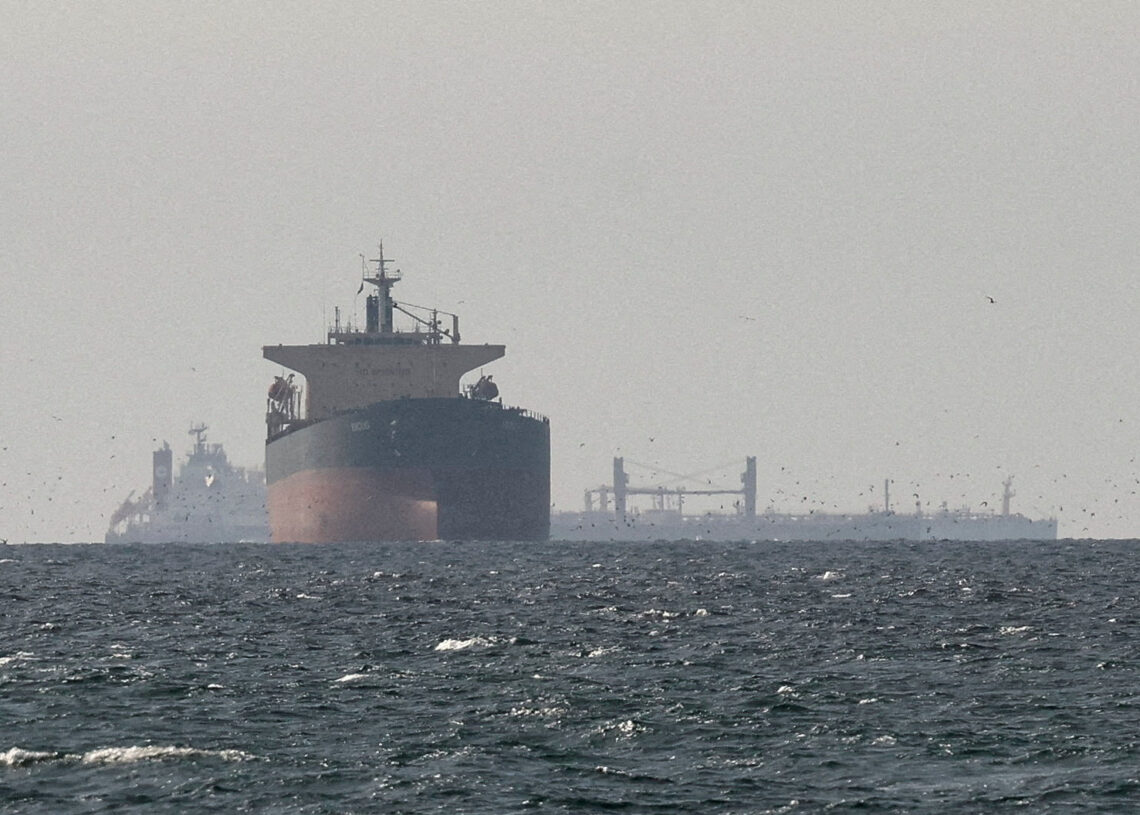
At the same Cabinet meeting, Trump referred to his comment two days ago that Iran had delivered a “present” to the U.S. as a sign of goodwill and said that Tehran had allowed 10 Pakistani-flagged oil tankers to transit the Strait of Hormuz.
When asked earlier in the day Thursday if he would extend his five-day deadline for Iran, Trump said: “I’m the opposite of desperate. I don’t care. … We have other targets we want to hit before we leave.”
Nearly a month into the war, weakening Iran’s hold on the Strait of Hormuz — a critical conduit for global energy supplies — has emerged as a top military objective for the United States. Tehran’s efforts to block the strait, through which roughly 15 percent of the world’s oil and 20 percent of its liquefied natural gas pass, have caused oil prices to spike and fueled global anxiety over energy prices and supply chains.
Israeli operations in Iran continued to target senior leaders for assassination. Israeli Defense Minister Israel Katz said Thursday that Iran’s top naval commander, Alireza Tangsiri, was killed in an overnight airstrike, casting it as an effort to support the United States’ push to reopen the Strait of Hormuz.
Katz said the commander of the Islamic Revolutionary Guard Corps’ navy was targeted along with other senior naval commanders for their roles in using military force to close the strait. Katz also accused Tangsiri of “mining and blocking” the waterway.
Tangsiri, 62, was subjected to sanctions by the U.S. Treasury Department in 2019 in response to his threats to close the Strait of Hormuz. “Tangsiri sits atop a structure … that is responsible for the sabotage of vessels in the international waters,” Treasury officials wrote at the time. In 2023, the department again imposed sanctions against him for his chairmanship of an Iranian arms company that produced drones used by the IRGC. He had also overseen the IRGC’s testing of drones and cruise missiles, the department said.
On Wednesday, Iranian Foreign Minister Abbas Araghchi questioned why Iran would allow “the enemy” to pass through the strait. “We have permitted certain countries that we consider friendly to pass through; we allowed China, Russia, India, Iraq, and Pakistan to transit,” he said, according to the Iranian state news agency IRNA.
Araghchi confirmed Thursday that Tehran and Washington were exchanging messages through intermediaries but said he did not consider that a negotiation, according to IRNA.
Pakistani Foreign Minister Ishaq Dar said Islamabad was acting as an intermediary for indirect talks. “In this context, the United States has shared 15 points, being deliberated upon by Iran,” Dar said Thursday.
In a separate social media post earlier Thursday, Trump lashed out at NATO countries for refusing to join the U.S. and Israel’s joint military offensive, in his latest expression of frustration after European leaders and other allies rebuffed his calls to help secure the strait. NATO allies have done “ABSOLUTELY NOTHING,” he said.
European leaders are reluctant to join a war they did not initiate and are still reeling from Trump’s efforts this year to wrest Greenland from Denmark’s control. On Thursday, The Washington Post reported that Pentagon officials were considering plans to divert U.S. weapons for Ukraine to the Middle East, a further signal of the widening rift between Europe and Washington.
Lior Soroka in Tel Aviv, Heba Farouk Mahfouz in Cairo, and Karen DeYoung and Michael Birnbaum in Washington contributed to this report.
The post Trump says U.S. to hold off for 10 days on hitting Iran energy sites appeared first on Washington Post.