President Trump said on Thursday that he would sign an emergency order to pay Transportation Security Administration agents who have gone without compensation for weeks, as senators struggled to strike a homeland security funding deal that could end the intensifying crisis at airports.
Mr. Trump did not provide any details, but the administration was expected to use funds provided to the Department of Homeland Security last year as part of his tax cut and domestic policy law, according to a senior administration official and another person familiar with the plan, both of whom spoke on the condition of anonymity to describe it.
No executive order, emergency or otherwise, would be required to access those funds, which were enacted into law last summer, but Mr. Trump appeared eager to claim credit for releasing them. It was not clear why he had waited more than five weeks after the Department of Homeland Security was shuttered to direct that they be used to pay T.S.A. employees.
Travelers are facing long waits at airport security checkpoints, in some cases more than two hours, as the partial shutdown continues. About 50,000 T.S.A. personnel have been working without pay for over a month, and hundreds have quit or stopped appearing for work.
As lawmakers have struggled to come up with a deal to fund the department, Mr. Trump and Republicans in Congress have repeatedly blamed Democrats for depriving T.S.A. agents of their pay. Democrats had been pressing to separately fund T.S.A. for weeks, an approach that Republicans rejected time and time again after Department of Homeland Security funding lapsed on Feb. 14.
But until Thursday, neither side had wanted to budge on money for T.S.A. — the part of the department that most visibly affects Americans’ daily lives — as each sought leverage in a broader dispute over Mr. Trump’s immigration crackdown. That fight began last month when, following the killings of two U.S. citizens by federal immigration agents, Democrats refused to fund the Department of Homeland Security without measures to rein in enforcement tactics.
With long lines at airports ahead of a prime spring travel weekend, and with lawmakers eager to compromise ahead of a two-week congressional recess, Senate Democrats and Republicans had stepped up their efforts in recent days to reach a funding deal, and spent Thursday haggling over the terms.
Yet as the pace of conversations picked up on Capitol Hill, there was still no sign of a compromise by evening, which Mr. Trump acknowledged in a social media post announcing his plan.
“I am going to sign an Order instructing the Secretary of Homeland Security, Markwayne Mullin, to immediately pay our TSA Agents in order to address this Emergency Situation,” he said.
He lashed out at Democrats, who he said had “recklessly created a true National Crisis” by refusing to fund the Department of Homeland Security. And he said he had been moved to intervene personally.
“It is not an easy thing to do,” Mr. Trump said, “but I am going to do it!”
Senator John Barrasso of Wyoming, the No. 2 Republican, acknowledged that senators, who have traditionally fought to preserve their power of the purse, “would have preferred to get this done here on the floor of the United States Senate.”
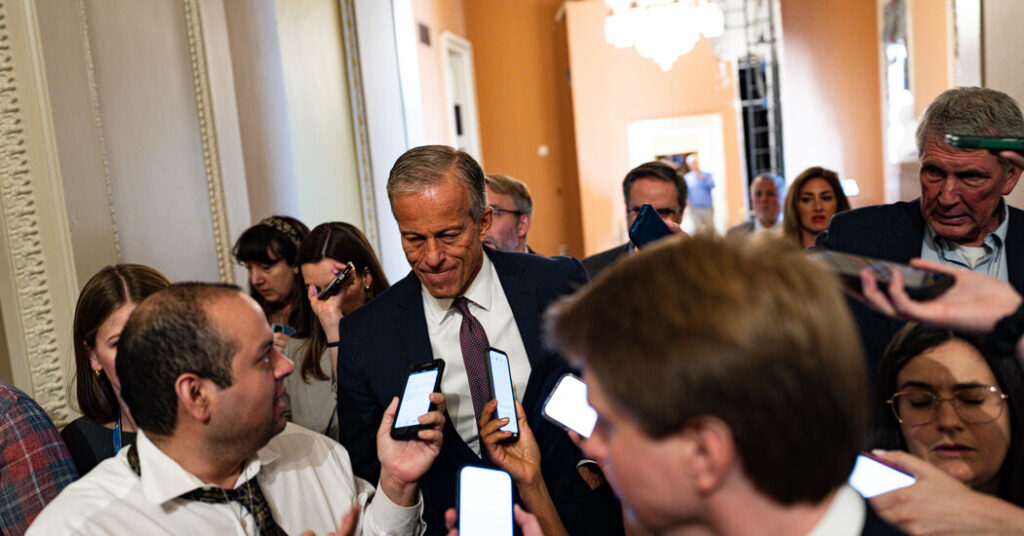
Senator John Thune, Republican of South Dakota and the majority leader, called Mr. Trump’s announcement a “short-term solution,” suggesting that Republicans would keep pressing to reach a broader deal.
“Obviously we want to fund everything within” the Homeland Security Department, he said.
Democrats slammed Mr. Trump’s intervention, saying they would continue pressing for immigration enforcement changes. Representative Rosa DeLauro of Connecticut, the top Democrat on the Appropriations Committee, said that lawmakers still needed to negotiate a funding bill.
“I am glad that this administration has finally chosen to pay these workers, after choosing not to for 41 days,” she said in a statement. “The administration must provide an explanation as to what funding it is using to pay these workers after falsely claiming it could not do so.”
Republicans on Thursday morning sent Democrats what Mr. Thune called “our last and final” offer. It would have funded the department without money for Immigration and Customs Enforcement’s deportation and detention operations.
But Democrats have continued to insist that any spending measure still include limits on federal immigration agents, and contain guardrails to prevent funds from be moved from other parts of the department to be used for immigration enforcement efforts.
Senator Chris Coons, Democrat of Delaware, hinted that the talks were making headway, saying that the “back-and-forth” was continuing between the two parties.
“I think the good news is that there is very broad agreement that we have to fund T.S.A.,” he said. “The bad news is that there’s not yet agreement on exactly how to fund D.H.S. without Democrats funding ICE, and we’re trying to get clarity on exactly what that looks like.”
The negotiating was happening in closed-door meetings and in public, as bipartisan groups of senators huddled in the Senate chamber to discuss the shape of a potential deal. Still, by Thursday evening, optimism had faded.
Senator Mike Rounds, Republican of South Dakota, looked glum when he was asked whether lawmakers had made progress on negotiations.
“No,” he said, shaking his head before heading to the Senate floor.
Earlier Thursday, the House separately voted to pass a bill to fully fund the Homeland Security Department, the third time in two months that the chamber had done so. Four Democrats joined Republicans in supporting the bill, which passed 218 to 206.
Still, a funding bill remains stalled in the Senate, where 60 votes are required for major legislation to move forward.
Senator John Kennedy, Republican of Louisiana, had said he would push for a separate bill that would fund just the T.S.A. And before Mr. Trump’s announcement, officials had been weighing whether they could find a way to pay T.S.A. agents by using funds that Republicans gave the department last year as part of their sweeping tax and domestic policy bill.
That measure handed a slush fund to ICE, and billions more to the rest of the Homeland Security Department with few limitations, including $10 billion for “border support.”
Senator Susan Collins, Republican of Maine and the chairwoman of the Appropriations Committee, told reporters on Thursday that the Office of Management and Budget had determined that Mr. Trump had the authority to use the funds in the law to pay T.S.A. workers.
Carl Hulse, Tony Romm, Chris Cameron and Erica L. Green contributed reporting.
Michael Gold covers Congress for The Times, with a focus on immigration policy and congressional oversight.
The post Trump Says He Will Order T.S.A. Agents Paid as Funding Deal Stalls appeared first on New York Times.