Times Insider explains who we are and what we do and delivers behind-the-scenes insights into how our journalism comes together.
When President Trump took office last year for the second time, Jennifer Schuessler, a culture reporter for The New York Times, knew he wanted to make major changes to the nation’s cultural institutions. She also knew he had a track record of criticizing content that he deemed “woke” or divisive.
She just didn’t know how significant those changes would be — or how quickly they might come.
“I’m surprised by the forcefulness with which the president has pursued this campaign,” said Ms. Schuessler, who writes about intellectual life and the world of ideas, and, more recently, Mr. Trump’s efforts to reshape America’s museums and scholarly institutions.
Over the past year, she has written about his canceling peer-reviewed grants awarded by the National Endowment for the Humanities, his attempts to exert influence over exhibitions at the Smithsonian and other American museums and his ongoing push to put his stamp on how the nation’s story is told.
“The full shape of it is very hard to determine,” Ms. Schuessler said, “but I suspect there will be more of this.”
In an interview, she discussed why the president is so focused on America’s cultural institutions and how lasting his efforts to reshape them might be. These are edited excerpts from the conversation.
When did these changes — or the promise of these changes — start in earnest?
President Trump has been talking about his vision of American history for quite a long time. He talked a lot in his first term about the need to put forward what he deemed patriotic history. That was when he first proposed the National Garden of American Heroes. He established the 1776 Commission, which released a report two days before he left office.
Barely more than a week after he came back into office, he released an executive order that called for celebrating America’s 250th birthday. But what really got things going was the executive order he issued last March that called for restoring “truth and sanity” to American history.
The first part criticized the Smithsonian and called on Vice President JD Vance to redirect the institution, which — in Mr. Trump’s view — had been taken over by a corrosive, race-based ideology. The second half directed the secretary of the interior, Doug Burgum, to investigate and recalibrate all the history within the National Park Service, which has many historical sites like Gettysburg and Independence Hall in Pennsylvania.
And now what we have seen in the past few months, in quite a dramatic way, are efforts to remove or change material that the administration doesn’t like.
Why is President Trump so focused on cultural institutions?
I think there was a recognition among people in his movement that culture matters, that the stories we tell ourselves about what kind of a country we are really matter. And their view is that all these cultural institutions are controlled by liberals who are anti-American, and that it’s really important to take these institutions back.
In some ways, this is very similar to the Trump administration’s complaints about universities, which he has similarly tried to bring to heel. But there’s an interesting difference. While trust in higher education has plummeted, surveys show that museums remain trusted sources of information for people across the political spectrum. And the Smithsonian museums remain crowded and popular places.
What have been some of the most significant or potentially long-lasting changes?
It remains to be seen what the long-term impact will be on the Smithsonian. It isn’t under the direct authority of the president.
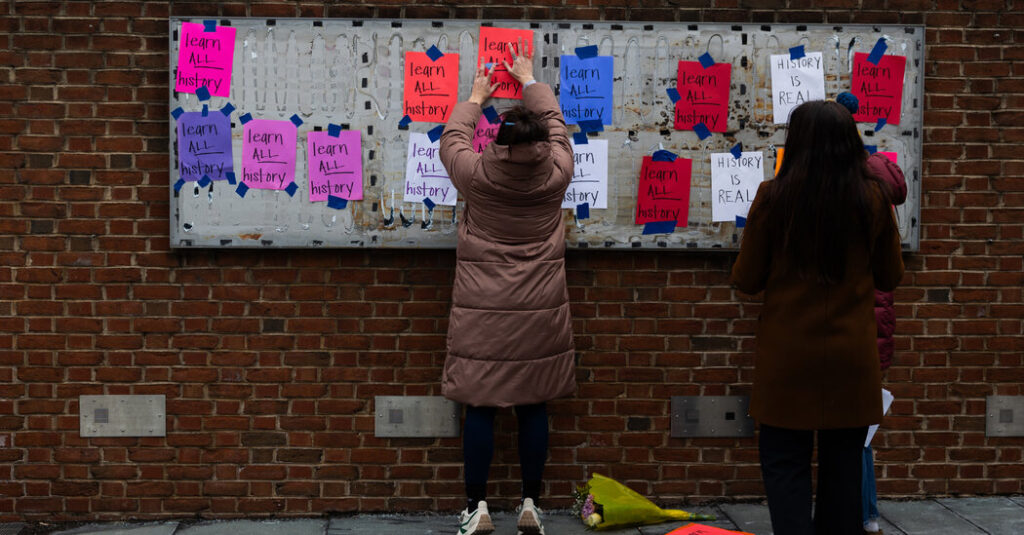
But what has shocked and upset a lot of people is seeing what happened in Philadelphia in January, when the National Park Service leadership ordered workers to remove every sign that discussed slavery in early America at a site next to Independence Hall, which specifically included discussion of the enslaved people owned by George Washington when he lived at that site. [A federal judge has since ordered the Trump administration to temporarily restore the displays.] That felt concrete and very, very real. Many people experienced it as an attack on knowledge, memory or even the legitimacy of wanting to know about these things.
How are people you’ve talked to at these institutions responding?
It’s hard to get any federal employees to talk. But I’ve had conversations with people who work with these federal institutions — whether they’re historians or archaeologists or other experts who consult on exhibitions that are now coming under attack, or people in the surrounding community, as in Philadelphia. The people who are invested in these sites and have worked over years to create them feel very upset.
What else should people know about President Trump’s attempts to reshape cultural institutions right now?
It’s fascinating to watch the president try to assert a particular kind of story about America. But that doesn’t necessarily mean that everybody who’s exposed to it, including people who voted for him, are going to think the way he does. It’s important to understand that a lot of discussions of history and decisions about historical sites happen at a state and local level. The federal government is not the sole arbiter of any of this.
Is there anything that has surprised you about reporting on this story?
One thing that has really struck me is that ordinary Americans are far less interested in fighting about history than it might seem. People who work at historical sites, whether government-run or private, report that most visitors, whatever their politics, show up open-minded and curious and hungry for fact-based, nonpartisan history.
Sarah Bahr writes about culture and style for The Times.
The post Tracking Trump’s Efforts to Reshape Cultural Institutions appeared first on New York Times.