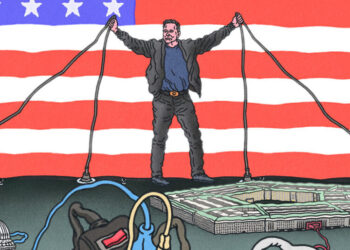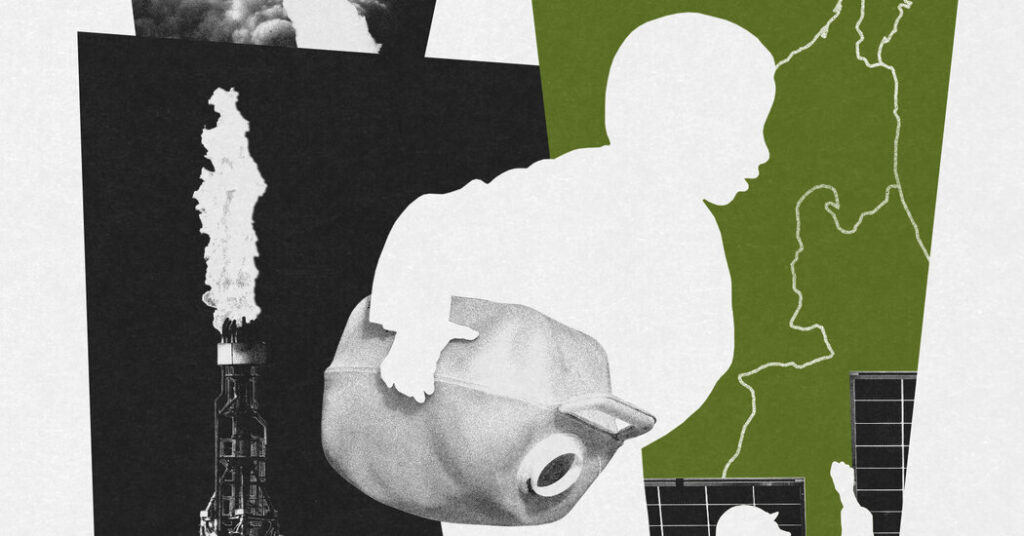
America’s war on Iran began with what was meant to be an intimidating performance of overwhelming air power. Quickly it became another kind of conflict, with low-cost missiles and drones effectively neutralizing a superpower by punishing its allies and paralyzing energy flows. By the time President Trump tried to threaten Iran into reopening the Strait of Hormuz with a 48-hour ultimatum, it was clear not just that the strait had become America’s singular strategic fixation but that the whole campaign was now a war about energy, in which oil prices and gas plants had become the central theater of conflict.
With Russia’s invasion of Ukraine and the supply-chain disruptions of Covid, the war in Iran marks the third major energy shock in just a handful of years, years in which fossil loyalists argued that the green transition risked intolerable turmoil and political leaders cooled off on climate urgency in the name of “energy security.”
The world is still feeling the sting of the last shock, and the new one promises a brutal long tail, as well; the head of the International Energy Agency has called the war in Iran “the greatest global energy security threat in history.” One-fifth of the world’s liquefied natural gas flows through the Strait of Hormuz, along with perhaps one-fifth of its oil — and though the direct costs of the blockade have generated the most attention, the downstream price spikes are just as concerning. Across much of Asia and parts of Africa, fuel shortages and blackouts are likely. The world could be pulled into recession by the force of energy inflation, even if outright conflict subsides soon, and the higher costs of everything, including the inputs for semiconductors, The Financial Times has warned, might pop the A.I. bubble that is keeping the American economy afloat. A food crisis to dwarf the one that followed the invasion of Ukraine could follow, as the war disrupts not just the price of food but also the global flow of fertilizer — another product of fossil fuels — on the brink of planting season.
That so much could be pulled down the drain by a somewhat goal-less war of choice is partly a result of inept or indifferent planning. But this war is also a new kind of conflict, given shape by fossil-fuel turmoil and the uncertainty brought about by the energy transition of the last decade.
By many metrics and from many vantages, green energy has been a dizzying, ecstatic success. Renewables have grown faster than any new source of energy in history, surpassing nearly all expectations. But we are still in the middle of that transition, with the end of the old paradigm, built on oil and gas and coal, still decades away.
Climate advocates and energy analysts like to say that in the postcarbon future, the geopolitics of energy will be defanged. In the meantime, the energy transition has tightened fossil-fuel markets and concentrated fossil-fuel supply, drawing investment away from aging infrastructure. This has made energy supply somewhat more vulnerable to shock and energy infrastructure more attractive to military targeting. Even wars of choice unfold in a global context, and Iran is no different: a new age of resource conflict arising just as the old energy order was being upended but before the new one has really taken hold.
Call it a midtransition war.
This Is the Midtransition
You can date the very beginning of the long green transition to the energy crises of the 1970s: Jimmy Carter slapping solar panels on the White House roof, France going all in on nuclear power, those first earnest lectures about “energy efficiency.” The price of solar panels fell 99 percent in the 50 years that followed, but global uptake was painfully incremental. It was only in the decade after the signing of the Paris Agreement in 2015 that the world really started to believe that renewables might soon dominate the energy future. Money followed, with worldwide investment in fossil fuels dropping by more than a third between 2015 and 2020 and clean-energy investment growing nearly twice as high since.
But global transformations take time, and for all the rapid green progress, we are still drawing a majority of our energy from legacy systems burning through fossil fuels.
The term “midtransition” comes from Emily Grubert, an environmental sociologist who uses it to describe just how messy decarbonization might be, even if it all goes inspiringly well. Take, just for instance, gas stations: How many of them should there be, once electric vehicles take over the roads while charging exclusively in garages and driveways, and what should we do about all the others made redundant? Or think about the electricity grid, which nearly everyone considering the energy future now agrees must be rapidly expanded: Elsewhere in the world, users have flocked to rooftop solar to secure their own energy needs, shrinking their carbon footprints but also destabilizing the grid by depriving it of customers and revenue. What happens to the global shipping industry as the world moves away from fossil fuels, given that they account for some 40 percent of all shipping by volume? Literally: What are we supposed to do with all those tankers? This is the midtransition in energy.
There is also a midtransition in geopolitics, already underway. Look, for example, at the Arab gulf countries, petrostates that have spent the last decade channeling oil profits into Big Tech venture capital, bringing them further into alignment with the United States and Israel. Or at China, which now spends hundreds of billions on clean-energy investments abroad while maintaining a fossil-fuel partnership with Russia — and Iran.
And then there’s the midtransition in war. Though Vladimir Putin offered a mesmerizing array of justifications when he invaded Ukraine in 2022, Europe’s energy transition offered its own logic — or rather, its own timeline. The continent’s ambitious net-zero commitments meant that Europe was planning to move away from imports of gas, inevitably cutting Russia’s energy leverage over NATO. When the Nord Stream pipelines were blown up that September, it seemed so hard to understand that many assumed Russia was to blame. But even American intelligence now believes it was the Ukrainians, effectively applying the same midtransition principle in reverse: Blowing up the pipeline ensured that Ukraine’s NATO allies couldn’t make up with Russia easily and pushed Europe faster along its path of decarbonization. This used to be called ecoterrorism; now it was the strategic work of hardheaded nation states.
In Foreign Affairs last fall, Jason Bordoff and Meghan L. O’Sullivan declared “the return of the energy weapon.” For most of the modern era, they wrote, energy was a familiar tool of great power coercion. But over the last half-century, since the 1973 oil crisis, global powers had managed to mostly avoid the old conflicts and smooth out once-familiar disruptions. Citizens across the rich world were lulled into the expectation that the energy system would always work reliably for them. “Today, that complacency has been upended,” they wrote, with the global order and the energy system fragmenting at the same time. And that was before Trump ordered the kidnapping of President Nicolás Maduro of Venezuela partly to secure a new source of oil, and before the United States stumbled into a global energy crisis by trying to bomb a petrostate into regime change.
No one has ever started a war over solar panels, as any climate activist will tell you. And the economic blast radius of the Iran conflict is large enough that it’s hard to miss the argument it makes for rapid decarbonization. Why continue to rely so heavily on imports from erratic authoritarians overseas when you can instead harvest the bountiful sun, wind, hydropower and geothermal found nearly everywhere on earth?
In a time of resource wars, you get to reap additional rewards, too. The most outspoken Western critic of the war in Iran has been Prime Minister Pedro Sánchez of Spain, a country that has doubled its renewable capacity in the last five years and cut the influence of fossil fuels on its electricity price by 75 percent. The Spanish energy transition is far from complete, but the country has already bought back the right to speak its conscience.
The Wars of the Future
Not that a renewable future will be a peace-loving utopia. There are already heated trade wars over the minerals necessary for the batteries that power electric vehicles. The United States’ recent escalation with China reached its boiling point over rare-earth metals, and Trump grew thirsty for Greenland seemingly on the same basis. (As it turns out, Greenland doesn’t actually have particularly great rare-earth deposits, which aren’t all that rare anyway.) Lithium and cobalt mining are a source of intense conflict in countries from Bolivia to Congo. It’s not hard to imagine those fights spiraling out of control, with consequences all down the global supply chain.
Beyond the famous petrostates, plenty of governments across the developing world depend on tax revenue from energy companies or direct funding from state-owned fossil-fuel enterprises. That funding will dry up more quickly the faster the transition goes, leaving those states precarious and vulnerable. Anytime the world map of literal power changes, the political hierarchy shifts, too.
Then there’s the issue of water. In Iran, a six-year drought has pushed the country to the brink of what is called “water bankruptcy,” with regular supply curtailments and street protests demanding “water, electricity, life.” In December, taps in Tehran’s south began to run dry. Then came larger protests, brutal crackdown and now war.
Already, desalination has become a miraculous lifeline in an increasingly inhospitable and unforgiving land, with parts of the Gulf drawing 90 percent of their drinking water from desalination plants. Over the last few years, the global green-energy boom has fed a dream that such free and abundant power will allow desalination to transform water-starved regions into oases. But what looks in the distance like techno-utopianism appears, in the meantime, more like a terrifying military vulnerability: Two desalination plants have already reportedly been struck — one in Iran, with the Iranians blaming the United States, and one in supposed retaliation by an Iranian drone in Bahrain.
This is all happening on a planet in the middle of its own transition, one that may well last thousands or even millions of years and to which few nations have even begun to properly adapt. In the meantime, vulnerabilities proliferate like heat.
The post The Iran War is Revealing the Messy Middle of Our Renewable Energy Transition appeared first on New York Times.