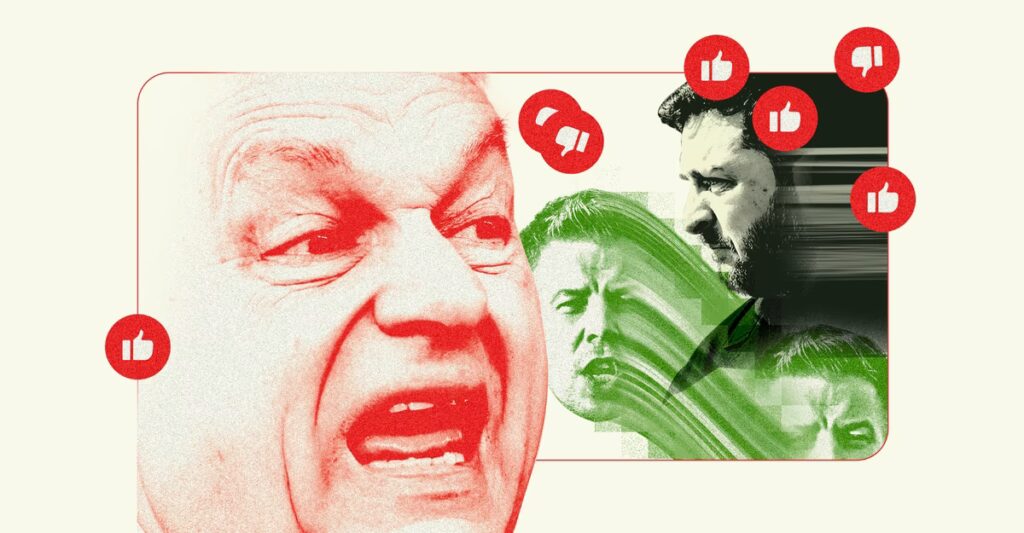
Flick through pro-government Hungarian accounts on TikTok, and you might see an AI-generated version of Volodymyr Zelensky, the president of Ukraine, sitting on a golden toilet, counting his money, snorting cocaine, and barking orders at a Hungarian soldier. You might also find an AI-generated Péter Magyar, the leader of the Hungarian opposition, appearing to say he’s fine with handing Hungarian factories over to foreigners, as long as he’s the one in charge of the country. Keep going, and you will find images of war, violence, and a SpongeBob lookalike declaring that Magyar “wipes up cocaine with me after he accidentally sneezed and it all fell to the floor.”
You won’t find much about Hungary itself, which is not an accident. In recent years political parties around the world have produced surrealist campaigns, comic campaigns, conspiratorial campaigns, even beer-drinking campaigns. But on any list of strange elections, the 2026 parliamentary election in Hungary will stand out—this may be the world’s first post-reality campaign.
In actual reality, the news for Viktor Orbán, the Hungarian prime minister, is not good. After 16 years in office, plus an earlier three-year term, Orbán has made his country the mostcorrupt in the European Union, one of the poorest, and certainly the least free. His political party, Fidesz, now controls most universities, the civil service, the high courts, and, through a network of oligarchs, almost all newspapers and broadcasters, as well as about a fifth of the economy, according to independent economists. General paranoia about Fidesz spies means that Budapest, once again, has become a city where people lower their voices when talking about politics in public.
With that kind of influence, Fidesz, which is well behind in most polls, cannot evade responsibility for Hungarian stagnation, and so neither the party nor its leader are talking much about Hungary, its falling industrial production, or its shrinking population. Instead—backed by Russian propagandists, the European far right, and now the Trump administration (about which more in a minute)—the party is directing a small fortune’s worth of posters and social-media videos toward a different goal: convincing Hungarians to fear sabotage, thievery, or even a military attack from … Ukraine.
This is an entirely false, even ludicrous threat. The Ukrainians have enough to do without starting a second war in Hungary. But Orbán, his government, his party, and many outsiders are now focused on making this threat seem true. Pay attention, because this may be the future of electoral politics: Multiple politicians from several countries are shoveling propaganda at an electorate in order to build terror of an enemy that doesn’t exist at all.
The campaign is not subtle. In Budapest last week, Orbán’s face was almost nowhere to be seen. But posters featuring Zelensky were ubiquitous. Sometimes the Ukrainian president is seen glowering alongside the slogan “Don’t let Zelensky have the last laugh.” Sometimes Zelensky appears with Magyar and Ursula von der Leyen, the president of the European commission, along with the slogan “They are the risk. Fidesz is the safe choice.” Peter Kreko, who runs a Budapest think tank, told me that this is unprecedented. In 2022, Orbán campaigned on keeping Hungary out of the war. Now he’s telling Hungarians that, as Kreko put it, “we are under imminent threat of attack.”
The same threats reach Hungarians on their phones. On TikTok, where new pro-Fidesz accounts appear every day, AI-created videos of Magyar seem to show him slandering his country—“I stay silent because my masters in Brussels have forbidden me from defending the homeland”—or else singing the Ukrainian national anthem. Another genre of video shows war violence: a Hungarian girl crying as her blindfolded father, wearing a Hungarian uniform, is executed, apparently in Ukraine. Multiple videos also smear Magyar, making personal, sexual, and financial allegations against him, but the fear-Ukrainian-invasion narrative dominates. During a Fidesz march on March 15, a group in the front of the crowd carried a banner declaring We won’t be a Ukrainian colony!
This language and these images have been backed up by the actions of the Hungarian state, each one designed to reinforce Fidesz propaganda. In February, Orbán sent Hungarian soldiers to guard the country’s oil and gas infrastructure, allegedly to prevent a Ukrainian attack, for which there was no evidence. In March, Hungarian counterterrorism authorities seized two trucks, owned by a Ukrainian bank, that were passing through the country on a routine cash-transport run from Vienna. They arrested seven bank employees, one of whom lost consciousness after they injected him with what may have been truth serum. Later they were all released because, again, there was no evidence against them.
[András Pethő: Trump’s attempts to muzzle the press look familiar]
The Hungarian government nevertheless confiscated $82 million in gold and cash, which it has not returned. The online publication Direkt36, one of a tiny number of outlets still doing investigative reporting in Hungary, wrote that Fidesz reckons this ham-handed operation a success: It provoked Zelensky to half-jokingly threaten Orbán, which gave the Hungarian leader another few days’ worth of material.
Hungarian state institutions are not the only government bodies seeking to shape Hungarian perceptions of reality. Although Orbán likes to use the word sovereignty, he now functions, in practice, as the most important Russian puppet in Europe. According to a Washington Post investigation published last week, Orbán’s foreign minister, Péter Szijjártó, regularly calls his Russian counterpart, Sergei Lavrov, to keep the Russians informed following European Union meetings, and sometimes to ask for favors. During a 2020 call between the two men, according to a transcript published by a Hungarian journalist, Szijjártó asked Lavrov to arrange a meeting in Moscow for a pro-Russian Slovak politician, to help him win an election. The meeting did later take place. Other European leaders long ago stopped discussing any security issues in the presence of Orbán himself, who has repeatedly used his veto to block European sanctions on Russia and European aid for Ukraine.
Concerned that a key asset might lose power, the Russians have sent a team of propagandists to Budapest to ensure that Orbán wins. The Financial Times has identified the influence group as the Social Design Agency, a Kremlin-backed IT company whose activities are well known. In 2023, back when the American government was still interested in unmasking Russian propaganda, the State Department’s now-dismantled Global Engagement Center exposed the agency’s role in creating a series of seemingly native pro-Russian websites in Latin America. In Budapest, they were tasked with creating AI videos and using their existing network of trolls and bots to pass them on. One Russian network has circulated doctored screenshots of the English-language website Euronews, with fake quotes attributed to Magyar. The Washington Post investigation revealed that the Russians even proposed to stage a fake assassination of Orbán, in order to build more sympathy for him. They called this strategy “Gamechanger.”
[Anne Applebaum: The longest suicide note in American history]
Tisza, Magyar’s opposition party, is expecting more. Several people close to Tisza told me that they feared a false-flag operation, perhaps an explosion at a Hungarian pipeline or another energy site. I was also told that Tisza has been preparing for a major hack of their internal communications infrastructure, and has built an analog backup system, just in case. Last week, that seemed prudent, since the party’s membership database had already been hacked, with names and private information of members dumped online. Now it seems prescient: This week, Direkt36 published an article, based partly on material from a whistleblower, claiming that this was indeed the Hungarian government’s plan. In response, the Hungarian government said some of the individuals involved were linked to Ukrainian intelligence, and separately accused a Direkt36 journalist of espionage. The story continues to twist and turn.
Not long ago, the U.S. government would have vocally defended the democratic process in Hungary, and might have sought to downplay wild claims about fictional Ukrainian invasions. Instead, the Trump administration is doing its best to amplify them. Strange though it sounds, Hungary, although a tiny country in Central Europe, plays an outsize role in the imagination of the American and European far-right: MAGA and its international wing understand that the Hungarian election, the most important in Europe this year, could mark a turning point in the war of ideas that has convulsed the democratic world for the past decade.
Orbán has been actively engaged in this battle, fighting against liberal democracy and the rule of law, advocating for authoritarian populism and one-party rule. He became a beacon for other leaders who seek to alter their own democratic political systems, who also want to twist the rules in order to ensure that they never lose. Kevin Roberts, the head of the Heritage Foundation, once said Orban’s Hungary was not just “a model for modern statecraft, but the model.” Orban pioneered a form of campaigning too, spending years convincing Hungarians that existential threats—from migrants, from so-called decadence, from the European Union—required the radical institutional changes that have kept his party in power. Americans will be familiar with these tactics, which have been adopted, and adapted, by Trump and Vance.
Now the political leaders who have long admired Orban’s methods are gathering to help him. Secretary of State Marco Rubio traveled to Budapest in February to endorse Orbán, even seeming to offer financial support “if you face things that threaten the stability of your country.” Vice President J. D. Vance is set to visit Budapest, probably after Easter. President Trump himself appeared on video at the Budapest meeting last Saturday of CPAC, the formerly mainstream-conservative organization that now organizes pop-up rallies on behalf of the international radical right. In his message, Trump offered his “complete and total endorsement” for Orbán, Russia’s closest European ally.
Other members of the European far right showed up in person. Alice Weidel, head of the far-right Alternative for Germany, made a speech attacking the European Union for allegedly sending billions of euros to Ukraine, “the most corrupt regime on Earth,” as if she were not speaking on a podium inside the most corrupt state in the EU, and were not echoing the rhetoric of Russia, which might authentically be the most corrupt regime on Earth. She was followed by Santiago Abascal, the leader of the Spanish far right, who said that Orbán’s Hungary—repressed and impoverished after years of ersatz populism—is a “shining beam of light in the darkness.” Marine Le Pen of France, Karol Nawrocki of Poland, and Geert Wilders of the Netherlands have also made appearances. Benjamin Netanyahu endorsed Orbán by video. Even the libertarian president of Argentina, Javier Milei, came all the way from South America to laud Orbán, a man who has built one of Europe’s most centralized and repressive societies.
All of them have their own motives. Maybe Weidel is trying to help out the Russians, who fund some of her party members and amplify her own online campaigns. Milei may reckon it prudent to back an ally of Trump, who gave him $20 billion to shore up his country’s currency just before his own recent election. Perhaps Abascal or LePen hope for a boost in their campaigns too. But mostly they were there because the return of a different government in Hungary would invalidate the claim that the far-right represents Europe’s future.
[Read: Is the end of NATO near?]
In Budapest, Orban’s language and tactics already feel like they belong to the past. His old threats aren’t working anymore, perhaps because reality is reasserting itself. There is, in fact, no wave of migration challenging the survival of the Hungarian nation. Brussels doesn’t pose an actual threat to Hungarian health and happiness, but the poor state of the nation’s hospitals very well might. And, of course, Ukraine is not going to invade, but Russia might. Hungary was actually invaded, after all, in living memory—by tanks sent in by Moscow, not Kyiv: In 1956, the Soviet army came to Budapest to crush the anti-Communist Hungarian revolution.
To counter Orban’s post-reality campaign, Tisza has focused on building a grassroots campaign that reaches actual people in the three-dimensional world. Magyar gives no interviews but instead makes campaign speeches in several different towns and villages every day, mostly on topics people understand: the economy, health, corruption. Usually he stays away from the geopolitical themes Orbán much prefers. But at a large rally in Budapest earlier this month, Magyar did start chanting “Russians go home.”
That chant, and the historical memory behind it, also helps explain why Budapest feels so feverish, and why Orbán’s post-reality campaign is so fraught. To win, Orbán has to corrupt that searing national memory, and to substitute fear of Ukraine. That means waging cognitive warfare on a scale no one else has tried before. Emotions are high because the stakes are high. If he succeeds, he will once again blaze a path that others will follow. And if he loses, an era comes to an end.
The post The First Post-Reality Political Campaign appeared first on The Atlantic.