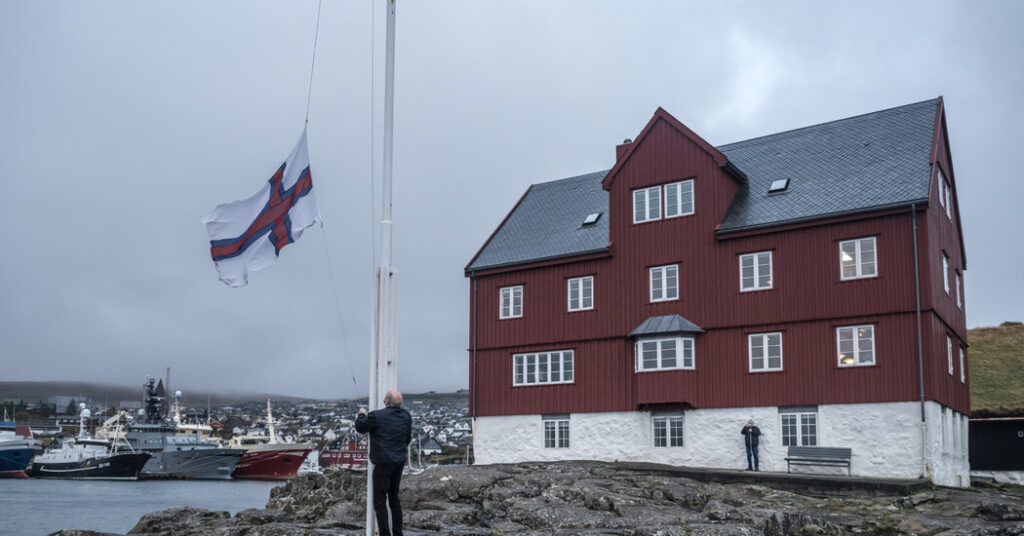
The Faroe Islands, a tiny Danish archipelago in the North Atlantic, shifted rightward on Thursday in parliamentary elections that came just months after the Greenland crisis dulled a local push for more autonomy from Denmark.
Ultimately, Faroese voters appeared to be focused more on economic concerns than geopolitical ones.
A conservative party, the People’s Party, got 26.7 percent of the vote, the largest share, as the polls had roughly predicted. (That is a jump from 2022, when the party got almost 19 percent of the vote.) The main pro-Denmark party, the Unionists, also increased their share to 21.5 percent from 20 percent.
That registered as an upset: In 2022, the last election, the center-left Social Democrats got 26.6 percent of the vote, the largest share. This time, they got 18.9 percent. But they could still be in the governing coalition — it is likely to take a few weeks before the seven parties manage to form a new government.
The vote came after an intense few months in the Faroes, where many of the 55,000 residents were locked in heated debates about the future of their semiautonomous archipelago.
Before President Trump doubled down on his threats earlier this year to occupy Greenland, another semiautonomous Danish territory, the Faroese had been headed toward negotiations with Denmark over their decades-old desire for more autonomy. But the crisis ate into their momentum. Those talks never materialized.
And questions about statehood and Faroese relations with Denmark were not at the top of voters’ minds.
“It hasn’t been completely absent — but it has certainly not been central,” said Heini i Skorini, a political analyst who teaches international relations at the University of the Faroe Islands.
As with the Danish elections earlier this week, the Faroese focused more on the economy.
Some were frustrated that reforms promised by the Social Democrats, like a shorter workweek, never materialized. Others were worried about high housing costs for first-time buyers. That is an existential concern in a place that has struggled to keep its young people from moving overseas. “There is a permanent exodus, or a brain drain,” Dr. Skorini said.
Another major question had been the fate of a new abortion law, which will allow women to end a pregnancy in the first 12 weeks and replaces a near-total ban. A smaller party had said it wanted to block the law before it took effect in July.
But in a debate on Wednesday, Dr. Skorini said, all the party leaders said they would leave the abortion law alone. “All indications are that this law will not be touched,” he said.
Amelia Nierenberg is a Times reporter covering international news from London.
The post The Faroe Islands, Wary After Greenland, Vote for Change appeared first on New York Times.