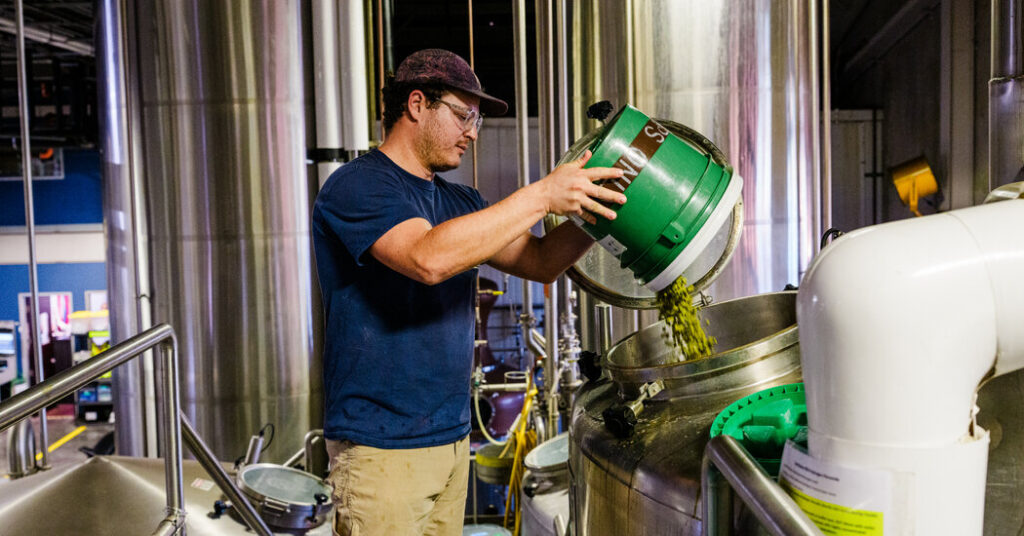
Every year, Garrett Marrero orders thousands of pounds of malted barley and hops from the mainland to his business, Maui Brewing. Then, some of the beer he makes is sent by ship back to continental ports.
That round-trip is getting more expensive. Mr. Marrero has already heard from a freighter that he’ll have to pay an increased fuel surcharge for shipments, and he’s thinking about how to soften the blow to his business. Eventually, he said, the price increases will “have to get passed along, or items will have to get reworked.”
It is no secret that fuel costs are soaring. The four-week U.S.-Israeli war with Iran, with its disruption of energy exports from the Persian Gulf, has led to a spike in oil prices that’s passing through to other products. For American consumers, the most apparent reminder of this is in the gasoline prices billboarded across the country.
A less immediate, though arguably more pernicious threat to the economy is the cost of diesel — which has climbed faster than regular gasoline. That could lead to inflation across a wide range of goods, as businesses like Mr. Marrero’s are forced to contend with the added expense of producing and shipping everyday products.
“The cost of everything goes up — that’s a disconnect that I think a lot of consumers don’t necessarily understand,” Mr. Marrero said.
Diesel “powers a lot of basic industries,” said Vidya Mani, a visiting associate professor at Cornell University’s business school whose research focuses on supply chains. “Mining industries, chemical factories, clothing factories — a lot of those things come from diesel.”
“Because of its far-reaching consequences, it can stop a lot of industries,” she said, adding that if prices continue to rise, consumers will probably begin to see the effects on everyday items and necessities within the next several weeks.
The average cost of a gallon of diesel in the United States was $5.38 on Friday, according to AAA, up nearly 45 percent since the start of the war. Gasoline, by comparison, has climbed about 33 percent.
Not all shipments rely on diesel for power. Many ships, for example, use bunker fuel, a byproduct of oil refining, while planes use jet fuel. The cost of those fuels is also on the rise.
Much of the diesel in the United States comes from domestic supplies. But oil companies can still price the commodity at global market rates. In January, a little more than 40 percent of the cost of diesel came from the price of crude oil, according to the Energy Information Administration.
The rest of the cost is based on things like the price of refinement, distribution and taxes. Diesel costs tend to rise faster than gasoline because of high demand, high costs of transportation and higher federal taxes than those imposed on gasoline.
Most affected by the spike in diesel prices is the cost of transporting products — everything from a can of soda to fresh berries — by truck, ship or rail. Those industries are already adding surcharges, and consumer prices are beginning to climb. On Wednesday, the U.S. Postal Service said it plans to impose a temporary 8 percent surcharge on packages, beginning on April 26.
Even surcharges that are in place are going up: The freighter that Mr. Marrero uses notified him twice that it was raising its fee, to 28 percent of a shipment’s contracted price, up from 16.5 percent before the war, he said.
If they last, those increases will be more apparent to consumers, analysts say. The higher costs are also a threat to the livelihoods of truckers responsible for moving products across the country.
Mustafa Altuner owns Bonelli Logistics, a transport company with eight trucks in Southern California — the state with some of the highest fuel costs in the country. Each of those trucks can use 300 gallons of fuel or more in a week, at a current cost of about $2,000, he said.
At current prices, the company is breaking even, Mr. Altuner said, though it is drawing down on cash reserves to pay for fuel. That’s after he already added an emergency fuel surcharge. So far, his customers, including those that request furniture and steel transports, have accepted the added charge.
Still, “things are getting very, very scary for everybody,” Mr. Altuner said. “If we don’t pay on time, we don’t get our fuel — what if I don’t get paid on time by my clients?”
Mr. Altuner thinks his business will weather the crisis, but he worries about smaller owner-operators who often rely on fixed rates, and can’t pass costs on to customers.
Drivers who own their own trucks and work independently face the most immediate financial risks.
“Fuel is one of the biggest operational costs for owner-operators,” said a spokesperson for the Owner-Operator Independent Drivers Association, a trade group. “Our members often work load-to-load and can’t simply raise their rates when fuel spikes the way their larger competitors can.”
There have been efforts to switch to electric fleets, but more than 75 percent of commercial trucks still use diesel engines, according to the Engine Technology Forum.
The agriculture industry also relies on diesel, to fuel tractors and combines (and of course to truck produce to markets), which means food prices will increase. The agricultural products that come from other countries are likely to reflect those increases first.
“We’ve built an economy that’s increasingly dependent on just-in-time delivery of things that we order, often from other countries,” said Kate Gordon, a former senior adviser in the Department of Energy who is now chief executive of California Forward, a nonprofit business group. Grocery stores, she added, could soon begin to see shifts in the type of products they carry, and their costs.
“We’re used to, in the United States, having our fruits and vegetables not be particularly seasonal, because we get them from all over the world,” Ms. Gordon said. “If there’s a combination of diesel for agriculture, for transportation, some of those prices will start going up. You may not see as many vegetables out of season.”
All of this comes as inflation and high interest rates have already taken a toll on household budgets.
“Our main concern is for the consumer, especially for lower income consumers, who spend a much larger share of their budgets on food than higher income households,” said Bernard Yaros, the lead U.S. economist at Oxford Economics. “The outsize pressure that we’ll see in food inflation is just going to further widen that consumer bifurcation.”
He added that food price increases typically follow an increase in diesel by three months, and in this instance would be comparable to the inflation during pandemic-era lockdowns.
The pace of fuel cost increases may slow now that oil prices have, for the moment, pulled back from their highest point. Domestic crude futures are still up about 45 percent since the United States and Israel first attacked Iran on Feb. 28. The gains are mostly the result of Iran’s threats to ships passing through the Strait of Hormuz, and damage to oil production and storage infrastructure in the Persian Gulf.
But even when the strait reopens, fuel prices are not likely to drop immediately.
“The problem is not just the strait, it’s the producing regions, the factories getting affected, those will take almost a month or more to come back,” Ms. Mani said. “That’s what’s going to cause this prolonged pressure.”
Until prices stabilize, businesses of all sizes will have to adjust their strategies and their outlooks.
Mr. Marrero said that since the costs of shipping have increased, Maui Brewing has focused on sending its beer to the West Coast instead of states farther away. He is also searching for a large brewer on the mainland that can produce and distribute its products.
“It’s more sustainable, but also much more cost effective, because we’re shipping barley over here just to convert it and ship it back,” he said.
“As the world changes around us, of course we zig and we zag,” he added. “That’s what we do.”
Emmett Lindner is a business reporter for The Times.
The post Spiking Diesel Prices Mean Everything Will Get More Expensive appeared first on New York Times.