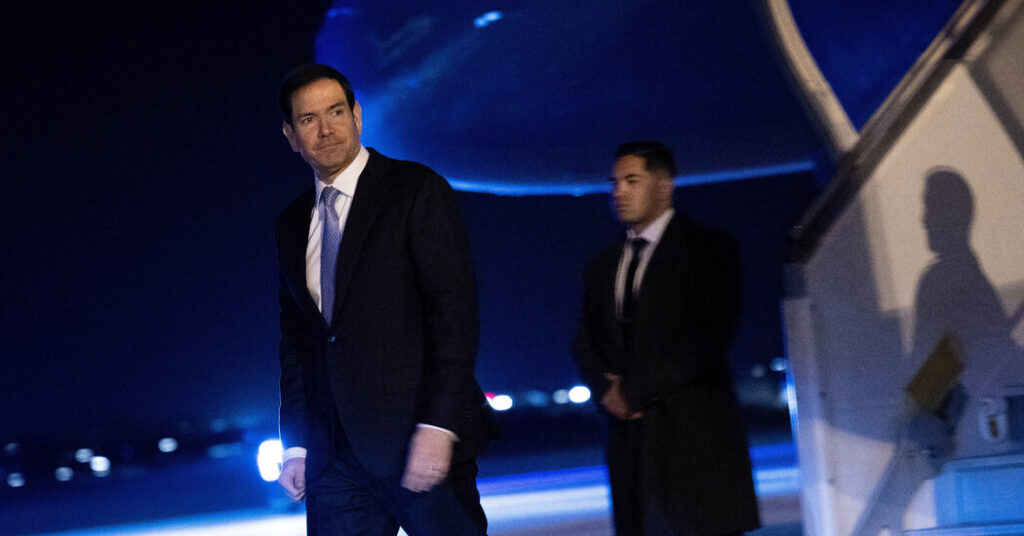
The war in Iran is set to dominate a meeting of top diplomats from the Group of 7 nations on Friday morning in France, where Secretary of State Marco Rubio was expected to press European and Asian allies to help reopen the Strait of Hormuz.
An agenda provided by France’s foreign ministry, which is hosting the meeting in the town of Vaux-de-Cernay, near Paris, said the group would discuss efforts to stop the war, end Iran’s nuclear and ballistic missile development, and reopen maritime trade routes.
Many of the foreign ministers whom Mr. Rubio will meet are from countries that have rebuffed President Trump’s call to send warships to the Strait of Hormuz, the Persian Gulf waterway traversed by a fifth of the world’s oil shipments. In addition to the United States, the Group of 7 comprises Canada, France, Germany, Italy, Japan and Britain.
Iran’s efforts to choke off the strait have driven up global energy costs, especially affecting Asia, which buys most of the fuel produced in the Gulf.
“Very little of our energy comes from the Strait of Hormuz,” Mr. Rubio said on Thursday as he departed for France. “It’s the world that has a great interest in that, so they should step up and deal with it.”
Other than Japan, the rest of the Group of 7 nations also belong to the North Atlantic Treaty Organization, which the Trump administration has criticized for not helping the United States with its war in Iran.
“There was a couple of leaders in Europe who said that this was not Europe’s war,” Mr. Rubio said. “Well, Ukraine is not America’s war, and yet we’ve contributed more to that fight than any other country in the world.”
European and Asian countries counter that Mr. Trump and Prime Minister Benjamin Netanyahu of Israel started the war in Iran without consulting them. Europe also argues that NATO is a defensive alliance that does not traditionally involve itself in the Middle East.
European members of the Group of 7 are eager to keep support for Ukraine on the agenda. The French foreign ministry said the meeting would attempt to step up pressure on Russia’s shadow fleet, which has transported sanctioned goods like oil. Earlier this month the Trump administration paused sanctions on some Russian oil in an effort ease the energy crunch.
Kaja Kallas, the European Union’s top diplomat, said as she arrived at the meeting on Thursday that European countries wanted an off-ramp to the war in Iran for Ukraine’s sake.
“This oil price hike is giving Russia the possibility to fund this war again, which is really not good for the Ukrainians,” she said.
Francesca Regalado is a Times reporter covering breaking news.
The post Rubio Meets Today With Countries That Haven’t Sent Warships to Strait appeared first on New York Times.