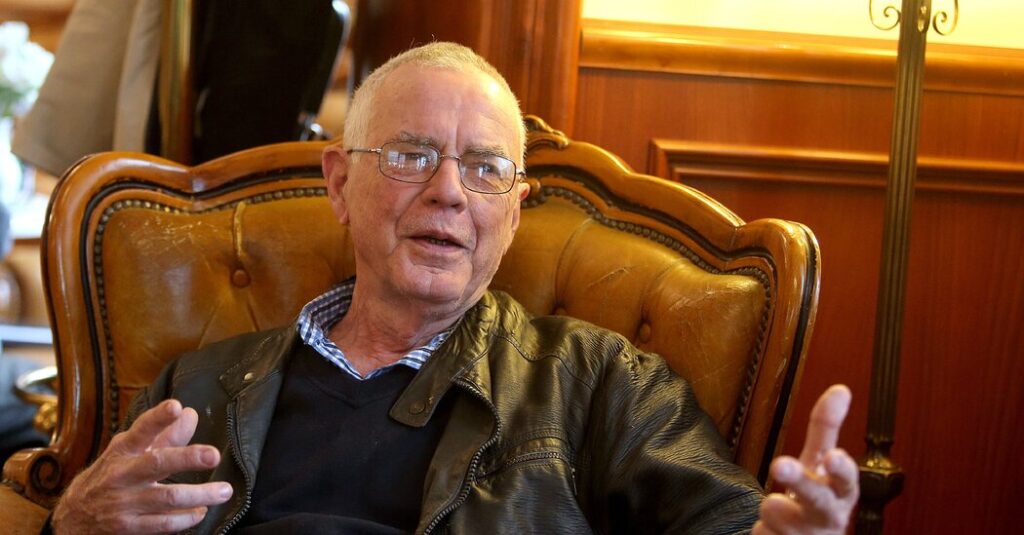
Robert Trivers, a visionary, eccentric and volatile evolutionary biologist who explored the genetic reasons humans cooperate, compete and deceive each other, drawing comparisons to Charles Darwin in a career filled with intellectual highs and behavioral lows, died on March 12, in Mount Vernon, N.Y. He was 83.
His death, at his daughter Natasha Trivers Howard’s home, was confirmed by his family. No cause was given.
Professor Trivers was a rebellious figure in academia who joined the Black Panthers, clashed with colleagues and spoke in support of the convicted sex offender Jeffrey Epstein, from whom he accepted research money. He was often stoned and nearly always armed with a knife for self-defense.
“Robert Trivers was unlike any other academic I have known,” David A. Haig, an evolutionary biologist at Harvard, wrote in a remembrance of Professor Trivers for the journal Evolution and Human Behavior. “In another life, he might have been a hoodlum.”
Raised by a diplomat and a poet, and educated at Phillips Academy in Andover, Mass., and Harvard University, Professor Trivers thrived on challenging scientific orthodoxies, calling the field of psychology a “set of competing guesses.” (He also scorned physics, noting that its utility was “connected primarily to warfare.”)
In the early 1970s, as a graduate student at Harvard and later as an untenured professor there, he published a series of papers applying Darwin’s theory of natural selection to social behavior, arguing that science had failed to connect evolution to an understanding of everyday life.
“I was an intellectual opportunist,” he wrote in “Natural Selection and Social Theory: Selected Papers of Robert Trivers” (2002). “The inability of biologists to think clearly on matters of social behavior and evolution for over a hundred years had left a series of important problems untackled.”
His first paper, “The Evolution of Reciprocal Altruism” (1971), tackled a puzzling question about evolution: Why do people help those they aren’t related to, even at a cost to themselves? Professor Trivers used game theory to show how the concept of “I’ll scratch your back if you scratch mine” is a kind of genetic bargain.
Helping a nonrelative, he argued, is evolutionarily beneficial if there is a high probability that the roles will be reversed in the future. The caveat is that the system works only if cheaters are punished. Emotions like gratitude, sympathy, guilt, trust and moralistic outrage evolved as a behavioral detection system and policing tool.
In “Parental Investment and Sexual Selection” (1972), Professor Trivers proposed a novel theory of mate selection, arguing that the gender that invests more energy in offspring tends to be choosier about picking partners. In humans, this is the female, owing to pregnancy, childbirth and nursing. (In sea horses, it’s the male, because the males are the ones who bear offspring.)
His most counterintuitive paper during that time was “Parent-Offspring Conflict” (1974). For centuries, scientists had viewed the relationship between parents and their offspring as fundamentally harmonious. Professor Trivers saw it as more of a wrestling match between cooperation and conflict.
The reason: Parents share 50 percent of their genes with every child, so they are genetically programmed to value all of their children equally. But children want more than they are entitled to, resulting in sibling rivalry and temper tantrums.
Perhaps his most provocative intellectual bombshell came in 1976, when he laid out a theory of self-deception in the foreword to “The Selfish Gene” by Richard Dawkins.
Deceit, Professor Trivers argued, is fundamental to animal communication, so organisms naturally evolve to spot it. In humans, this evolutionary arms race leads to self-deception, or burying lies in the unconscious to keep them from being detected by others.
“If I’m unaware of the fact that I’m lying to you,” Professor Trivers said, “those avenues of detection will be unavailable to you.”
In 1977, Time magazine featured his research in a cover story with the headline “Why You Do What You Do.” The Royal Swedish Academy of Sciences cited the work in 2007 when it awarded him the Crafoord Prize in Biosciences, widely considered the Nobel Prize for biology.
“I don’t know of any comparable burst of creativity by another scientist,” Professor Haig said in an interview. “It’s a bit like Albert Einstein’s miracle year, when he brought out the theory of relativity in the beginning of quantum mechanics.”
During this creative burst, Professor Trivers struggled with mental health issues and was hospitalized at least once for bipolar disorder. He applied for early tenure at Harvard, but the decision was postponed because of concerns about his mental health.
“He could be a brilliant and wonderful colleague,” Professor Haig said. “In a different mood, he could be unnecessarily hostile to those around him.”
Professor Trivers joined the faculty at the University of California, Santa Cruz, where he met Huey Newton, the co-founder of the Black Panthers, who was then a doctoral candidate in the school’s History of Consciousness program. Together, they published a paper on self-deception.
The men became close. Professor Trivers began hanging out in Oakland with the Black Panthers, later admitting to doing “an illegal thing or two” in a 2016 interview with Psychology Today. Eventually, Dr. Newton eased him out of the group and instructed him to stay out of the city for his own good.
In 1994, Professor Trivers moved to New Jersey to join the faculty at Rutgers University, where dust-ups inevitably ensued. In 2013, he refused to teach a course on human aggression, protesting that he didn’t know the material any better than his students did. The university suspended him, and he left not long after.
“I am one of the most accomplished scientists they have ever had, period,” he told Psychology Today.
Then he posed a question to himself in the third-person: “Why not treat him well?” His answer: “Honesty is not their strong suit. Remember, we’re talking about New Jersey.”
Robert Ludlow Trivers was born on Feb. 19, 1943, in Washington, D.C. His father, Howard Trivers, was a diplomat with the U.S. State Department. His mother, Mildred (Raynolds) Trivers, was a poet.
Robert grew up in Berlin, Copenhagen and Washington before attending Phillips Academy.
At Harvard, he initially studied math and then switched to American history.
During his junior year, he suffered the first of several mental breakdowns. After a lengthy stay in a psychiatric hospital, he considered studying psychology, sensing that “it might be a useful subject to know,” he wrote in his autobiography, “Wild Life: Adventures of an Evolutionary Biologist” (2015). But he decided against it, convinced that the field was “not yet a science.”
After graduating in 1965, he applied to several law schools, but wasn’t accepted. He took a job at Education Services Incorporated, a Harvard offshoot that published science books for children. There, he was tutored in biology and evolution by William Drury, an ecologist and research director for the Massachusetts Audubon Society.
“It was perhaps the greatest stroke of luck in my life,” Professor Trivers told Psychology Today.
After returning to Harvard for graduate studies in biology, he took the first of many trips to Jamaica for research. There, he spent long stretches of time in Southfield, a remote town in the parish of St. Elizabeth, where he built a house. Outraged by the violence against gay men that he saw there, he formed an armed group to protect them.
The many contretemps in Professor Trivers’s life included comments he made to Reuters in 2015 about Mr. Epstein, the convicted sex offender, with whom he had corresponded and socialized, and who had helped fund his research.
He called Mr. Epstein a person of integrity and minimized his crimes against teenage girls, saying that “by the time they’re 14 or 15, they’re like grown women were 60 years ago.”
Professor Trivers was married and divorced twice, first to Lorna Staple and then to Debra Dixon.
In addition to his daughter Natasha Trivers Howard, he is survived by four other children, Jonathan Trivers, Natalia Barnes, Alelia Trivers Doctor and Aubrey Trivers; 10 grandchildren; one great-grandchild; and his siblings, Jonathan Trivers, Ruth Ann Mekitarian, Milly Palmer and Howard Trivers.
Later in life, Professor Trivers reflected on his self-destructive tendencies.
“Inside me there are two voices,” he wrote in Skeptic magazine. “One cries out, ‘Bob, you have made this mistake 630 times in the past and regretted every single one. Why not forgo it this time?’ Then comes a stronger voice, ‘No, Bob, this time is different,’ and there goes 631.”
The post Robert Trivers, Eccentric Scientist Who Probed Human Nature, Dies at 83 appeared first on New York Times.