This article is part of Overlooked, a series of obituaries about remarkable people whose deaths, beginning in 1851, went unreported in The Times.
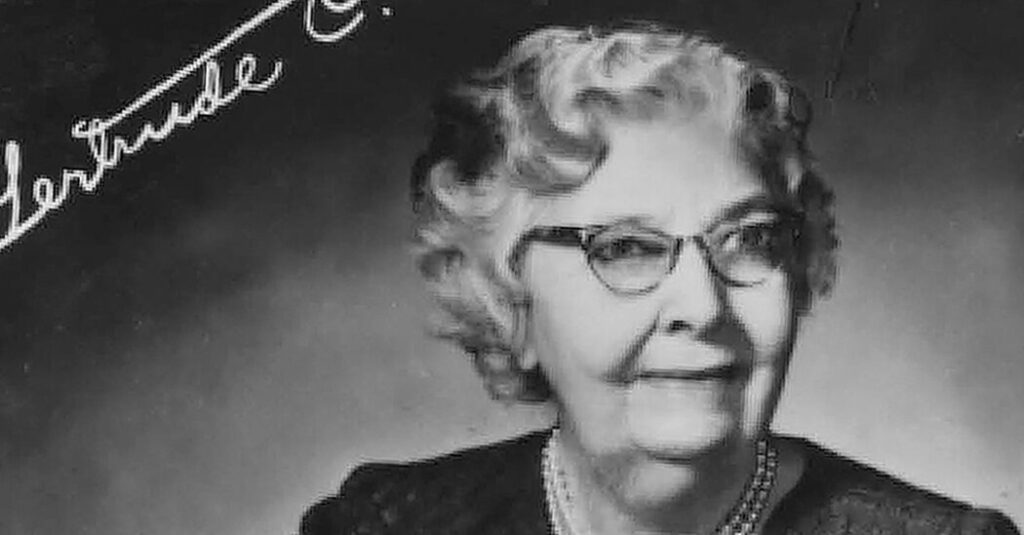
As a girl, Gertrude Chandler Warner would sit for hours outside her home marveling as trains chugged through her sleepy hill town, Putnam, Conn.
If she was lucky, she caught a glimpse inside the cars. One day, peering in through the window of a stalled caboose, she made out a stove, a small table, cracked cups and a tin coffee pot whistling steam. What might it be like to sit at the table, she thought, to live in such a place?
That fixation on railway cars and the prospect of adventure they offered would inspire her to write the Boxcar Children, a best-selling series of books about four orphaned siblings who live in an abandoned railroad car. The stories form one of literature’s most popular children’s mystery series, alongside the Nancy Drew and Hardy Boys books. The Boxcar books — 19 by Warner and more than 200 that have been ghostwritten since her death in 1979 — are still in print and have sold more than 80 million copies worldwide.
The books have inspired two animated films, released in 2014 and 2018, featuring the voices of the actors Martin Sheen and J.K. Simmons. Random House acquired the series in 2023, and a graphic novel adaptation is slated to be published this year.
Yet for all the series’ eventual success, Warner’s first installment, titled simply “The Boxcar Children,” published by Rand McNally & Company in 1924, was a commercial disappointment, in part because of its dark back story: The children’s mother has died, and their alcoholic father soon drinks himself to death.
Warner was born in Putnam on April 16, 1890, the second child of Edgar and Jane (Carpenter) Warner. Her father was a city court judge.
At the turn of the 20th century, when home electricity was a luxury and automobiles were portents of the future, the trains passing through on their way to New York or Boston were a symbol of the exciting world beyond Putnam, with their ability to travel to far-flung places. For Gertrude, they seemed magical.
A regular at the local library, she gravitated toward imaginative books — her favorite was Lewis Carroll’s “Alice’s Adventures in Wonderland.” She often said that she had begun writing as soon as she could hold a pencil. Collaborating with her older sister, Frances, on writing projects became a pastime.
But illness overshadowed Warner’s childhood. After enduring measles and mumps, she had sore throats so debilitating that she had to drop out of high school and study at home with a tutor. She continued to live with her parents even as her sister and younger brother, John, left for college.
In 1918, Warner became a temporary assistant teacher at the Israel Putnam School, a local kindergarten-through-12th-grade public school, after many of its employees had left to fight in World War I. Within a year, the head teacher died in the influenza pandemic then raging, and Warner taught the class on her own.
After “The Boxcar Children” was published, Warner read it to her third- and fifth-grade students, but found that it did not resonate with them.
She spent about two decades, off and on, rewriting the book, scrubbing out most of the troubling details about how the children had become orphans and simplifying the vocabulary to make it accessible to emerging readers.
She also heightened the story’s sense of mystery.
“One warm night, four children stood in front of a bakery,” began the new version, which was published in 1942 by Scott, Foresman & Company. “No one knew them. No one knew where they had come from.”
The revamped version, with illustrated silhouettes by L. Kate Deal, was a hit, with children across postwar America raptly following the adventures of the orphans, Harry, Jessie, Violet and Benny Alden, along with Watch, their wire fox terrier. The Aldens make beds from pine needles, forage for blueberries, and furnish an abandoned boxcar with castoffs from a nearby dump before their grandfather, a steel magnate whom they had never met, finds them and greets them with warmth and generosity.
“Warner has produced a delightful volume,” noted a review in The Deseret News of Salt Lake City.
Librarians, however, initially worried that the children in the story “were having too good a time without any parental control!” Warner once wrote in a letter.
In 1949, she published a second Boxcar Children book, “Surprise Island,” in which the Alden siblings spend a summer on an island owned by their wealthy grandfather. There, they meet a young man recovering from amnesia whom they discover to be their cousin. Subsequent sequels transport the children to the woods of Maine, a uranium mine and a desert island in the South Seas, where they solve mysteries.
Warner was a careful researcher — she once wrote to the U.S. Coast Guard asking for a detailed description of house boats — as well as a rigorous reader and revisionist who occasionally sparred with her editors.
“Surely the four chapters I just received are not mine,” she remarked in a letter to one of them in 1966. “I have led readers to expect a certain style which is destroyed in this revision.”
The books not only expanded the imaginations of young readers; they were also a source of liberation for Warner herself, who had been weakened by various illnesses and injuries.
“At one time or another,” Mary Ellen Ellsworth wrote in a 1997 biography of Warner, “she broke her back, both hips, three or four ribs, and her knee. She had severe sore throats, had her tonsils removed twice, and her appendix once.”
Warner published her 19th and final Boxcar Children book, “Benny Uncovers a Mystery,” in 1976. She died on Aug. 30, 1979, in Killingly, Conn., about 10 miles south of Putnam, in the northeast corner of the state. She was 89.
She also wrote a collection of stories, “Life’s Minor Collisions” (1921), and, with her sister, a collection of essays, “Pleasures and Palaces” (1933). Her other children’s books include “The World in a Barn” (1927), “Windows Into Alaska” (1928), “The World on a Farm” (1931) and “Children of the Harvest” (1940).
In 2004, the Gertrude Chandler Warner Boxcar Museum was opened in a refurbished Depression-era boxcar a few blocks from her childhood home.
In recent years, some critics have reappraised the Boxcar Children’s portrayal of childhood. In a 2016 essay for The New Yorker, Jia Tolentino called the first book “an odd sort of capitalist parable” that reinforced traditional gendered divisions of labor among children. Elisabeth Egan, writing for The New York Times in 2020, was gentler, referring to the series as “cozy, wholesome, slightly dated.”
Warner remained active in Putnam civic life, playing the pipe organ at the Congregational church and volunteering for the American Red Cross. She lived with her friend Esther Welles, a nurse. Sometimes they would welcome children wishing to meet the author and discuss the plots of her books.
She always thought highly of her young audience. “In fact, I raise my hat to them in spirit, as I teach them to raise theirs to me in truth,” she wrote in a 1921 essay.
After all, she concluded, “They are beneath me only in years.”
The post Overlooked No More: Gertrude Chandler Warner, Author of ‘The Boxcar Children’ appeared first on New York Times.