The United States has spent nearly a year pursuing deep sea mining without cooperation from the rest of the world. Now, Japan has said it will help out.
In memo signed by officials of both countries last week, Japan and the United States agreed to share research and insights from their forays into the fledgling industry. It was an extraordinary public show of support for recent U.S. efforts to jump-start the deep sea mining industry, according to diplomats and officials who work on seabed issues.
Vast areas of the ocean floor are rich with valuable minerals, but mining them would be technically challenging and critics say it could damage marine ecosystems. In addition, issuing permits to mine in international waters, which the United States has said it intends to do, raises diplomatic questions given that international waters, by definition, aren’t the domain of any one country. The document, known as a memorandum of cooperation, lays out the countries’ intentions but is not legally binding. It was signed along with a number of other economic and resource-focused partnership agreements after President Trump and Japan’s prime minister, Sanae Takaichi, met in Washington.
It was then circulated at a semiannual meeting of the International Seabed Authority, an independent organization created under the United Nations Convention on the Law of the Sea to regulate the ocean floor in international waters. The 170 nations that agreed to follow that law have spent a decade locked in debate over potential rules for mining international waters for metals and minerals.
At a recent meeting they again failed to reach a consensus.
Some 40 countries have called for a moratorium or ban on the practice.
The lack of an international agreement on rules has agitated the industry and countries interested in it. In a recent statement during the meeting, the Japanese delegation said it was concerned about further delays.
Without global rules, the industry’s pace will be set by those willing to take action, whether unilaterally, like the United States, or via partnership like the one Japan and the United States have announced, said Marie Bourrel-McKinnon, an expert on seabed governance who served as the authority’s chief of staff until last year.
It took 12 years for the Law of the Sea Convention to enter into force after it was initially adopted in 1982 because countries couldn’t agree on how to approach deep sea mining, Ms. Bourrel-McKinnon said, and the final text was designed to carefully balance the competing priorities of the time. Now, as the world changes, the “system may need to adjust again,” she said.
The United States never agreed to the Law of the Sea and is not required to abide by the authority, but it had long followed the international customs and participated in the meetings. That changed last year, when President Trump ordered U.S. regulators to begin issue permits for deep sea mining. Now the United States seems set to apply domestic laws to enable the fledgling industry in international waters. Last month, the Metals Company, a front-runner in the effort to mine the ocean, said it had applied for a commercial mining permit under a new U.S. law that fast-tracks applications by reducing environmental assessment requirements.
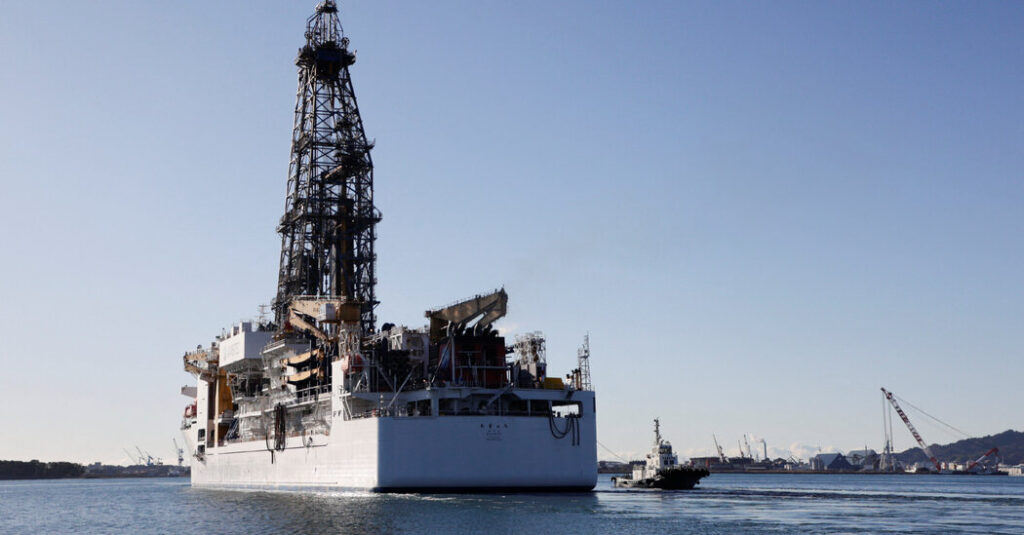
The new memorandum states that Japan and the United States will create a working group to share information on deep sea science and mining projects, including insights from a recent effort by Japan to begin mining within its national waters. Japan wants to harvest deep ocean mud to counterbalance China’s dominance in rare earths metals.
In some ways, the partnership is no surprise and comes in the context of a larger critical-minerals partnership with the United States.
The new document did not specify whether Japan would help the United States in national waters or international ones. Because Japan has agreed to follow the Law of the Sea, the latter could put it at risk of breaching the international agreement.
Japan verbally reaffirmed its commitment to the international process during the seabed authority’s meetings, but experts worry the new partnership may be a sign of a coming geopolitical shake-up if other countries decide to follow suit.
It is possible for countries, like Japan or China, to withdraw from the convention, said Donald Rothwell, a professor of international law at the Australia National University’s School of Law who specializes in ocean geopolitics. Back in the 1980s, he said, Japan was among a handful of countries that was cautious about joining the Law of the Sea without the United States and was exploring the possibility of an alternative seabed mining agreement.
“That Japan would appear to be reviving this type of interest and seeking to work alongside the Trump Administration in deep sea mining would trigger concern and interest from a number of major ocean players, especially China,” he said.
Before this year’s meeting, Leticia Carvalho, who is leading the discussions as head of the authority, said in an interview with The New York Times that America’s unilateral push to mine the ocean risked fracturing international standards.
Sachi Kitajima Mulkey covers climate and the environment for The Times.
The post Japan and the U.S. Agree to Team Up on Seabed Mining appeared first on New York Times.