Roughly a year ago, Elon Musk was everywhere, a “co-president” or “first buddy” who promised to slash $2 trillion from the federal bureaucracy via the Department of Government Efficiency.
He is no longer involved with DOGE, but Mr. Musk remains the world’s wealthiest man — and very much enmeshed in the U.S. government and global politics.
Is he also an avatar of bigger shifts in historical forces that will remake politics and economics? The writers Quinn Slobodian and Ben Tarnoff have a theory that “Muskism,” as they call it, is reshaping America, and maybe even the world. They explored the theory in a written conversation with John Guida, an editor in Times Opinion.
John Guida: Elon Musk is still very active in business and global politics. Just the other day, Gov. Gavin Newsom of California called him both this generation’s Thomas Edison and “one of the great disappointments” of our time.
How does Muskism map onto what’s going on in the world right now?
Quinn Slobodian: Our attraction to the category of Muskism was to use it how social scientists have used “Fordism” for the last century — based in part on the life and work of one man but, more relevantly, as a prod to ask questions about what new society is required for their model of building businesses and capital to function. We know what products and services Musk builds, but what is the social contract that comes along with it? What is the future for humans in a world, as he foresees it, where blue-collar labor has been taken over by humanoid robots and white-collar labor has been taken over by artificial intelligence? The one-way bet the U.S. economy is currently making on a specific kind of A.I. makes these questions all the more relevant.
Ben Tarnoff: The war on Iran by the U.S. and Israel is a good prism for a few of the themes integral to Muskism. One is “electric autonomy.” This is the idea that renewable energy can fortify a country’s self-reliance. From the start, Musk has positioned Tesla as a provider of electric autonomy to various nation-states, beginning with the United States during the Obama era but also extending to China and the European Union.
What we’re seeing with the Iranian conflict is that those countries that have embraced electric autonomy — whether by buying Musk’s products or his competitors’ — have been able to weather the storm much better than those that haven’t. The Southeast Asian countries are taking a big economic hit because of their dependence on oil exports from the Middle East. In contrast, China, which has invested heavily in renewables, has been able to achieve a degree of insulation from the destabilizing effects of the conflict.
Guida: There is a rather obvious exception to the nations that have embraced “electric autonomy.” The Trump administration has pushed back many of those efforts. Corporations have noticed: Honda, for example, will halt the production of three forthcoming E.V. models in the U.S.
Tarnoff: Trump has done more than any other single historical actor to supercharge Muskism. Not only through his actions in Iran, which are incentivizing countries to invest in electric autonomy, but more broadly through causing global economic instability with his unpredictable trade policies, as well as shredding the norms and institutions that stabilized the world system under American leadership. These moves will accelerate the deglobalizing trend that has been underway at least since the pandemic, as countries increasingly see global integration as a source of risk and begin to prioritize self-sufficiency and resilience. This, too, is a central theme of Muskism. It envisions the factory as an enclave, garrisoned against the instability of a hostile world.
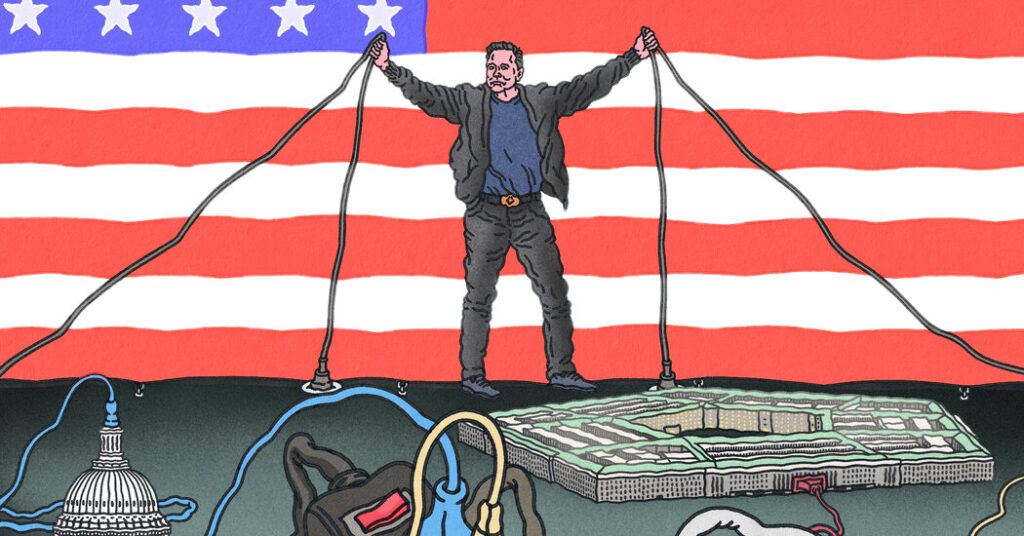
Slobodian: The status of the conflict as the first “A.I. war” is also relevant to our argument about Muskism. The automation of target selection and the introduction of new Silicon Valley products like Anthropic’s Claude and Palantir’s Maven system into the operations of the military show how even something like DOGE, reputed to be a failure, was actually a success in another way, by making the government dependent on a new suite of A.I. tools to exercise basic state functions. We call this “sovereignty as a service.”
Guida: “Sovereignty as a service” is a fusion of public and private power. Very often, in Musk’s case, as you have just pointed out, we can talk about both hardware and software. Maybe you could start with hardware — SpaceX, Starlink and the like?
Tarnoff: Musk and most of his Silicon Valley colleagues are not libertarians. Rather than seeking to displace the state, they want to merge with it. We call this impulse “state symbiosis,” and it’s a through line in Musk’s career.
Take the case of SpaceX. Musk founded SpaceX in 2002. This was the first full year of the war on terror. Defense Secretary Donald Rumsfeld believed that winning the war would require a new approach to warfare, in which Special Forces units were deployed to fight terrorists around the world with the help of advanced technology. A centerpiece of this strategy was satellites, which could be used for surveillance, reconnaissance, missile guidance and battlefield communications. SpaceX got its start by positioning itself as a cutting-edge contractor for the Pentagon.
Guida: And now SpaceX has become dominant in its field.
Tarnoff: By 2024, SpaceX controlled more than 95 percent of all U.S. orbital launches. Musk has become the de facto gatekeeper for U.S. government access to orbit — and for many governments around the world. If these states want to exercise core sovereign functions from space — such as those related to warmaking, for instance — they need to purchase their capacity to do so from the monopoly private provider of SpaceX.
Slobodian: On Starlink, the satellite wing of SpaceX, the control of a chokepoint is even more evident. Musk launched his first low earth orbit satellites only seven years ago, and he now has over 10,000 in the sky — which amounts to well over half of all satellites in orbit. He recently filed an application with the Federal Communications Commission to launch one million, an astounding number, even as he announced a new move into so-called Starlink Mobile, which will deliver direct satellite-to-handset connectivity.
One can see this as an attempt to exploit first-mover advantage and perform a world-historical land grab, or space grab, which could be used to exercise leverage not only over states as clients but also over customers and individual users whom one can imagine being brought into the software of the walled garden Musk is creating through the X platform and its chatbot, Grok, built by Musk’s company xAI.
Guida: The venture capitalist Shaun Maguire said that “xAI will win” and “people are sleeping on Elon … again.” The hardware and digital parts seem inseparable — for Musk and for Muskism. Is that the point?
Slobodian: The hardware and the software are mutually reinforcing. One can see this literally in the mergers of the past few months, in which the social media platform X was merged with the A.I. company xAI, which was, in turn, merged with SpaceX. The SpaceX I.P.O. expected later this year could reportedly run into the tens of billions of dollars. xAI still trails its rivals OpenAI and Anthropic, but it is making rapid progress in part by burning $1 billion a month on scaling up. The way in which SpaceX emerges here as a full stack company — from rockets to X — says much about the way Musk sees little difference between the metal material in his empire and the means to propagate what he sees as the antibody for the “woke mind virus.” It’s a head-spinning undertaking.
Guida: That ambition is, I assume, part of the reason that you have suggested that Muskism is the Fordism of the 21st century. Fordism structured life for part of the 20th century. What is Fordism, and how is Muskism emerging to fill that role?
Tarnoff: Social scientists typically describe Fordism as not just a way of organizing a factory but as a way of organizing the society outside of the factory. Reductively, it can be described as: mass production plus mass consumption. New technologies and new techniques — such as those innovated by Henry Ford in the 1910s, like the moving assembly line — made it possible for industrialists to produce goods at a new scale. But just as important, industrial workers could afford to purchase these goods, thanks to relative job security and a living wage, as secured through the institutions of collective bargaining and the welfare state.
By the 1970s, Fordism had begun to come apart, to be followed by what is generally known as “post-Fordism.” Post-Fordism is associated with new “lean” and “just-in-time” production practices developed in Japan, outsourcing and offshoring, free-market globalization, the decline of unions, the rise of finance and the weakening of the welfare state.
Slobodian: There are some striking similarities between Fordism and Muskism, especially in the model of vertical integration, meaning keeping as much of production as possible within the walls of the firm. When Musk started doing vertical integration in the 2000s at SpaceX and Tesla, he was very much cutting against the grain. At the time, the post-Fordist model was captured in the words on an iPhone: designed by Apple in California, assembled in China. Globalization dictated the search for cheap products and labor wherever they could be found.
Tarnoff: We are now living in a world of reshoring and rearmament. It’s an open question on what new basis the world order will someday stabilize. We think Muskism is one candidate, as it’s uniquely attuned to the politics of a deglobalizing world.
Slobodian: Where Muskism differs from Fordism is in the layer of the digital. Musk’s early adoption of the idea of the internet as the “superset of all media” has metastasized over time into a belief that the online world is the primary layer of reality and the offline is downstream from it.
Guida: You mentioned a new social contract. The benefits of Fordism for many Americans (not all, of course) were visible in physical products, but also in certain material and social aspirations. What is on offer in the social contract of Muskism?
Tarnoff: As you point out, Fordism wasn’t solely or even primarily a model of industrial production. It was a way to secure people’s consent so that society could be constructed around the needs of industrial production.
When it comes to Muskism, it’s easy enough to see the basic accumulation strategies. Concentrate production. Fuse with the state. Sell the promise of sovereignty through technology. But what are you giving the vast majority of people in return? How do you secure their consent?
Slobodian: The social contract of Muskism was developed from a small scale out — and it’s not clear how far it can extend. He developed a hard-core group of loyal investors and followers cultivated by the idolatry of the founder-god. Those loyal enough saw dividends in literal terms.
We sometimes think of this as a fan contract. He has sought and succeeded in building in dependencies on services already mentioned, like rocket launch provision and satellite internet as well as the microgrids and Megapacks now being sold to countries and regions through Tesla Energy. But how far can it go? The discordance of DOGE was in part a scene of Musk leaving the space of his own fandom and being shocked at the hostile reception.
Tarnoff: This is a weakness in Muskism, but we’ve begun to think of it as a symptomatic one. If you believe, as Musk and most members of the Silicon Valley leadership class do, that “artificial general intelligence” is around the corner, then you believe that in the very near future, most people will be thrown out of work. They will be designated as social surplus, and will no longer have the leverage to exert influence on the direction of society. In that case, you don’t need their consent.
And if that sounds a bit fantastical, consider the depth of cuts to Medicaid introduced by Trump’s One Big Beautiful Bill Act. Estimates suggest that around 10 million people could lose their health care coverage as a result of these cuts. You would enact this policy only if you had ceased to believe in the possibility of pitchforks. In this respect, and in many others, Muskism is refracting broader trends in our political and economic life.
Guida: Musk has thrown tens of millions of dollars into elections in America. In Europe, he supports nationalist, sovereigntist politicians, even as many of them have kept their distance from him. Is politics one area where Musk has not cracked the code, or is he trying to develop a new code?
Slobodian: Musk does not see politics in the conventional terms of persuasion, deliberation, compromise or popular self-determination. In the spirit of his understanding of society as what he calls “cybernetic collectives,” Musk thinks of politics as a matter of programming. Political ideas he doesn’t like are “mind viruses” contaminating the mainframes of the human-machine network, and ones he does like are “truths” that drive out the bad.
Guida: Last year, when Musk and Trump were feuding, Steve Bannon called on Trump to nationalize SpaceX, for national security reasons, among other things. What do you see as the vulnerabilities of Muskism, particularly since it is so reliant on the state and on — at least for now — the consent of the governed?
Tarnoff: Given the importance of federal contracts for SpaceX, you might think that such contracts are a point of vulnerability for Musk. And, indeed, during the feud between Trump and Musk, Trump threatened to cancel SpaceX’s contracts. But to take that step would be very difficult for the federal government, given the degree of reliance it has developed on SpaceX. This illustrates the deep entanglement of public and private power that we describe as state symbiosis.
It’s not impossible to disentangle: The Europeans in particular are investing in local alternatives to SpaceX in order to reduce their dependency on Musk. But we’re living in an era when a handful of large firms, mostly from Silicon Valley, are embedding themselves deeply into the back end of government, in ways that are designed to be hard to remove.
Slobodian: Another similarity between Musk and Ford is the overwhelming concentration of their wealth in their own companies. For Musk, if Tesla and SpaceX go to zero, he does, too. Arguably, this is one of the incentives for Musk in making ever greater promises — from 10 billion humanoid robots to data centers in space. The forward momentum is a requirement of his financial fabulism. In that sense, his vulnerability is his reliance on “us” — meaning the world’s consumers and, more important, institutional investors — continuing to believe in his vision of the future. We think there is reason not only to distrust but even to actively oppose his vision of the future.
Guida: Once upon a time, Musk was a favorite of the left. That has obviously shifted. He is now strongly identified with the Republican Party. Do you see that as a vulnerability?
Slobodian: Yes and no. Consider the fact that the Norwegian Oil Fund is among the Top 10 Tesla shareholders. Musk as a person and Tesla as a brand are extremely unpopular in Norway, yet the value of his company still constitutes part of the load-bearing infrastructure for the future prosperity of the nation. Muskism exists because of what has become something like a death grip between global finance and a handful of tech giants.
Tarnoff: The identification with MAGA has hurt Musk in certain ways. If you think about Tesla customers, they tend to be affluent, eco-conscious liberals. These people aren’t buying as many Teslas anymore, especially in Europe, where the company’s sales fell off a cliff. More broadly, it’s harder for Musk to sell his model of electric autonomy to the Chinese and the Europeans now that he is so closely linked to Trump. Countries outside of the United States might think twice about welcoming one of his Gigafactories, or buying energy storage solutions from him.
Guida: I’m wondering if you think Marc Andreessen gave a glimpse into the Muskism mind-set in a recent interview? Andreessen said he himself possesses “zero” levels of introspection, and added: “Great men of history didn’t sit around” being introspective. “Move forward, go.” Is that something you see in Musk? Do you see him as a world-historic figure?
Tarnoff: Andreessen seems to be channeling an Ayn Rand-style notion of the great man as an individual author of history. For Hegel, by contrast, a world-historic figure is an instrument through which the spirit of history finds fulfillment: What makes such an individual historically significant is how they are able to take what is implicit and latent in a particular era and make it explicit and active. And they do so without knowing it, without full awareness of the significance of their actions.
Musk fits this description. Through the course of his career, he is weaving together a particular ensemble of historical forces that we describe as Muskism, even if he would never see himself as a Muskist.
Guida: Is it fair to say that, in terms of the world he is making, capital and global investors seem to think he is a guide to the future?
Slobodian: As the boilerplate warning label goes, past performance does not guarantee future results — but, in Musk’s case, taking his investment as indicative of the direction of travel for the next big growth story has made a lot of people a lot of money. This is part of the reason we found it necessary to confront him head on. How is that someone who seems increasingly unhinged manages to still make the “line go up” in terms of his personal net worth and the value of his companies? What does this mismatch between what feels like common sense and the supposed wisdom of market forces tell us about the era we are in? What rearrangements of atoms and symbols is necessary to keep the machine of Muskism working?
We often posed a kind of thought experiment to ourselves. Would a couple of leftist critics in the 1920s wave away Henry Ford by simply calling him “an idiot”? Likely not.
Quinn Slobodian, a professor of international history at Boston University, is the author of “Hayek’s Bastards: Race, Gold, IQ and the Capitalism of the Far Right” and “Crack-Up Capitalism: Market Radicals and the Dream of a World Without Democracy.” Ben Tarnoff is a writer and the author of “Internet for the People: The Fight for Our Digital Future.” They are the authors of the forthcoming “Muskism: A Guide for the Perplexed.” John Guida is a Times Opinion editor.
The Times is committed to publishing a diversity of letters to the editor. We’d like to hear what you think about this or any of our articles. Here are some tips. And here’s our email: [email protected].
Follow the New York Times Opinion section on Facebook, Instagram, TikTok, Bluesky, WhatsApp and Threads.
The post It’s Elon Musk’s World Now appeared first on New York Times.