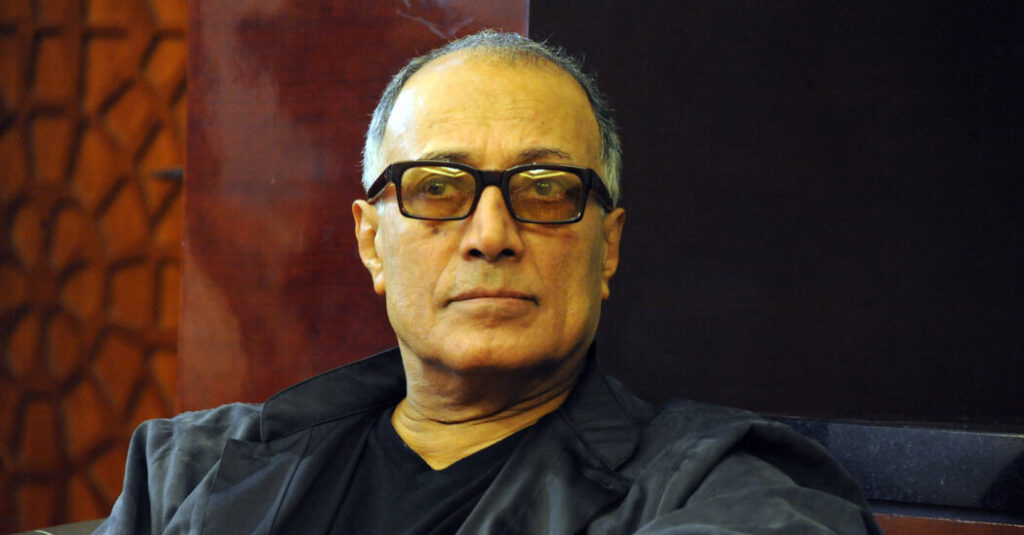
When the Tehran home of the late film director Abbas Kiarostami was damaged in a strike earlier this week, amid the U.S.-Israeli military campaign, a spokesman for Iran’s foreign ministry was quick to use the incident to push Iran’s narrative about the war.
Was the home of Mr. Kiarostami, “part of the alleged ‘imminent threat’ to the United States?!” asked Esmail Baghaei, the spokesman, in a post on X on March 25. “The truth is that this American-Israeli WAR OF WHIMS is not merely against a State — it is against a deep-rooted culture, civilization, and identity.”
In his post, Mr. Baghaei praised the director’s work “Taste of Cherry,” the first Iranian film to win a Palme d’Or at the Cannes film festival, as a “masterpiece.”
But Mr. Kiarostami’s son, Ahmad, who lives in California, was quick to fire back, saying in a reply to Mr. Baghaei on X that “Taste of Cherry” had been barred from screening in Iran for years, and he criticized the pressure authorities had put on his father.
Mr. Kiarostami, who died in 2016, once exchanged polite cheek kisses with the actress Catherine Deneuve, after receiving the 1997 Cannes Film Festival’s top prize. That earned him the ire of conservatives back home who accused him of violating Islamic precepts barring contact between unmarried men and women.
When he arrived back in Iran, “‘brothers’ were waiting for him at the airport to give him a lesson” as punishment, Ahmad Kiarostami said in his post.
In a phone interview on Friday, Mr. Kiarostami explained that although “Taste of Cherry” was never entirely banned in Iran, its domestic release was repeatedly delayed, and was eventually screened in only a small number of cinemas for a very short period of time.
Mr. Kiarostami recalled that after the furor over the cheek kiss, his father delayed returning to Iran for a few days, and told him that the agent who stamped his passport upon his return had thrown it to the ground in anger, saying, “You’ve disgraced us.”
In his post on X on Wednesday, Ahmad Kiarostami was clear about his opposition to the war in Iran, saying it was “destroying ordinary people’s houses and lives.” But, he added, “I’m also strongly against what has been done in our country for decades to get us here. Can I be both?”
He said the damage to his father’s home was limited to broken windows, and demanded that Iranian officials refrain from using his father’s name in promoting the government’s agenda.
“Keep him out of your rhetoric,” he wrote. “Hopefully that house will outlast those who have brought ruin to our homeland.”
Ahmad Kiarostami had earlier posted on his Instagram account descriptions of damage to both his parents’ homes, which are located in the Chizar neighborhood of north Tehran. “I don’t think I’m going to see that house ever in my lifetime again,” he told The New York Times, lamenting both the war and his view that the Iranian government was unlikely to fall.
Abbas Kiarostami was one of Iran’s most acclaimed directors. Of the restrictions that artists faced in Iran, he told The New York Times Magazine in 2007 that “it makes them more creative, because art is the one positive thing they can get out of their life in Iran.”
The magazine asked him why he had stayed in Iran despite the pressures he had faced.
“I like my house,” he replied. “The only place I sleep well is my own room in Iran.”
Yeganeh Torbati is the Iran correspondent for The Times.
The post Iran Tried to Use a Famed Director’s Home to Push Its War Narrative. His Son Fired Back. appeared first on New York Times.