As Iranian missiles and drones exploded over the Persian Gulf city of Dubai this month, the government there shared a video on social media warning, “Threats do not always come from outside.”
“Some may live among us,” a disembodied male voice says in the video, which shows mysterious figures lurking around the city, the largest in the United Arab Emirates.
“Conspiring in the shadows — hiding behind screens,” the voice adds.
The message was a window into the fears and challenges facing governments around the Persian Gulf amid the war in Iran — and the ways it is straining their grip on the flow of information, which they have long maintained through tight media controls and political repression.
In the United Arab Emirates and Qatar, the authorities have arrested hundreds of people since the war began last month, accusing some of spreading rumors and others of merely sharing videos and imagery of Iranian attacks, according to statements published by their official news agencies. Some in the Emirates and in Bahrain have also been charged with “glorifying” the attacks, those countries’ governments said. In Kuwait, three men were accused of making a satirical video that officials said “harmed the country’s national security interests.”
Sultan Alamer, a fellow at the Middle East Policy Council, a nonprofit in Washington, said the crackdown appeared to have multiple motivations.
“The first has to do with preventing Iranian open-source intelligence analysts from using these photos and videos to locate air-defense systems, improve the precision of their attacks and identify new vulnerable targets for future strikes,” he said. “The second has to do with protecting the image of certain Gulf cities as islands of safety and prosperity in the region.”
The Emirates in particular has carried out a sustained campaign to preserve its reputation as an attractive country for investors and tourists. A recent promotional video by the Dubai municipality featured clips of beachgoers talking about how peaceful it felt, even as the country has reported more than 2,000 Iranian missile and drone attacks in the past few weeks.
On the social media site X, dozens of prominent accounts are no longer accessible to users inside the Emirates, after many of them shared videos of attacks in the early days of the war. The banned accounts include that of a cryptocurrency influencer who posted a video of a luxury hotel in Dubai on fire and that of Jackson Hinkle, a firebrand right-wing influencer based in the United States. Users who try to access the accounts find a message that they have been withheld “in response to a legal demand.”
It was unclear why Mr. Hinkle’s account was banned, but he has posted content about the Iranian attacks in the region, some of it apparently of dubious sourcing or questionable accuracy.
In a post of his own this month, the head of the Emirati national media authority, Abdulla Alhamed, warned, “One image can ignite fear in a city, and one inaccurate word can unsettle an entire society.”
At the same time, TikTok and Instagram influencers in Dubai — who are required to obtain government licenses — have been churning out patriotic content, venerating the royal family for protecting them.
“Dubai is still the safest place on earth,” declared one video, set to a catchy pop song.
Gulf governments are not the only ones that have tried to control the narrative since the U.S. and Israeli offensive against Iran began.
The Trump administration has unleashed a multifaceted pressure campaign against news organizations’ coverage of a war that many Americans oppose.
In Israel, the military censors news coverage and has warned outlets against publishing information about sites hit by missiles.
The government in Iran has imposed a near total internet shutdown for weeks, choking off the flow of information from inside the country.
Gulf governments are well poised to carry out such a crackdown because most of them already have far-reaching laws that restrict freedom of expression and social media usage. Tight news media oversight — in Iran and across the Gulf Arab countries — has also stifled independent local outlets.
Even so, the latest crackdown across the Gulf stands out, spanning multiple countries and sweeping up dozens of ordinary citizens and foreign residents, some of whom probably had a limited understanding of the laws they might be breaking.
The arrests also come at a time when the attacks have placed significant pressure on the region’s political and economic models. The Iranian drones and missiles hitting Gulf countries — most of which host American military bases — have shaken the status of those countries as global aviation, business and tourism hubs.
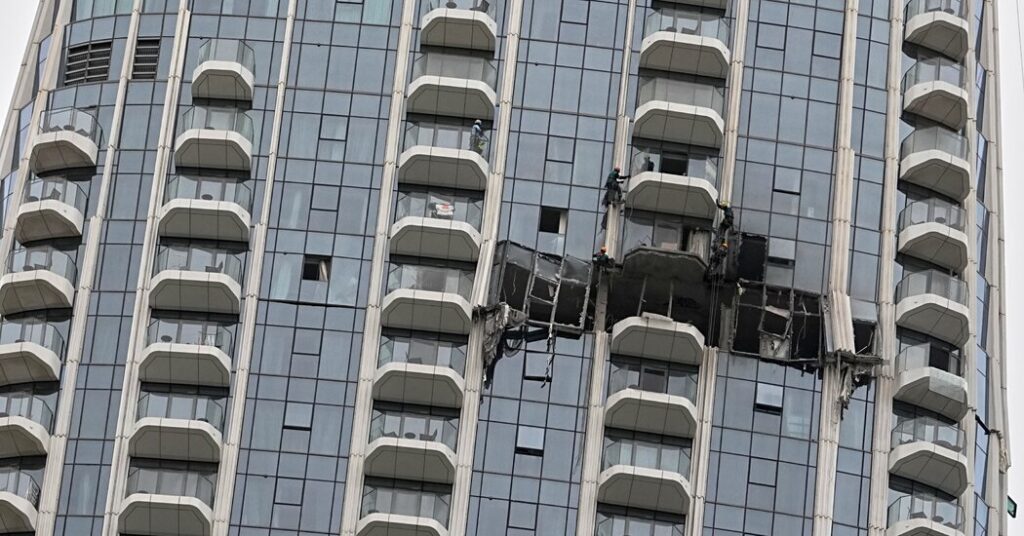
In the Emirates, the target of many attacks, five-star hotels have caught fire and explosions have shattered the windows of high-end apartment towers.
The authorities there soon issued a warning to the public to avoid taking photographs or sharing imagery of attack sites or of damage.
The Emirati government has arrested at least 35 people, ordering expedited trials — some on charges of “glorifying” the attacks and others on charges of publishing videos that contained misleading or fabricated content. But the largest proportion of the detainees — whose nationalities and partially obscured pictures have been released by the state news agency — were accused of “publishing true videos of the attacks and their impact.”
Many of the detainees came from Bangladesh, India and Pakistan, countries that send large numbers of low-paid workers to the Emirates. Pakistani embassies across the Gulf have issued advisories via social media, warning citizens that sharing such content may violate local laws.
Last week, the Emirati authorities arrested a videographer for an international news outlet, accusing him of filming in “restricted areas without obtaining the necessary official permits.” They did not name the outlet or the videographer. Amid the restrictions on social media, photographers working for international media have become one of the few sources of imagery documenting the effect of the attacks.
In a statement to The New York Times, the Emirati government said that misinformation “can have serious consequences and, in some cases, can cost lives.”
“The attorney general emphasized that disseminating such materials or inaccurate information can incite public panic and create a false impression,” the statement added.
The government did not respond to questions about the list of social media accounts that were no longer accessible inside the Emirates.
The largest number of arrests have been made in Qatar, which said it had detained more than 300 people accused of “filming and circulating unauthorized video clips, spreading misleading information and rumors, and disseminating content intended to incite public concern,” according to an interior ministry statement.
In response to questions from the Times, the Qatari government said that many of those detained had been released within hours after signing a pledge not to post such material. It also said that the arrests only targeted people who had filmed military installations or who had “knowingly spread rumors or false videos.”
In Bahrain, there have been no arrests “solely for filming or sharing footage,” the government said in a statement to The Times. Detentions in the country, the statement added, were of “individuals suspected of perpetrating violence; inciting violence or hatred; or threatening national security by transmitting sensitive information, coordinates or intelligence to hostile actors.”
But in one of several cases that has had a chilling effect on people sharing information about attacks, the public prosecutor in Bahrain has been pursuing the death penalty against four people accused of filming strikes and committing treason by “promoting and glorifying Iranian terrorist acts” in the country. It was unclear what they had posted.
On March 7, the Kuwaiti Interior Ministry announced that it had arrested three people — two of them prominent social media influencers — after they appeared in a video clip “mocking the current situation in the country.”
The clip appeared to be a satirical video in which the men had cowered underneath the stairs laughing, wearing helmets and clutching makeshift weapons while sirens warning of an attack blared outside.
Rania Khaled, Sanam Mahoozi, Raja Abdulrahim, Zia ur-Rehman and Lizzie Dearden contributed reporting.
Vivian Nereim is the lead reporter for The Times covering the countries of the Arabian Peninsula. She is based in Riyadh, Saudi Arabia.
The post Gulf States Crack Down on Videos of Iranian Attacks Posted Online appeared first on New York Times.