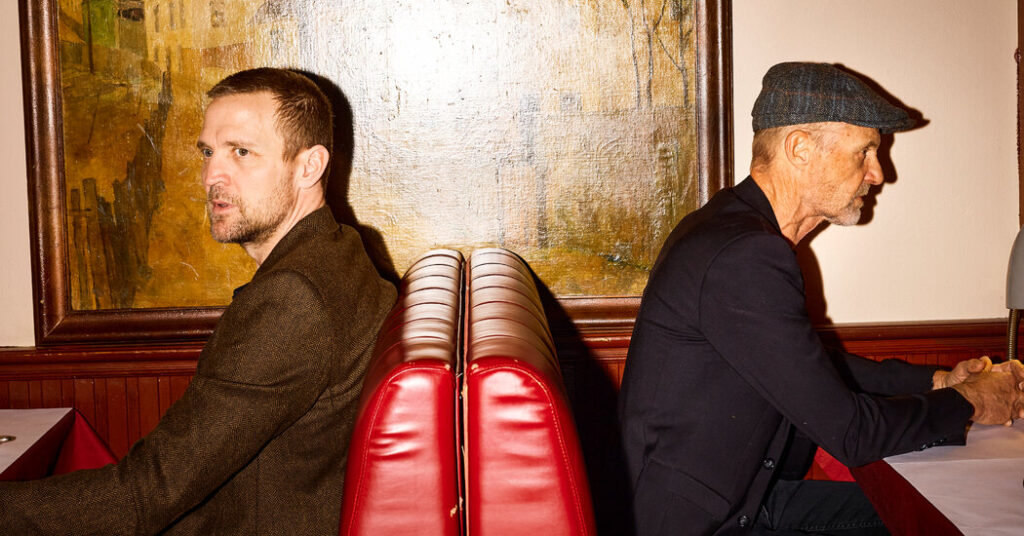
As fictional detectives go, Harry Hole — which, before we go any further, is pronounced HAR-ee HOO-leh — isn’t exactly breaking the mold. A troubled cop, Harry doesn’t mind skirting police procedures and roughing up suspects. He is a man of few words and impeccable musical tastes, although his Pixies T-shirt could use a good wash.
When his partner is killed, he falls off the wagon and goes back to drowning his demons. A witness in a murder inquiry has Harry’s number: “You’re a giant cliché,” she says in a new series-length adaptation, “Jo Nesbo’s Detective Hole,” which debuted Thursday on Netflix. This is after trying to seduce him, of course.
Nesbo, the Norwegian author who has written 13 Harry Hole novels since 1997 and oversees the Netflix series, is of two minds on that assessment.
“Harry was inspired by some people in my life that I know real well that are not clichés,” he said in a video interview from a London hotel. “Also I wanted to consciously use the stereotypes from the hard-boiled detective novel — a little bit like Frank Miller did in ‘Sin City,’ where he took the detective and instead of shying away from the clichés, he went all the way and made them even bigger.”
That approach extended to the series. Tobias Santelmann, 45, who plays Harry and had joined the call from Oslo, leaned in. “We love the crime genre here in Scandinavia, and I think that we’re quite good at it,” he said. “But with this show, it’s sort of like we take it a step further.”
“We make Oslo a little bit bigger than it really is,” he added. “Some of the buildings are a little bit taller. There’s a gondola that’s not really here. It’s like Oslo plus 15 percent.”
This sprucing up of genre conventions — and Nesbo’s propulsive writing — may help explain why his books have sold over 50 million copies worldwide. Given that popularity, screen adaptations were probably inevitable. The first, unfortunately, was an unwieldy English-language mishmash, “The Snowman” (2017), which the New York Times critic Manohla Dargis described as “a grim, thrill-free thriller, one without a twitch of real feeling and next to no elementary story sense.” (The movie has only a 7 percent positive critics’ score on Rotten Tomatoes.)
Perhaps unsurprisingly, Nesbo was more hands-on this time, adapting his own novel “The Devil’s Star” for the Netflix teleplay. At the suggestion of Oystein Karlsen, one of the series’ two directors, he also took on showrunning duties, helping further ensure that “Detective Hole” remains faithful to his vision.
“No one knows Harry as much as him — he’s lived with this character, this person, for 30 years,” Santelmann said. “It was great because he has an idea of how Harry sits in a chair, how he looks at people, and if he smiles, how he smiles.”
“The Devil’s Star,” published in the United States in 2010, is the fifth book in the Harry Hole series and is one of Nesbo’s most popular. It follows a string of gruesome, seemingly fetishistic killings, which Harry investigates teamed with a corrupt, murderous cop named Tom Waaler, played in the series by Joel Kinnaman (“The Killing,” “For All Mankind”).
The book is a brutal, relentless page-turner, which made for a great procedural onscreen. But the season’s emotional core is the relationship between Tom and Harry, who constantly lock horns. The nefarious Tom is often the voice of temptation, tantalizing Harry with a life free from pesky rules and conventions. The more righteous but vulnerable Harry, in turn, tries many times to expose his id-driven counterpart for reasons that are deeply personal.
Writing novels is, of course, a highly solitary endeavor with a lot of creative control. Turning it into a Netflix series, with all the collaboration and budget pressures that entails, presented new challenges to Nesbo as he sought to keep a handle on the story’s direction. But it also presented new insights and opportunities; he enjoyed collaborating with Santelmann to summon the screen version of Harry, who in many ways began to take on a life all his own.
“When I go on set, I’ve left my character at home,” Nesbo said. “For me, it’s great to see great actors doing their thing. It’s magic to see that, OK, this wasn’t the guy I was looking for, but now I’m getting to know him.”
He added: “What I have to be careful with is when I’m writing my next Harry Hole novel, I’m not putting Tobias in there.”
Kinnaman, who was born in Stockholm, was less familiar with the books than with Nesbo adaptations, in particular the film “Headhunters” (2012), and said he had jumped at the chance to portray Harry’s nemesis — especially since he was eager to work back in Scandinavia, having spent much of the past two decades in his adopted home of Hollywood. (He is keeping busy, with two other premieres on Apple TV just this month: the eight-part thriller “Imperfect Women,” which debuted last week, and Season 5 of the sci-fi epic “For All Mankind,” which debuted on Friday.)
“What I really like about Jo is that he’s not bound by Scandinavian good taste,” Kinnaman, 46, said in a separate video call from Sweden. “I feel like he allows himself to be bloody and gory, and to really kind of go far.”
For an embodiment of that approach, look no further than Tom. An amoral rogue, he drives a Lotus, wears shiny shirts, sports a gold chain. (“He’s not the most subtle guy,” Kinnaman said, laughing.) Nesbo described Tom’s relationship with Harry by bringing up an episode from his own childhood, when a friend suggested they steal a car.
“I went along with it; I wouldn’t have suggested it,” Nesbo said. “With Waaler and Harry, I think Waaler is the one suggesting, ‘Why don’t we steal that car?’”
At the same time, Tom craves intimacy, even as he rejects it. He envies Harry’s loving relationship with Rakel (Pia Tjelta) and her young son, Oleg (Maxime Baune Bochud).
“I think there is an admiration and also an attraction to Harry,” Kinnaman said. “In one way, he hates him, and then he also wants to be his friend,” he added, suggesting that Tom, a man of many appetites, would maybe sleep with Harry, too. (He used a blunter expression.)
Along with writers like Henning Mankell and Stieg Larsson, Nesbo has been central to the “Nordic Noir” boom of the past few decades. Adapting these dark and moody thrillers has become something of a cottage industry. The 2011 David Fincher version of Larsson’s “The Girl With the Dragon Tattoo” grossed nearly a quarter-billion dollars. Shows like “The Bridge” and “The Killing” have drawn devoted followings and topped critics’ year-end lists.
If “Detective Hole” proves successful, it may be because it relishes some of the conventions established by its predecessors while also jazzing them up a little: You don’t necessarily expect to find Tom, who would fit right in on “Miami Vice,” in the land of fjords and Edvard Munch. And while the show is bleak in its own ways, the action happens during a summer heat wave — no wintry landscapes, no frozen corpses.
To Kinnaman, who helped establish himself in some of those genre-defining adaptations, this made for an invigorating twist — Nordic Noir plus 15 percent.
“A lot of Scandi noir sort of follows the pattern of Scandinavian filmmaking and Scandinavian writing in many ways, where it’s much more sparse and restrained, and there’s sort of an undercurrent of emotional darkness,” he said. “Jo really pushes all those boundaries and then jumps over and tramples them.”
The post Don’t Let the Name Harry Hole Fool You. The Important One Is Jo Nesbo. appeared first on New York Times.