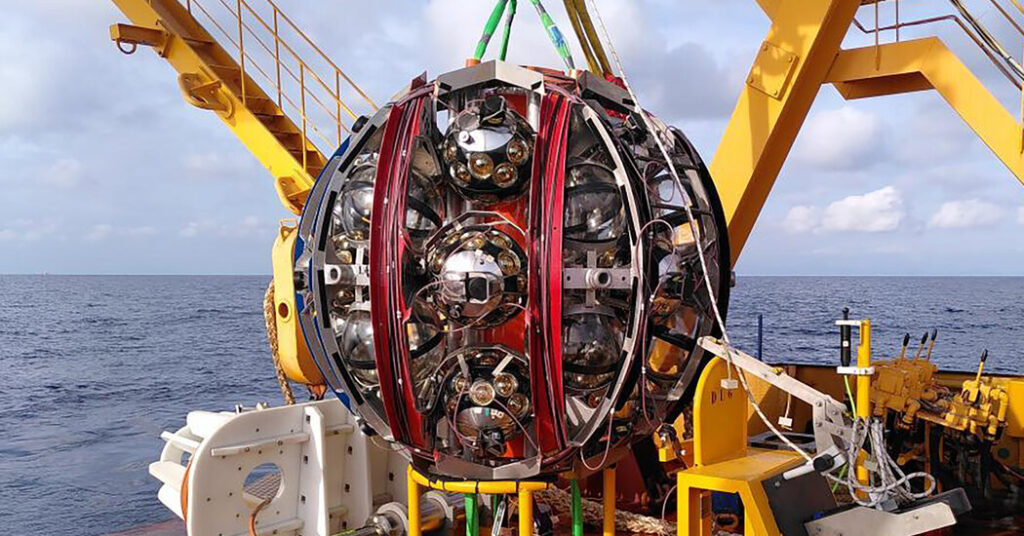
On Feb. 13, 2023, a cosmic bullet of sorts zipped beneath the Mediterranean Sea near Sicily. It was a subatomic particle known as a neutrino, traveling through the depths at virtually the speed of light and carrying a whopping 220 petavolts of energy. Its presence was detected by a new underwater observatory known as the Kilometer Cube Neutrino Telescope, or KM3NeT.
As a study in the journal Nature noted last year, the neutrino was more than 100,000 times as energetic as any particle ever produced in colliders on Earth, and more energetic than astrophysicists can easily explain based on the part of the sky the neutrinos came from. But astrophysicists are trying, and some have proposed a truly ambitious explanation: This cosmic bullet came from an exploding black hole, an object so dense that not even light can escape its gravity.
In 1974, the theoretical physicist Stephen Hawking calculated that black holes leak and eventually explode, releasing energy that had been entombed for centuries in a sort of mini-replica of the Big Bang. But no one has ever seen it happen.
Hawking also suggested that a variety of smaller black holes could have formed during the actual Big Bang. Scattered throughout space, such black holes might constitute some or all of the mysterious dark matter that makes up most of the material universe, some astronomers say.
According to calculations by Hawking and Bernard Carr, his assistant at the time who is now at Queen Mary University of London, some of those primordial black holes — about the size of a pinprick but as massive as an asteroid — should be exploding right about now (if they exist). Observing such an explosion would confirm Hawking’s hypothesis. It could also reveal new forms of matter and energy, and offer fresh clues as to the origin of space and time.
That’s a lot to hang on the testimony of a single subatomic particle. Among other shortcomings, the new underwater array is still not good at determining the directions from which the neutrinos come, said Erik K. Blaufuss, a research scientist at the University of Maryland, in an accompanying article in Nature. So other explanations, such as quasars obscured by dust, could arise.
“What we discover depends on what’s out there,” said David Kaiser, a professor of physics and history of science at M.I.T. who leads a group studying the prospects of these so-called primordial black holes.
Michael Baker, a particle physicist at the University of Massachusetts, Amherst, agreed. “We have a real piece of data that we need to explain,” he said. “We don’t currently know how to explain it.”
The Mediterranean neutrino belongs to a tribe of barely-there denizens of nature that sails through ordinary matter like moonlight through a window. The masses of the particles are too slight to measure; for a long time, they were thought to travel at the speed of light.
But neutrinos have always punched above their weight in astronomy and cosmology. They have been implicated in theories about why matter and antimatter did not cancel each other out during the Big Bang and produce an empty universe.
Astronomers can catch and track neutrinos by detecting the telltale flashes of light that they release as they shoot through water. IceCube, an array of detectors embedded in the Antarctic ice, has recorded neutrinos that trace back to quasars, the sun, the center of the Milky Way galaxy and other regions of cosmic violence. But IceCube has also recorded a half-dozen high-energy neutrinos that don’t trace back to any of the usual suspects.
At first glance, the Mediterranean neutrino also did not derive from any obvious candidates.
“Our results indicate the KM3NeT event is likely the first observation of a new astrophysical source,” Shirley Weishi Li, a physicist at the University of California, Irvine, and her colleagues said in a paper shortly after the neutrino was reported.
Dr. Kaiser already had an idea of what that source might be: Hawking’s tiny black holes.
The idea started as a joke, Dr. Kaiser recalled, but it gathered weight as he and Alexandra Klipfel, a graduate student, broke down the hypothetical math.
“You’ll never, ever hope to see Hawking radiation if the only black holes ever were ones that formed from dead stars,” he said. Primordial black holes have different masses and different lifetimes, he noted: “Some go bang right now.”
In a paper published in September in Physical Review Letters, Dr. Kaiser and Ms. Klipfel concluded that if primordial black holes were the explanation for long-sought dark matter, scientists should expect about 40 black-hole explosions to occur each year in every cubic light-year near the Milky Way.
They also calculated that one of those primordial black holes could have produced the Mediterranean neutrino if, by chance, it was closer to Earth than the averages would indicate — say, about 20 billion miles away, on the outskirts of the solar system in the Oort cloud.
Normally, such an explosion would have been detectable by the Large High Altitude Air Shower Observatory in Sichuan, China, as a flash of gamma rays in the sky. But the region of the sky from which the neutrino originated was not in the observatory’s field of view at the time, Ms. Klipfel said recently at an M.I.T. symposium. The whole show lasts only a minute or two, she added, but there would be a chance of seeing the explosion if it happened that close again.
Dr. Kaiser emphasized that his group was not claiming a discovery. They have about an 8 percent chance of being right, he noted, a significance called 2-sigma — far short of earthshaking.
The point, he added, was merely to demonstrate, using “off-the-shelf ingredients” — ordinary Einsteinian gravity and known particles — that it was possible for primordial black holes to explain dark matter. “They all fit together with no new ingredients, which I thought was really pretty cool,” he said.
Two hours west at the University of Massachusetts, Amherst, Dr. Baker and his particle-physicist colleagues are also scouring the KM3NeT and IceCube data for insight into the identity of dark matter. In a paper published last spring, they noted that when a black hole finally exploded, it would erupt “democratically,” spewing not only familiar particles — the contents of the Standard Model — but also particles and forces unknown to science.
In effect, an exploding black hole, like the Big Bang itself, would be the ultimate particle collider, revealing hitherto unknown aspects of nature’s repertoire that could account for the dark matter.
Dr. Baker and his colleagues presented what they called a toy model of how this would work, using a popular theory proposed by students of dark matter.
The hypothetical suspects often mentioned by dark-matter sleuths are “dark” photons and “dark” electrical charges, invisible analogues of the electromagnetic forces responsible for ordinary light.
Black holes imbued with these “dark” electrical charges would take longer to evaporate and explode, Dr. Baker and his colleagues calculated. Thus, they could lurk unseen and unsuspected until the moment they suddenly lit up and then vanished for good, without ever flashing signature bursts of gamma rays.
“There could be a whole population of these black holes out there, but since they don’t radiate we can’t observe them in any way,” said Andrea Thamm, a member of Dr. Baker’s team.
Dr. Baker said that “our job as theorists is to fill out the space of possibilities that are consistent with all the experimental observations.” He added: “We haven’t written down a grand unified theory” — the fabled theory of everything that Albert Einstein pursued in vain — “but I would say our work is kind of like a first step toward showing that something like that could be possible.”
Whether the Grand Unified Theory, or even a deeper vision into black holes or dark matter, is imminent depends on the whims of nature.
“The amusing fact,” John Learned, a veteran neutrino expert at the University of Hawaii, said in an email, is that the Mediterranean neutrino will remain a mystery until more of them are found. “Quite delightful,” he said, adding: “And nothing at all that we can do but wait. (And build more instruments of course.) Ain’t science wonderful!”
Dennis Overbye is the cosmic affairs correspondent for The Times, covering physics and astronomy.
The post Did Scientists Just Detect an Exploding Black Hole? appeared first on New York Times.