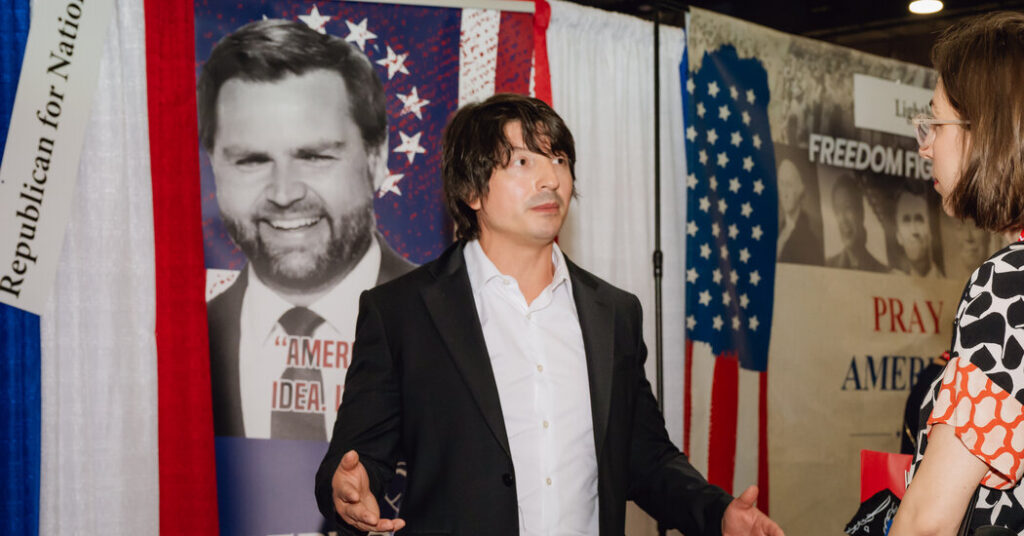
As usual, CPAC is replete with bedazzled Trump attire, ivermectin advertisements and live podcasts. It is, after all, a place where the Republican Party’s most fervent — and sometimes eccentric — grass-roots loyalists mingle and energize the party faithful.
But this year, an uncomfortable feeling is creeping through the conference: For the first time in a decade, Republicans are being forced to contemplate life after President Trump, and consider whom they want to take the reins of the MAGA movement.
Though Trump still has nearly three years left in his second term, some Republicans are breaking with the president on issues like the war with Iran — a discontent that even reared its head at CPAC, where speakers like Steve Bannon and former Representative Matt Gaetz criticized U.S. military action in the Middle East.
And although CPAC attendees all praised the president, some said they were already sizing up his potential successors. (On Saturday, CPAC will release its highly unscientific but headline-grabbing straw poll of whom attendees support for 2028.)
Unsurprisingly, two names came up most frequently in discussions: Vice President JD Vance and Secretary of State Marco Rubio.
“Either of them would be great,” said James Payne, a retired military officer, though he admitted that both would feel like a drop-off from Trump: “His successors are mortal men.”
It is still very, very early, and how Republican voters broadly view Rubio and Vance — if both decide to run — depends partly on what happens the next couple of years. But attendees at CPAC seemed to fall generally into two camps: Those who supported a more aggressive approach to intervening in world affairs tended to favor Rubio, while those who preferred an anti-intervention mind-set generally backed Vance.
As John Kent and Alex Johnson stood next to each other at a booth in the CPAC exhibition hall where they were tallying attendees’ support for the Iran war — drop a pinto bean in the “yes” or “no” jars — they acknowledged that they disagreed about both the war and their 2028 pick.
“I’m not sure Vance is ready — he’s kind of young,” said Kent, who is pro-war. (Vance is 41, while Rubio is 54.) “Rubio, he’s got more experience; he’s been around a little bit longer. And maybe his Latin roots will play a part in getting elected.”
Johnson, who is antiwar, favored Vance: “Rubio is a bit more hawkish when it comes to foreign policy,” he said, while the vice president “has American interests at heart.”
Some suggested a joint Vance-Rubio ticket, with the vice president at the top. And others threw out a handful of dark-horse names: Gov. Ron DeSantis of Florida taking a second shot at the presidency after his 2024 run flamed out, or former Gov. Glenn Youngkin of Virginia giving it a go. (Tucker Carlson and Senator Rand Paul of Kentucky were also mentioned, but with derision.)
For Peter Bower, it was too early — and, perhaps, too painful — to consider any Republican other than Trump.
“Who knows?” he said. “Maybe the American people will be smart enough to change the Constitution so Trump could run again.”
Hasan Piker sets off a Democratic fight
The Democratic Party’s bitter arguments over Israel and antisemitism are flaring up again in Michigan.
At the center of the drama is Hasan Piker, a popular left-wing streamer who has fiercely condemned the Israeli government — sometimes in provocative terms. Planned appearances by Piker at rallies for Dr. Abdul El-Sayed, one of the three Democratic candidates, have drawn criticism from El-Sayed’s two rivals.
My colleague Tim Balk has more.
Grandmas for Graham
Maine is also home to an increasingly contentious Democratic primary for Senate, with Gov. Janet Mills, 78, trying to hold off a progressive insurgent, Graham Platner, 41.
Older women, my colleague Jenna Russell reports, are likely to play a key role in the race, and some of them prefer the younger Platner as the Democratic Party confronts a nationwide generational rebellion.
QUOTE OF THE DAY
“It’s going to be another Vietnam.”
That was Vincent Martinez, a conservative city councilman in Wasco, Calif. He voted for President Trump in 2024 but has since soured on him, and he’s especially incensed about the war in Iran.
Two years after Latino voters shifted toward Republicans, my colleague Jennifer Medina writes, there are signs they could be swinging away from the party.
ONE LAST THING
The MAGA merch ecosystem
Trump rubber ducks. The president’s signature comb-over affixed to a red visor. A shirt with Trump’s mug shot that reads, “I’m voting for the convicted felon.”
These are only some of the products powering the $300 million-plus world of Trump-themed merchandise, a wide-reaching marketplace that both feeds off the president’s power and reinforces it, my colleagues Tiffany Hsu and Stuart Thompson found.
Taylor Robinson and Ama Sarpomaa contributed reporting.
Kellen Browning is a Times political reporter based in San Francisco.
The post CPAC Considers Vance, Rubio and Life After Trump appeared first on New York Times.