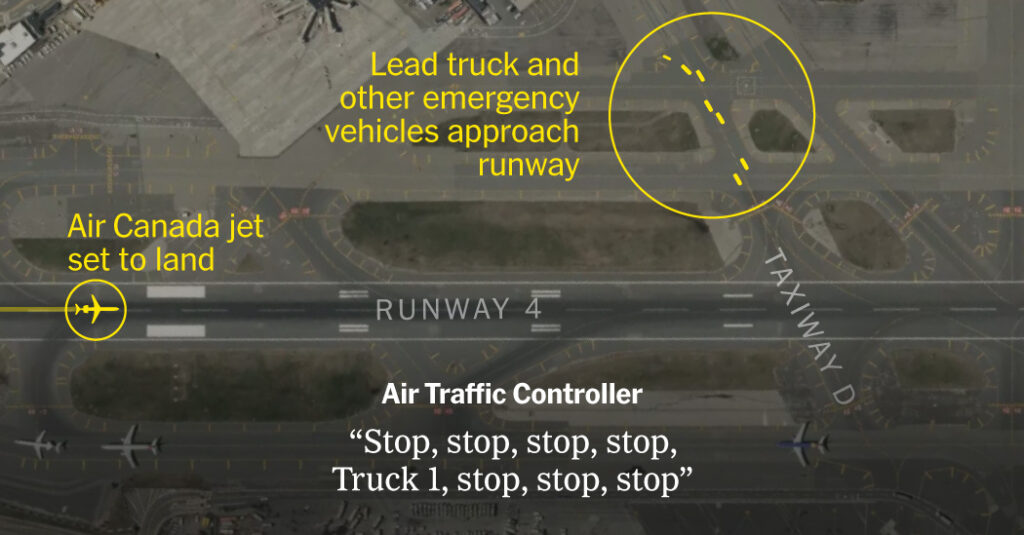
The air traffic controller’s voice was urgent. Over nine seconds, his orders became more frantic. “Stop, Truck 1, stop!”
But the fire truck kept going, moving closer to a runway at LaGuardia Airport, as an Air Canada regional jet bore down for a landing.
At the end of those nine seconds late Sunday night, the plane plowed into the truck, killing the two pilots and injuring dozens of people aboard. The two rescue officers in the truck were hospitalized.
Why didn’t Truck 1 stop?
Much remains unclear about the circumstances of the crash. Federal authorities are investigating whether it stemmed from problems with air traffic controller staffing, vehicle tracking technology, human error or a combination of factors.
The New York Times used air traffic control audio, flight data and surveillance footage to reconstruct the nine seconds before the incident, the first fatal crash at LaGuardia in more than three decades.
Those nine seconds were critical.
A Routine Call
Truck 1, leading a convoy of emergency vehicles, had been summoned to respond to an odor on a United Airlines plane that had sickened the flight crew. By all accounts, the emergency call was routine for the Port Authority Police Department’s Aircraft Rescue and Firefighting unit, known as ARFF. Members are specially trained to respond to planes arriving at airports with damaged landing gear, foul smells and, more rarely, crashes. Most requests for help turn out to be false alarms.
Before responding to an emergency, the rescue officers put on their bunker gear. Their breathing apparatuses are in their seats. Multiple radio transmissions blare in their trucks, which are larger than typical fire trucks.
Some officers use headphones inside trucks to listen to communications from the air traffic control tower, and to reduce the sounds of other radio transmissions, said Bobby Egbert, a spokesman for the Port Authority police officers’ union. (It is not clear whether the officers in Truck 1 were using them.)
Truck 1 made a request at 11:37 p.m. to cross Runway 4 at Taxiway D, according to a timeline from the National Transportation Safety Board and air traffic audio reviewed by The Times. Piercing through the noise five seconds later, an air traffic controller responded: “Truck 1 and company, cross 4 at Delta.”
Fourteen seconds before the truck reached the runway, the officers repeated the runway clearance to ensure that they had received the message correctly, and to verify that they understood the instructions: “Truck 1 and company crossing 4 at Delta.”
‘You Have to Listen’
Inside Truck 1 were two veteran rescue officers, Sgt. Michael Orsillo and Officer Adrian Baez. About half a dozen other emergency vehicles followed behind them, footage shows.
Mr. Egbert said it is the responsibility of the crew chief to ensure the safety not just of their truck but of the other vehicles crossing the runway after receiving clearance from the tower. Speed is crucial: The units often train in “time trials” and are expected to respond to emergencies within a certain amount of time designated by the Federal Aviation Administration.
But no aircraft or vehicles can move about the taxiways and runways without the permission of an air traffic controller, who serves as the eyes and ears in the sky and on the ground.
“They’re God,” Mr. Egbert said. “You have to listen to their instruction. It’s sacrosanct. They control everything. Even if a truck is responding to a life-threatening emergency, he still has to wait to get clearance to go from Point A to Point B.”
There were two air traffic controllers in the LaGuardia tower at the time of the crash, in line with standard procedure for the overnight shift, Jennifer Homendy, chairwoman of the National Transportation Safety Board, said on Tuesday. Safety officials have long worried about this staffing arrangement, she said, but she stressed that it was too soon to know whether staffing may have played a role in the communications failures.
Back-to-Back Orders
Five seconds after Truck 1 got the go-ahead to cross, the Air Canada flight was 30 feet off the runway, and the control tower instructed a Frontier Airlines aircraft to hold its position on the ground.
About two seconds later, the traffic controller radioed again: “Frontier 4195, stop there, please.”
In almost the same breath, the controller then urged Truck 1 to stop.
Mr. Egbert, of the officers’ union, said the other vehicles in the convoy would be equipped with radios and would most likely have also received the order to stop.
But the back-to-back orders to the Frontier flight and the lead truck could have caused confusion, aviation experts said.
“Part of communications at the airport is a rhythm,” said Kit Darby, an aviation consultant and retired airline pilot and instructor. “They were talking to the airplane, telling it to stop, and then to the truck, and you’re not anticipating another call. The only thing unique to hear was ‘Truck 1.’”
Mr. Darby said the truck driver might not have realized that the order to halt was for him: “You don’t get cleared to cross and then told to ‘stop, stop, stop’ — that never happens.”
The Crash
Four seconds before the jet crashed into the fire truck, the controller again told the truck to stop.
Mr. Darby said it appeared that the driver had not heard the command. “It could have been a really noisy environment,” he said. “He could have been revving the engine to cross very quickly.”
But he said the rescue officers should have checked to be sure the runway was clear before entering, even though they had clearance.
“The airplane always has the right of way,” Mr. Darby said, adding that a plane’s landing lights are bright and typically easy to see at night.
It remains unclear whether the crew in Truck 1 heard the orders to stop. One of the rescue officers remained in the hospital as of Tuesday; the other had been discharged. Efforts by The Times to reach the officers have been unsuccessful.
The National Transportation Safety Board said that Truck 1 did not have a transponder that would allow air traffic controllers to monitor its position. The technology is standard at many airports across the country.
Mr. Darby said that air traffic controllers should have a clear line of vision from the tower. There is also ground radar that shows vehicles as blips on a screen. But the transponders offer more precision, giving the controllers a clearer picture.
Ms. Homendy of the N.T.S.B., speaking on CNN on Wednesday, said she believed it was important for such vehicles to have transponders. “If you’re an air traffic controller, you should be able to see everything that’s on the ground, everything that’s in the immediate airspace, so you can ensure safety,” she said.
Corey Kilgannon contributed reporting.
Sources for top map: satellite imagery via Mapbox; plane positions from Flightradar24; air traffic control audio from LiveATC.
Note: To estimate the path of Air Canada Flight 8646 during its approach and in the moments leading up to the collision, The New York Times used position data and time stamps from Flightradar24; cockpit voice recorder data shared by the National Transportation Safety Board; and audio communications between LaGuardia Airport’s control tower, the aircraft on the runway and the fire truck. The point of collision was estimated from surveillance footage of the crash, and the plane’s speed and position were then used to reconstruct the plane’s path moments before impact. The positions of the emergency response vehicles were approximated by analyzing surveillance footage of the crash. The timing of air traffic controller warnings in relation to the positions of the plane and fire truck was estimated by comparing the plane position data and cockpit voice recorder audio. The dots representing the emergency vehicles on the map are not to scale.
Jan Ransom is an investigative reporter for The Times focusing on the criminal justice system, law enforcement and incarceration in New York.
The post Before the LaGuardia Crash, Why Didn’t Truck 1 Stop? appeared first on New York Times.