The anti-nuclear artists collective whose work is on display at Pitzer College in Claremont never predicted a nuclear proliferation crisis would break out in the Middle East during their exhibit, or how grimly topical their work would quickly become as a result.
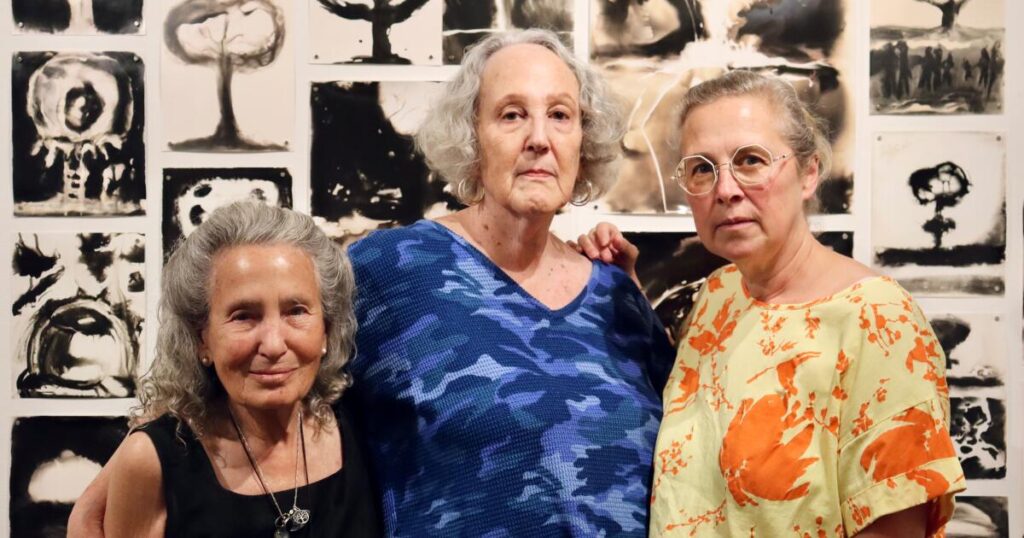
“Atomic Dragons,” wrapping April 4 with a closing-day symposium of nuclear experts, is the work of SWANS, which stands for Slow War Against the Nuclear State. The group is made up of artists, activists and academics with ties to the nuclear industry, including children and spouses of nuclear industrial complex workers — putting a new spin on the “nuclear family.”
The show examines the environmental and human cost of the atomic era through an artistic lens, tracing present day nuclear risk back to its Cold War roots.
The SWANS’ warning call has always been clear, but ”Atomic Dragons” took on a whole new meaning when the United States and Israel launched a joint assault on Iran over its illicit stockpile of nuclear materials Feb. 28, three weeks after the show opened.
“We’re at the start of what will be an exceedingly dangerous period in terms of the Iranian nuclear program,” nuclear policy expert Scott Sagan, who co-directs Stanford’s Center for International Security and Cooperation, said. “We’re likely to have a major, major conflict over this.”
In a time of acute nuclear anxiety, SWANS is an outlet through which the artists process the fear and gravity of our atomic reality.
“My maybe-naive hope is that the artworks help to provide an avenue into that understanding of the severity of what it means to play with the nuclear,” said Fiona Amundsen, whose arresting film photography of three trees in Hiroshima that survived the 1945 nuclear bomb was developed using contaminated seaweed growing in the Fukushima wastewater release line.
The resulting images are dotted with delicate white flares: trace amounts of radioactive tritium that transferred to the film from the nuclear effluent during the chemical processing, bearing physical witness to the usually invisible effects of radiation.
Amundsen’s work is in keeping with the rest of the show, which fills two halls at the liberal arts school with visual and multimedia works that probe the persistence of radioactive materials. Artifacts from the birth of the nuclear age are also featured, including items recovered from postwar Hiroshima and a letter from the father of the nuclear bomb, Robert J. Oppenheimer.
The artworks are as likely to unsettle as they are to move.
Elin o’Hara slavick labored over an expansive series of photochemical drawings of every above-ground nuclear test — 528 in total, a selection of which are featured in the exhibit— on salvaged darkroom paper from Caltech, the institution that played a role in developing the detonators for the U.S. nuclear bombs dropped on Japan under the top secret Project Camel.
Slavick said she found the abandoned silver-gelatin paper, which was fogged despite being stored in closed boxes, in the basement of the university near a door labeled “Radiation Science,” which led her to believe radiation exposure from Caltech’s Manhattan Project past distorted the photographic paper.
SWANS seems to double as a support group for families impacted by the nuclear industry. Many members believe they’ve lost loved ones to radiation, or were themselves likely impacted by early-life exposure as children of Manhattan Project engineers. The tension between the anti-nuclear artwork and its artists’ familial ties to the production of the very technology they reject is an enticing dance of its own.
Writer Judith Dancoff links her hyperthyroidism and long-term reproductive issues from a pituitary gland tumor to childhood radiation exposure during a summer spent at the Oak Ridge uranium enrichment site in Tennessee where her father worked as a student of Oppenheimer. Her father died young of cancer, and the story is woven into her featured SWANS work.
One of the largest pieces on display at “Atomic Dragons” is Nancy Buchanan’s interactive full-wall exhibit of documents her father brought home from his government work as a Manhattan Project physicist, alongside material from the FBI file on his mysterious death, on display for viewers to read under looming red letters spelling out “SECURITY.”
The current crisis in Iran has sent memories bubbling to the surface for the collective, and chills down the spines of viewers.
Many have expressed fears of an Orwellian-style forever war, or worse, the use of the atomic weapon invented “to end all wars” in a twisted attempt to do so, poisoning the region as a byproduct. But nuclear policy expert Sagan said the likelihood of the conflict escalating to involve nuclear weapons is “exceedingly low,” even if Iran has the capability to build them.
Iran possesses enough 60% highly-enriched uranium to build about 10 nuclear weapons if further enriched to 90% weapons grade, he said. This could take a matter of weeks to complete depending on the state of Iran’s enrichment centrifuges, which Trump claimed to have “obliterated” during air strikes in June.
Iran could also craft a primitive nuclear device out of minimally enriched materials for an offensive attack (“60% could actually create an explosion, it just wouldn’t be a very efficient one,” according to Sagan), but George Perkovich, senior fellow for the Carnegie Endowment for International Peace’s Nuclear Policy Program and author of “How to Assess Nuclear Threats in the 21st Century,” points out that “you have to build more than one for it to be useful,” especially under the wrath of a nuclear-armed West’s expected response.
What is more likely, and probably more dangerous, experts say, is the now-heightened long-term risk of global proliferation. “This war is going to suggest to some countries that if they want to secure their sovereignty, they need nuclear weapons,” Sagan said.
Since 1968, the world nuclear order has rested on the delicate architecture of the Nuclear Non-Proliferation Treaty, enforcing the international norm that countries without nuclear weapons won’t try to get them, and countries with nuclear weapons won’t help arm their allies. Now, experts say the rulebook has been thrown out.
“What this does is it breaks the old system that was based on the non-proliferation treaty,” said Perkovich, who has worked on nuclear issues for 44 years. “It’s now ‘might makes right,’ everybody’s on their own, friends versus enemies. I think the terms now change, and we’re not bargaining.”
Though the timing of the military operation in Iran with the “Atomic Dragons” exhibit could not be described as kismet as much as brutally ironic, slavick said the “sick and sad thing” is that “it’s always topical when you’re an American.”
“We do this. We wage wars. We are the leading nuclear country,” she said, speaking to the heart of the SWANS message: In a world where nuclear materials exist, it is not a matter of if humans will be harmed, but when.
There is a historic relationship between visual art and nuclear war, said Jim Walsh, a senior research associate at the MIT Security Studies Program on nuclear weapons risk issues in Iran and North Korea, who is also a speaker at the exhibit’s closing symposium. As the world enters a “more disruptive period” after the post-Cold War cooling of nuclear tensions, he expects to soon see “a flowering of artistic projects,” as nuclear risk reaches a local peak. “It’s a super powerful thing involving life and death, the planet, the entire environment, love and hate,” he said.
“Atomic Dragons,” which also features work created decades ago, highlights questions that are as relevant today as they were at the dawn of the nuclear era: Can we make the world safe enough so we can once again dream? Is the strength of a country found in its military rather than its culture? Is fear our gross national product?
The post An anti-nuclear art show opened in L.A. County. Then the U.S. bombed Iran appeared first on Los Angeles Times.