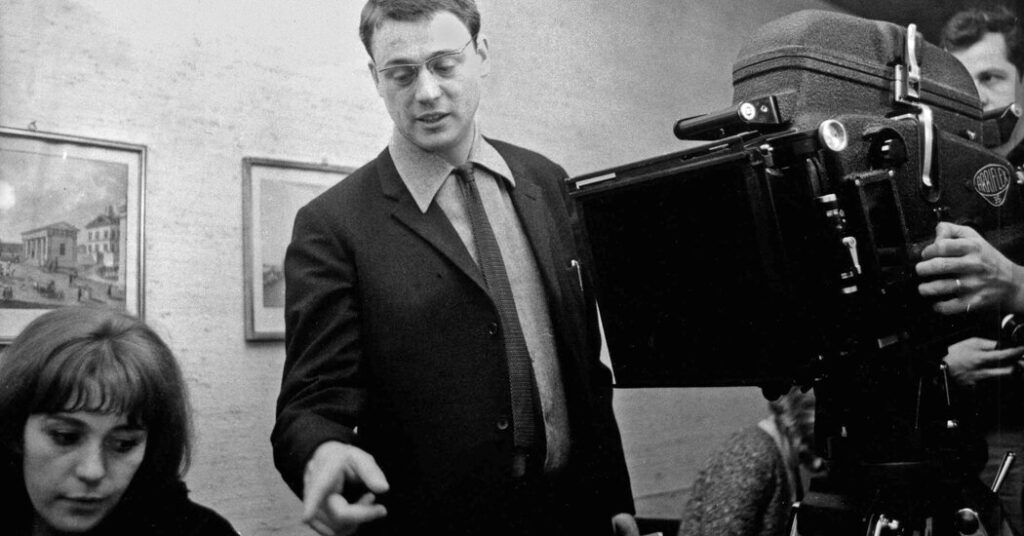
Alexander Kluge, a movie director, film theorist and author who became a pre-eminent figure in the New German Cinema movement of the 1960s and ’70s and was widely regarded as one of his country’s towering artists and intellectuals, died on Wednesday in Munich, where he lived. He was 94.
His publisher, Suhrkamp Verlag, announced the death but did not provide further details.
In a career that spanned seven decades and encompassed films, books, television productions and art installations, Mr. Kluge attempted to distill the entire intellectual, literary and artistic history of modern Germany, including the trauma and often-suppressed guilt of the postwar period.
Critics often described his work as dense, oblique and collagelike, with a heavy and sometimes discordant use of montage. He incorporated flurries of photographs, archival film footage, paintings, drawings and intertitles. His soundtracks might feature voice-overs, ambient sounds, air-raid sirens and classical or contemporary music — any of which may or may not relate to the scene.
With his nontraditional approach, he tried to reward the viewer’s imagination, the film scholar Michelle Langford wrote in the publication Senses of Cinema in 2003.
“Rather than putting these fragments together with a final ‘ideal meaning’ in mind, Kluge places the emphasis on the role of the spectator in the production of meaning,” Ms. Langford observed. “His theory of montage is interested in involving the spectator in the production of meaning, effectively making them ‘co-producers’ of the film.”
Working into his 90s, Mr. Kluge rarely stood still. His vast output included films that ranged in duration from less than one minute to nine-and-a-half hours; more than 1,700 hours of television programs; and thousands of pages of fiction, nonfiction and theoretical writings.
If not overtly commercial, his films stirred decades of discussion in academic journals, art publications and other erudite outlets. The author and essayist Susan Sontag once wrote that Mr. Kluge, whose films grew increasingly redolent with avant-garde theories on mass media and social-critical analysis, exemplified “what is most vigorous and original in the European idea of the artist as intellectual, the intellectual as artist.”
Outside of Germany, Mr. Kluge was less known than New German Cinema compatriots like Werner Herzog, Wim Wenders and Rainer Werner Fassbinder. Nevertheless, he was hailed for making some of the defining films of that movement, which sought to break from the bourgeois conformity of post-World War II German cinema with works that were far more thematically daring politically, socially and sexually.
In 1962, Mr. Kluge was among the 26 young filmmakers who signed “The Oberhausen Manifesto,” often seen as the founding charter of New German Cinema. It called for a new direction for German filmmaking, one that would be more creatively independent and free of commercial constraints.
The document took its title from a city that is home to one of the world’s oldest and leading short-film festivals. The Oberhausen Group, as the signatories came to be known, bluntly asserted, “Papa’s cinema is dead.”
“Together we’re willing to take any risk,” the manifesto said. “Conventional film is dead. We believe in the new film.”
One of Mr. Kluge’s key contributions to that effort was his 1966 feature film debut, “Yesterday Girl,” which starred his sister, Alexandra Kluge, as a Jewish woman from communist East Germany trying to start a new life in the capitalist West.
The film was sexually frank and employed an audacious montage sequence to critique postwar German society. It won the top directing prize from the Venice Film Festival.
Mr. Kluge’s 1968 film, “Artists Under the Big Top: Perplexed,” an allegorical circus-set drama starring Hannelore Hoger, a frequent actress in his movies, took home the festival’s highest prize, the Golden Lion.
Both films earned the director comparisons to the French New Wave master Jean-Luc Godard for their bold use of montage and political engagement. But where Mr. Godard wielded wit and a “sense of cinematic tradition” in films like “Breathless” and “Band of Outsiders,” the film historian David Thomson wrote, Mr. Kluge’s movies were far more “pondering” works of philosophical seriousness, concerned mostly with “the past and Germany’s inexplicable escape from it.”
Over the next four decades, Mr. Kluge made dozens of essay-films, often shot on video. Many were for a television production company he founded in the late 1980s and included interviews with artists and thinkers, among them Mr. Godard and the German playwright and director Heiner Müller.
One of Mr. Kluge’s essay-films, “News From Ideological Antiquity” (2008), took nine-and-a-half-hours to examine the Soviet filmmaker Sergei Eisenstein’s failed effort in the late 1920s to make a movie based on Karl Marx’s “Das Kapital.” Mr. Kluge referred to his own film as a “poetic documentary.”
Mr. Kluge had a particularly long collaboration with the German sociologist philosopher Oskar Negt, whom he met in 1969. They collaborated on three books about political and social subjects, including Marx’s historical materialism and the philosopher Jürgen Habermas’s concept of the bourgeois public square. They also conducted about 60 television interviews together.
Alexander Ernst Kluge was born on Feb. 14, 1932, in the town of Halberstadt, in Saxony-Anhalt, Germany, the elder child of Ernst and Alice (Hausdorf) Kluge. His father was a physician.
As a teenager during World War II, Alexander witnessed the near-total destruction of his hometown by U.S. bombers. Three decades later, he wrote an account of the attack, “The Air Raid on Halberstadt on 8 April 1945,” which became one of his best-known pieces of writing. The German man of letters Hans Magnus Enzensberger described it as a “kind of film made of words and still photographs.”
Mr. Kluge’s parents divorced in 1943, an event he recalled in an interview as “more shattering and devastating than the fact of our parental home burning down during the bombing raid.”
After the war, he and his mother lived in Berlin; his father and younger sister, Alexandra, remained in Halberstadt, which became part of East Germany.
Mr. Kluge studied law, modern history and church music at Marburg University, where he also received a law degree in 1956. He then worked for a law practice and at Goethe University in Frankfurt but was increasingly drawn to literature and film.
Mr. Kluge was legal counsel for the Institute for Social Research in Frankfurt, with which the philosopher Theodor W. Adorno was long affiliated. Dr. Adorno, who became an intellectual mentor, secured him an internship with the filmmaker Fritz Lang, who was making the adventure movie “The Tiger of Eschnapur” in Berlin in 1959.
The experience was eye-opening for the young Mr. Kluge, as he witnessed the renowned Lang being undermined by the decisions of a producer. It left Mr. Kluge disillusioned with the studio system and convinced that independent cinema was his only path forward.
A year later, Mr. Kluge made his first short film, “Brutality in Stone,” a provocative 12-minute-long documentary, co-directed by Peter Schamoni, that sought to address a seeming public amnesia in Germany about the Nazi period.
The film mixed archival and new footage of Nazi architecture in Nuremberg and words by Hitler and Rudolf Höss, the commandant of the Auschwitz concentration camp. Its use of jarring montage in the service of rendering social critique anticipated much of Mr. Kluge’s subsequent work.
Mr. Kluge’s first collection of short stories, “Case Histories” (also published as “Attendance List For a Funeral,” 1962), brought him accolades for its empathetic depiction of characters trying to navigate a country defeated in war. His experimental novel “The Battle,” which appeared two years later and focused on the Battle of Stalingrad as seen through German eyes, won the Bavarian State Prize for Literature.
In his short stories and novels, Mr. Kluge often included documentary material like photos, maps and diagrams, which could complicate narratives that were neither entirely factual nor, strictly speaking, fictional. (Perhaps the best-known writer to be influenced by Mr. Kluge’s vivid use of photographs was the novelist W.G. Sebald, whose work is similarly haunted by German postwar trauma and memory.)
In the 1960s, Mr. Kluge became involved in Gruppe 47, a West German literary association whose members included the future Nobel Prize-winners Günter Grass and Heinrich Böll. In 1972, Mr. Kluge published “Public Sphere and Experience,” a sociological study of television; it was his first book-length collaboration with Mr. Negt, the philosopher.
Mr. Kluge married Dagmar Steurer in 1982. Survivors include his wife and two children, Sophie and Leonard. His sister, Alexandra, died in 2017 at 80.
Around the turn of the millennium, Mr. Kluge published “Chronicle of Feelings,” a two-volume, 2,000-page collection of his stories. He also initiated collaborations with artists, writers and thinkers for exhibitions, theater productions and staged readings. Among those he partnered with were the German artists Gerhard Richter and Georg Baselitz and the American poet and novelist Ben Lerner.
Mr. Kluge was long a familiar, even unassuming, presence in Munich, one who would dismiss cars sent to pick him up for events and insist instead on taking the U-Bahn rapid transit system or simply walking.
And he was well-honored in his country. Mr. Kluge received the Georg Büchner and Heinrich Böll literary prizes and, in 2007, the German government’s highest honor, the Order of Merit of the Federal Republic of Germany. The Venice Film Festival awarded him its Golden Lion for Lifetime Achievement in 1982.
Though his career ranged widely, Mr. Kluge always considered himself foremost an author.
“This is because books have patience and can wait, since the word is the only repository of human experience that is independent of time,” he explained in his acceptance speech on receiving the Heinrich Böll Prize in 1993.
“Books are a generous medium, and I still grieve when I think of the library burning in Alexandria,” he continued. “I feel in myself a spontaneous desire to rewrite the books that perished then.”
Ash Wu contributed reporting.
The post Alexander Kluge, a Lodestar in New German Cinema Movement, Dies at 94 appeared first on New York Times.