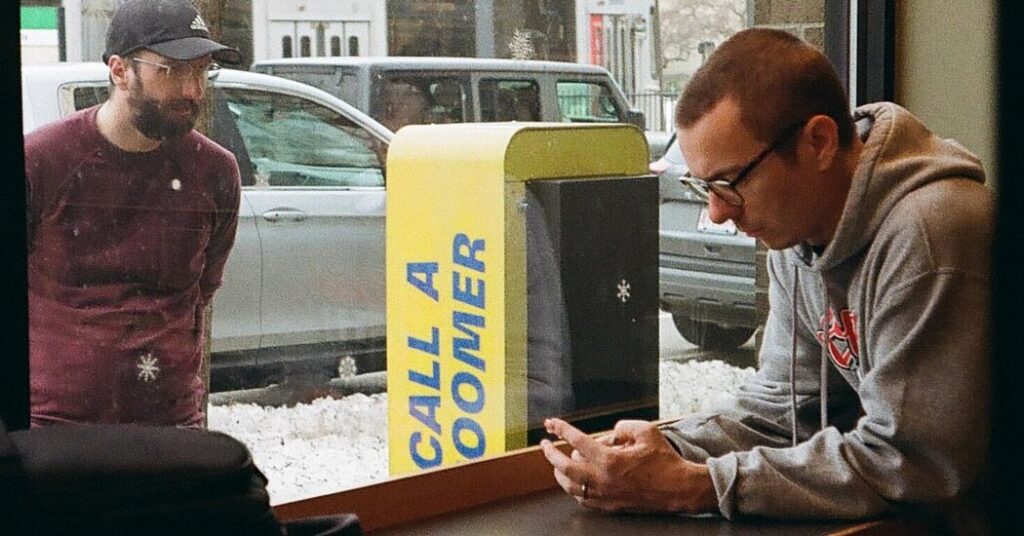
It’s a pay phone on a busy street in Boston, and if that were not unusual enough, picking up the receiver automatically places a (free) call to a similar pay phone on the other side of the country.
It’s the zoomer-to-boomer hotline, where pedestrians — especially college students — on Commonwealth Avenue in Boston are encouraged to pick up the phone to be connected to a senior living complex in Reno, Nev., for a chance conversation. The two age groups are the loneliest in the United States, studies have shown.
It’s an experiment by Matter Neuroscience, a start-up working to identify measurable biomarkers of happiness and develop tools to create more joy — with a goal of bridging a cross-generational divide.
“Over time, we have seen a steady erosion of the intergenerational spaces that once made connection routine — front porches, libraries, faith communities, shared civic institutions, even informal neighborhood rituals,” said Dr. Caitlin Coyle, the director of the Center for Social and Demographic Research on Aging at the Gerontology Institute at the University of Massachusetts, Boston. She is not connected to the project.
“This pay phone is creating the space for this kind of connection to be established,” she said, “and can serve as a good reminder to all of us how important these kind of shared, visible and low-barrier opportunities for interaction are to maintaining a sense of belonging.”
The pay phone in Boston, which was set up on March 9 and will be available for about a month, sits outside Pavement Coffee House at 736 Commonwealth Avenue. It was selected because of its proximity to Boston University, said Thomas Tague-Bleau, the marketing coordinator for the small coffee chain.
“It’s always pretty bustling there,” he said. “It’s just very sweet, I think, the genuine chance of having a conversation with a stranger. It’s really up to chance.”
Many more calls have originated from Boston than from Reno, where the pay phone sits in a public game room in Sierra Manor, a senior housing facility for nearly 200 residents that is run by Volunteers of America. According to data shared by Matter Neuroscience, of 888 calls between the two phones, 814 were made from Boston. The average call length is almost three minutes.
Maria Jaynes, 73, has picked up the phone twice in Reno.
“They were wonderful,” she said of the separate conversations she had with two young men, both of which lasted about five minutes. In the first, she said, they discussed the classes he was taking, and she told him about her favorite movies she has seen at Sierra Manor and how she talks to customers in her part-time retail job.
“Very lively communication is very important between the different generations,” she said. “I have grandchildren. You have to be open-minded and listening and learning and change with the times. It keeps me young, and I’m a young person at heart.”
Matter Neuroscience set up the hotline after creating a similar one that aimed to bridge political divides. That hotline, which was active for about a month starting in January, connected residents of one of the most liberal cities in America, San Francisco, with one of the most conservative, Abilene, Texas. In the approximately monthlong experiment, there were about 350 phone conversations.
Those numbers do little to conceal the grim data on sociability in the United States. More than half the adults surveyed by the American Psychological Association last year said they felt isolated, left out or lacking companionship often or some of the time.
Severe loneliness is linked to increased rates of heart disease, anxiety and depression, experts say, as well as health risks comparable with smoking, excessive drinking and lack of exercise.
“Positive social interactions can influence our biology in the opposite direction, lowering cortisol while increasing feel-good neurotransmitters like dopamine, cannabinoids and oxytocin,” said Calla Kessler, a social strategist with Matter Neuroscience.
“So the point of these pay phones is basically: cannabinoids over cortisol,” she added. “Small, positive interactions can have a ripple effect, and perhaps make the world a better place.”
No one cursed or yelled in the Abilene-San Francisco conversations, Ms. Kessler said, and when politics came up, people were inclined to find common ground.
One hesitation that pops up in Reno, said Heather Bolen, the Sierra Manor administrator, is that some residents are worried, in general, about being scammed. “We’re always telling them, ‘Don’t talk to strangers’,” she said.
In this case, though, she thinks the pay phone is a positive addition to the game room, and she said she has seen seven residents pick up the phone. “It just reminds people that they are not alone,” she said.
Matter Neuroscience has spent a total of about $11,000 to acquire the two old pay phones, which they bought on Facebook Marketplace and Craigslist, refurbished them and set up the connection. The company covered up the old phones with a new plywood front, and added a sign that explains the experiment and that the calls are recorded.
It replaced the original phones with newer internet-connected phones. In effect, they become like emergency phones, where you pick the phone up and it automatically calls 911.
Ms. Kessler said Matter Neuroscience had conducted “peer-reviewed, sanctioned studies” about happiness. The pay phone experiments, she said, are different. “This project is more anecdotal and feel-good,” she said. “We’re really interested in getting these conversations going.”
Ms. Jaynes, the Sierra Manor resident, said she has “loved the experience very much,” and likes picking up the phone when it rings.
“But I have not yet made a call,” she said. “I’m a very active person.”
Adeel Hassan, a New York-based reporter for The Times, covers breaking news and other topics.
The post A ‘Zoomer-to-Boomer’ Pay Phone Hotline Gets Two Generations Chatting appeared first on New York Times.