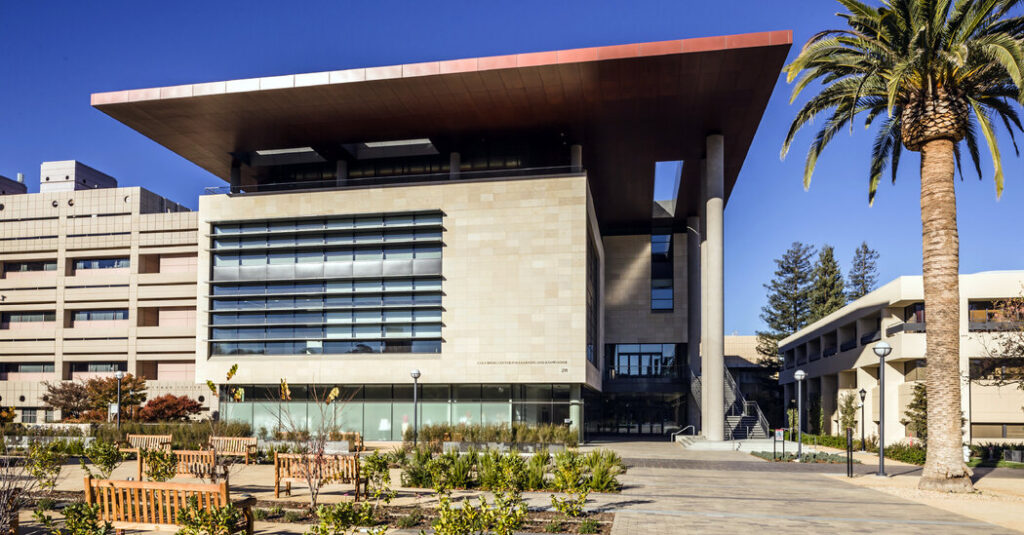
The Trump administration has opened investigations into admissions policies at three major medical schools, expanding the federal government’s pressure campaign beyond campus culture and taking aim at the heart of scientific authority in the United States.
The Justice Department on Wednesday informed Stanford University, the Ohio State University and the University of California, San Diego, about the investigations and demanded that the schools turn over extensive lists of data by April 24 or risk interruptions to essential federal funding, according to two administration officials familiar with the inquiries and documents reviewed by The New York Times.
The government is seeking information about medical school applicants from each of the past seven years, including test scores, home ZIP codes and any familial relationships to alumni or ties to university donors. The administration also demanded copies of any internal messages at the universities about diversity, equity and inclusion and any correspondence between school officials and pharmaceutical companies about admissions policies.
“At this time, our investigation will focus on possible race discrimination in medical school admissions,” Harmeet K. Dhillon, the Justice Department’s assistant attorney general for civil rights, wrote in each of the letters.
Ms. Dhillon on Wednesday afternoon posted a picture on social media of her signing one of the letters with her fountain pen, a Pelikan Souverän with an 18-karat gold, extra-fine nib. “Launching a series of civil rights investigations,” Ms. Dhillon wrote. “Another day in paradise!”
Two hours later, an editor at Lawfare posted a zoomed-in version of Ms. Dhillon’s picture that revealed the letter was to Ohio State’s College of Medicine.
It was not clear how the Justice Department chose the three medical schools. A department spokesman declined to comment.
Officials at all three universities confirmed they had been notified about the inquiries. A Stanford spokeswoman declined to comment. U.C. San Diego said it was reviewing the notice from the Justice Department and that it was “committed to fair processes in all of our programs and activities, including admissions, consistent with federal and state anti-discrimination laws.”
An Ohio State spokesman, Ben Johnson, said the university was “fully compliant with all state and federal regulations and legal rulings regarding admissions.”
The government’s attacks on higher education during the past year have in part been aimed at tilting the political balance of academia, which President Trump views as hostile to his brand of conservatism. Some medical schools had been swept up in that campaign, but largely at universities like Harvard, the University of Pennsylvania and the University of California, Los Angeles, where the full force of the government was on display through investigations into antisemitism, protections for transgender athletes and admissions policies.
By directing a triad of investigations specifically at medical schools in a single day, the administration is widening its targets and transforming a decades-long financial partnership into a tool of cultural leverage.
That partnership dates back to a postwar consensus in the country that scientific progress is a fundamental public good — one too vital to be left to the vagaries of the market or the limitations of private philanthropy. Since the 1950s, the federal government has consistently operated as the predominant source of research funding for universities, according to the National Science Foundation.
One of the largest government sources of research funding has been the National Institutes of Health, which disburses about $35 billion each year. The largest recipients of those N.I.H grants are medical schools, according to the Association of American Medical Colleges.
The new round of investigations also signals the latest chapter in a growing legal dispute the administration has sparked over college admissions.
Earlier this month, a group of 17 state attorneys general, all Democrats, sued the Education Department over the government’s growing appetite for admissions data. They argued, in part, that the depth of detail sought by the government posed a “significant risk” of identifying students and exposing sensitive information, including financial aid.
The privacy concerns may be more pronounced at medical schools, where enrollment is generally a fraction of that of undergraduate programs. The incoming class of aspiring doctors and physician assistants at Stanford this academic year was 119 students. Ohio State welcomed 211 medical students, while U.C. San Diego enrolled 140.
In the Justice Department’s letters on Wednesday, Ms. Dhillon indicated that civil rights laws override privacy concerns. She added that the information would be “maintained in accordance with applicable federal confidentiality requirements.”
Beyond legal battles, the new investigations exemplify an indisputable flex of federal power in an effort to tilt the racial balance in medical education.
The inquiries did not arise from a complaint or allegation, which typically prompt federal action. Instead, the Justice Department has invoked its broad powers from Congress to proactively investigate any federally funded institution for compliance with the law.
But the Trump administration’s interpretation of civil rights law, particularly regarding the Supreme Court’s 2023 ruling ending affirmative action, is widely debated.
The administration’s civil rights investigations into admissions processes have tended to focus on potential discrimination against white applicants. The Supreme Court ruling did halt race-conscious admissions, but many university officials maintain that the justices did not forbid a less direct consideration of an applicant’s race, through interviews or essays included in the application process.
But the administration has taken a harder stance, and has attempted to codify its stricter reading of the ruling through executive orders signed by Mr. Trump and guidance from Attorney General Pam Bondi.
According to the Association of American Medical Colleges, there were 99,400 students enrolled in medical school for the 2025-26 academic year. About 42 percent of those medical students were white, 28 percent were Asian, and about 8 percent were Black.
Those percentages closely aligned with the breakdown of the Ohio State medical school enrollment. The two California-based medical schools had about half as many white students, but a higher rate of Asian students. Black students accounted for 13 percent of the medical school enrollment at Stanford, and 6 percent at U.C. San Diego.
All three medical schools rank among the top recipients of N.I.H. funding.
In 2025, Stanford was awarded $575 million in N.I.H. grants, according to data compiled by the Blue Ridge Institute for Medical Research. Only U.C. San Francisco, Washington University in St. Louis, the University of Pennsylvania and Yale University were awarded more.
U.C. San Diego ranked 14th among medical schools, with $427 million in grants from the National Institutes of Health, while Ohio State received $210 million, 35th among medical schools.
The U.C. San Diego medical school is one of six within the University of California system, and largely enrolls California residents. But it is also a part of the public university system that has faced the most intense pressure from the Trump administration.
In California, federal officials have mostly focused on the campuses in Berkeley, which Ms. Dhillon visited last year, and Los Angeles. The Justice Department last month filed a lawsuit accusing the Los Angeles campus of being indifferent to antisemitism, and recently joined a separate lawsuit challenging admissions practices at its medical school. The San Diego campus, though, was the subject of an Education Department investigation into what the department described as “Title VI violations relating to antisemitic harassment and discrimination.”
Stanford has not come under as much pressure from Washington as many other elite universities, but it was targeted by the Justice Department last March in an inquiry related to its admissions policies. And the Education Department said last year that it was looking into accusations of antisemitism at Stanford.
Susan C. Beachy contributed research.
Michael C. Bender is a Times correspondent in Washington.
The post Trump Administration Begins Investigations Into Three Medical Schools appeared first on New York Times.