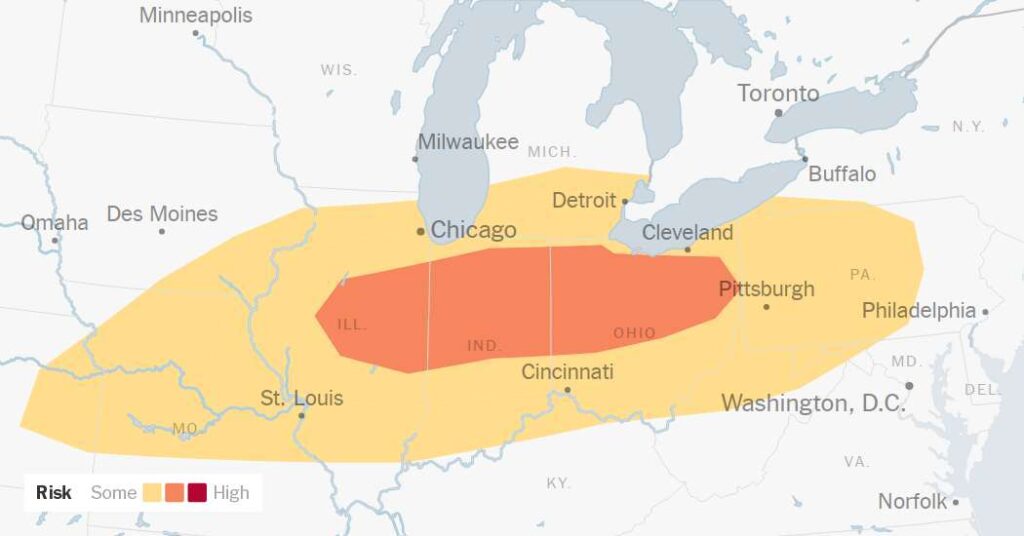
Storms moving across the Midwest on Thursday afternoon will bring with them the possibility of hail, strong winds and a few tornadoes, forecasters with the National Weather Service warned, highlighting an area that includes parts of Illinois, Indiana and Ohio where the risk is expected to be the highest.
The forecast details
Liz Leitman, a meteorologist at the Storm Prediction Center, said the storms were expected to begin late Thursday afternoon. A wide swath of the country, from Kansas to New York, is at some risk of severe weather, but forecasters are most concerned about a smaller area just south of the Great Lakes where it is most likely.
The storms could bring all manner of severe weather, including:
-
Very large hail, possibly larger than two inches in diameter;
-
Strong, damaging winds, with gusts up to 80 miles per hour;
-
Tornadoes.
Some of the storms may produce high rainfall rates too. The Weather Prediction Center said there was a marginal risk of flash floods, in an area from central Illinois through Pennsylvania to southern New York.
The severe weather risk is expected to be short-lived. Ms. Leitman said the storms’ intensity was expected to gradually decrease into the night as they moved farther south and east.
She added that the rest of the week, including the weekend, would remain “relatively quiet,” though more storms and severe weather were expected by the middle of next week.
This is the time of year for storms like this.
There have been several rounds of severe storms this month, and some of them have been deadly. At least three people were killed in Union City, Mich., on March 6 when a tornado moved through, and two others were killed that same night near Biggs. Okla., when a tornado caused by the same sprawling storm system moved through.
Scientists have been able to draw links between a warming planet and many types of extreme weather, including hurricanes, heat waves and droughts. But they are not yet able to determine whether there is a link between climate change and the frequency or strength of tornadoes. Read more about tornadoes and climate change here.
Researchers do say that in recent years tornadoes seem to be occurring in greater “clusters” and that the area of the United States known as Tornado Alley, a region where most tornadoes occur, seems to be shifting eastward.
How to prepare
Nazaneen Ghaffar is a Times reporter on the Weather team.
The post Storms Could Bring Tornadoes, Hail and Heavy Rain to the Midwest on Thursday appeared first on New York Times.